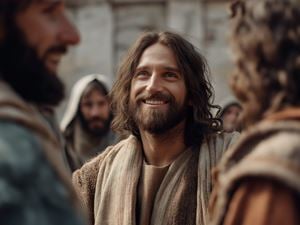
According to religious scholars, Jesus has influenced the world more than any other Jew in history. Yet, most Jews do not share Christians' belief that He is the Son of God. That fact raises this question: What do Jews believe about Jesus?
There is no single or simple answer to the question except to say that Jews have had mixed feelings about Jesus for the greater part of 2,000 years. But what do they believe at present?
Contemporary Jewish Perspectives
Most 21st-century Jews do not accept Jesus as the Son of God. And they do not believe God sent Him to preach the gospel, which means "good news," to the people on earth. They don't believe that Christ died for humanity's sins and rose again, and they don't accept the New Testament.
Otherwise, many are indifferent to him. Some are angry because of the age-old Christian persecution of their ancestors -- a persecution that stemmed from Christians' determination to convert Jews who did not wish to be converted.
Historical Context and the Split
Christianity was initially part of Judaism, but a split between followers of Christ and mainstream Jews began to develop in the first century. By the second century, Christians and Jews were reaching a breaking point. Jesus was the center of the Christian faith, but many Jews saw Him as a failed or deceitful prophet, a heretic or an idolator. He was not divine, and He was not worthy of worship in their minds.
Jews generally thought the true messiah would eventually come. He would restore David's kingdom, win military battles, rebuild the temple and bring Jewish exiles back to Israel. Jesus did none of those things.
To Jews, He was an itinerant preacher who healed the sick and falsely proclaimed the kingdom of God. He did not usher in a messianic age in which everyone who had ever died was resurrected. He also did not bring all Jews together, enact the final judgment or establish peace throughout the world.
The Rhineland Massacres and Antisemitism
Religious scholars agree that the differences between Christians and Jews erupted into violence about 900 years ago with the Rhineland massacres. In 1096, German and French crusaders, who were headed to Jerusalem to fight Muslims, murdered approximately 2,000 Jews in a series of massacres. The Crusaders also destroyed Jewish communities in what are now the German towns of Mainz, Speyer and Worms.
The Jewish people never forgot these atrocities. Of those who survived, some converted to Christianity out of necessity, and some killed themselves rather than be baptized.
Experts see the Rhineland massacres as the first of many antisemitic events in Europe. These events culminated in the Holocaust during World War II and, finally, Zionist redemption with the founding of modern Israel in 1948.
The late historian Arno Mayer, who specialized in diplomatic history, modern European history and the Holocaust, wrote about the Rhineland massacres in his study of Hitler's Final Solution. Mayer said the massacres "set a disastrous precedent, depositing a fatal poison in the European psyche and imagination."
However, the antisemitic massacres also strengthened many Jews' resolve to retain their Jewish identity. The gap between Christians and Jews continued to widen following the Rhineland massacres, and many Jewish people began to link Christ and Christianity to the Crusades and antisemitic violence.
Messianic Jews and Bridging the Gap
Despite this history, some modern-day Jews want to bridge the gap between themselves and Christians. But their number is low. These so-called Messianic Jews are controversial because, in part, they share Christians' belief that Jesus is the Son of God. They believe that Christ died for everyone's sins, was resurrected and ascended into heaven. But they also continue to obey the Torah's strict requirements regarding circumcision, food and other matters.
Can they be Jewish and Christian? Opinion is divided. The Jewish Road is an organization that insists that Jews who believe in Christ are still Jewish. The ministry focuses on helping Christians better understand the Jewish context of Christianity and helping Jews learn more about Jesus.
"For many of us, our faith in Jesus has actually made us more Jewish," the organization says. "God has kept His covenant with Abraham and with the Jewish people. However, the gospel message of salvation has now been commissioned to all who would follow and put their trust in the Messiah Jesus in this present age.
"God still has His covenant people, Israel. At this time, God not only has His covenant people, but He also has 'commissioned' people – Jewish and Gentile believers who make up the Body of Messiah (the church) and are committed to bringing the message of salvation to the world," the Jewish Road ministry explains.
The organization quotes the Apostle Paul in making its point: "Has God rejected His people? By no means! I myself am an Israelite, a descendant of Abraham, a member of the tribe of Benjamin. God has not rejected His people whom He foreknew" (Romans 11:1-2).
Jewish Road also believes that God has not replaced the Jewish people. Instead, God "has commissioned people (Jews and Gentiles, one in the Messiah) as well as His 'covenant,' people, Israel." It further says, "He's just waiting for them to pick up their end of the line so He can talk to them…. He will make good on His promise to give the kingdom back to the Jewish people."
Messianic Judaism came into existence in the late 19th and early 20th centuries when Christian missionaries reached out to Jewish communities. This type of evangelizing is important to modern-day Messianic Jews, but their efforts have rarely been successful.
Judaism as a whole has no official position on Jesus, but most mainstream Jews cannot accept that Christ is God incarnate. Only time will tell whether Christians and Jews can close the rift that divides them.