
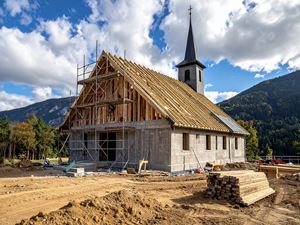
Church attendance has been declining for decades. But in a new kind of religious mystery, construction on churches and other houses of worship is booming.
In fast-growing Conroe, Texas, Pastor Josh Gosney and his wife built their Wake Church in a closed Kroger supermarket while renting space out for two connected businesses: a coffee shop and Oh Toodles, a children’s play place. The new church building opened last year.
Gosney said the business trifecta helps cover the $6.5 million purchase and renovation costs while attracting new members.
“What if the building was created for the community to be a part of it during the week?” the 35-year-old pastor said. “That was the conviction from not only a discipleship standpoint, but from a monetary and stewardship standpoint.”
The development represents a surprising pickup: Construction of new religious buildings is on the rise, even as many churches in the U.S. close their doors each year. Church-building broadly waned for two decades starting in the early 2000s, reflecting a decline in Americans’ religious participation, changing donation habits and a shift away from the construction of huge megachurches.
More recently, federal data show that religious construction spending rose nearly 17 percent in the 12 months running through June. Overall construction spending fell nearly 3 percent in the same period, weighed down by high interest rates and soaring costs for materials and labor.
Spending has been particularly strong over the past year on auxiliary religious buildings such as fellowship halls, camps and Sunday schools, data show, as churches broaden their appeal to newcomers.
Three decades ago, more than twice as many Americans were members of churches or synagogues as those who weren’t, according to Gallup polling. That trend flipped for the first time in 2020 and now churchgoers are in the minority. Religious construction spending bottomed out in late 2021 as the Covid-19 pandemic separated people and accelerated the drop in in-person church attendance.
Now, though, young generations are turning to religion and spirituality in greater numbers and for different reasons—despite broad declines in church attendance. A study by Barna Group this year found an increasing share of Gen Z and millennials, particularly men, identify as followers of Jesus.
Churches are also embracing less overtly religious weekday offerings—coffee shops are popular, as is child care—to raise revenue, cover bills and attract new members.
“You have churches with time and some capacity to reflect during Covid and the years following about ‘How do we re-create some of that third space, how do we meet some real needs in our community again?” said Frank Bealer, chief executive of Generis, a consulting company that works with churches.
While spending on religious construction slipped in the most recent quarter, it is still expected to reach $4.6 billion this year, up about 10 percent from last year, according to FMI Consulting, a consulting firm for the construction industry. That represents a 50 percent increase from the 2021 trough, but is still well below the $8.8 billion that went into religious construction during its peak in 2001.
The increase is a rebound rather than a revival, said FMI partner Jay Bowman. Much of the growth in religious construction is centered on multipurpose space for churches to address needs related to youth and child care, he said. An estimated 15 percent of working parents use faith-based child-care centers, according to the Bipartisan Policy Center.
“It’s not just about a Sunday or a Sabbath day, it’s becoming this sort of weeklong communal community center,” Bowman said.
The Boulder Jewish Community Center in Colorado, which isn’t a house of worship but works with local synagogues, opened a coffee shop last year. The JCC teamed up with a nonprofit that provides housing and skills to people experiencing homelessness.
“Any program we’re doing, it’s about the 30 minutes before the program and 30 minutes after,” said Executive Director Jonathan Lev. “The learning’s great, but people are looking for meaning, looking for relationships, looking for connection.”
Netcast Church in Danvers, Mass., a Boston suburb, has leaned into nontraditional amenities to build up a big congregation since spending $4 million to repurpose retail stores inside a local mall shortly before Covid-19 hit. The pandemic slowed them down, but they have since grown to more than a thousand attendees every Sunday, helped by the church’s children’s play place, a co-working space and a coffee shop.
Other mall staples also help.
“We probably have 15 people every single weekend that stumble upon our church and accidentally come to a service because they were returning something at Marshalls or running an errand or going to get their nails done,” Pastor Matt Chewning said.
Even for more established churches, adding amenities has helped fill seats on Sundays. Northway Church in Macon, Ga., set up a coffee shop, called Cathedral Coffee, in 2018 specifically as a place for members to bring friends and to help draw more people in. The business was a money loser for years but now is self-sustaining, said Kevin Mills, the lead pastor.
“We’ve had people that have come to our church on Sundays but their first introduction to the church was our coffee shop,” he said.
On a recent hot weekday morning at Wake Church, in Texas, customers sipped espresso drinks while, across the parking lot, a trickle of parents walked their children to the indoor playground. Michael Vogel attends a different church but said he still hits the Wake-adjacent coffee shop several times a week.
“I think a lot of Christians don’t go out to bars and things like that to go hang out,” he said. “I like the vibe in here.”
This article originally appeared on The Wall Street Journal.

