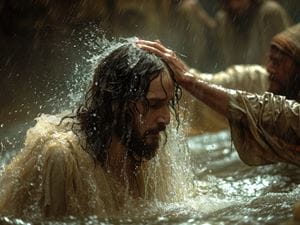
John the Baptist was sent to "Prepare the way of the Lord" and was bewildered when that Lord came to him to be baptized. John's baptism was one of repentance, so why would the sinless Christ need to go through it? Speaking to the Pharisees, John said this of Jesus:
"I baptize you with water for repentance. But after me comes one who is more powerful than I, whose sandals I am not worthy to carry. He will baptize you with the Holy Spirit and fire" (Matthew 3:11).
When Jesus came to him at the river Jordan, John was understandably reluctant, knowing that Jesus was far greater than he was and had no sin to repent of:
"I need to be baptized by you, and do you come to me" (Matthew 3:14b).
John's understanding of baptism was limited.
John's baptism was one of repentance. He baptized ordinary men and women, but also challenged the religious authorities of the day, calling them a "brood of vipers", and exhorting them to "produce fruit in keeping with repentance." He was a prophet operating under a God-given mandate, but when Jesus came to him, it had nothing to do with the forgiveness of sins. In other words, John didn't know what was going on.
Jesus' baptism foretold his death and resurrection – the key moments in the history of the world when the righteousness of Christ was extended to all humanity as a gift. This is why Jesus explained to John that He needed to be baptized "to fulfil all righteousness", at which point John relented. When Jesus was baptized, He was prophesying His death on the cross and victory over sin and death. He was showing his obedience to the Father and His commitment to our salvation.
None of this would have been clear to John, but he put aside his uncertainty and submitted to the will of Jesus. In and of itself, that is no small thing. John was not a timid man. He lived in the wilderness, ate locusts, wore coarse skins, and had no problem challenging the hypocritical religious authorities of the day to their faces. Ultimately, his fearless rebuke of Herod for divorcing his wife and marrying his niece earned him the enmity of royalty, who had him beheaded.
John's encounter with Jesus is revealing. He had the prophetic insight to know that Christ was greater than he was – the very man he had spoken of to the Pharisees, whose sandals he was unworthy to carry. He also understood that his baptism was inferior to the baptism of the Holy Spirit, which Christ Himself would administer. John had known of the greatness of Jesus before he was even born, and at some point in his life had come to understand that his cousin was the Christ, and so yielded to Him at the riverside, baptizing Him with water.
It is worth pausing to note that our obedience to God does not depend on having full knowledge of the reasons behind his leading. A spiritual person leans into the Holy Spirit, yielding to His will, just as John the Baptist yielded to Jesus.
The baptism of Christ foreshadowed His death and resurrection.
Jesus' baptism was also an act of obedience on His part, yielding to the Father's will as He later would in Gethsemane. In baptism, Jesus committed Himself to dying for us and received the Father's blessing and anointing:
As soon as Jesus was baptized, He went up out of the water. At that moment, heaven was opened, and He saw the Spirit of God descending like a dove and alighting on him. And a voice from heaven said, "This is my Son, whom I love; with Him I am well pleased" (Matthew 3: 16-17).
In that moment, Father, Son, and Spirit rejoiced together, knowing that through the obedience of Christ, all righteousness would be fulfilled. The eventual manifestation of that righteousness will be the reconciliation of all people in Christ, which is the ultimate goal of the Gospel –to bring all things unto unity in Christ. We must not forget that the Gospel is Good News! In the end, our relationships and our very souls will be restored by God Himself, who will wipe every tear from our eyes.
Jesus' baptism in the Jordan was a moment in time when His act of obedience prophesied the death and resurrection of Christ. He committed to His sacrifice on the cross there and then and would later recommit in the Garden of Gethsemane, in His time of trial. Jesus followed through on that obedience, giving Himself to death and rising from the grave. He broke the chains of sin and death, so that all people can ultimately step into the fulfilment of all righteousness.