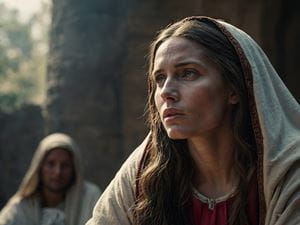
Mary Magdalene was a follower of Jesus Christ and part of a group that traveled with the Lord as He preached the gospel throughout Galilee and Judea. She lived in the 1st century, although the book that carries her name, The Gospel of Mary (Magdalene), was probably written in the 2nd century by other people.
The Gospel of Mary is a Gnostic text that differs from the four canonical Gospels: Matthew, Mark, Luke and John. Gnostic texts are early Christian writings unearthed by scholars that claim to hold Jesus's teachings and were used by certain early Christian sects.
In addition to its Gnosticism, The Gospel of Mary portrays Mary Magdalene as having a close relationship with the Lord and gaining a deep understanding of his teachings. It contrasts sharply with texts written by or on behalf of the other apostles, and these differences have made it controversial.
Mary Magdalene was called Christianity's first evangelist, but she was also depicted as a repentant prostitute, Christ's wife, Mary of Bethany, and the Apostle of the Apostles.
A Repentant Prostitute
Mary Magdalene was called a repentant prostitute because church leaders confused her with an unnamed sinful woman who washed Christ's feet, as described in the Gospel of Luke. Pope Gregory the Great officially labeled her a prostitute in the 6th century, and her reputation remained tarnished for centuries.
In truth, the New Testament mentions Mary Magdalene several times but never suggests or identifies her as a prostitute. The Orthodox Church did not portray Mary as a prostitute at any time, and the Catholic Church admitted it had been wrong in labeling her as such in 1969. The truth is that Catholics confused Mary Magdalene with an unnamed sinful woman mentioned in Luke 7:36-50.
The Wife of Christ
Many religious scholars have concluded that Mary Magdalene had a particularly strong relationship with Jesus, and some authors, such as Dan Brown, have claimed she was the wife of Christ. However, there is no reliable evidence in the Bible or other legitimate sources to support Brown's claim.
A Wealthy Woman
Recent archaeological findings suggest that Mary Magdalene came from wealth and may have been one of the women who financially supported Christ's ministry. She also may have been a widow.
"Usually, when a town or village is mentioned in connection with a woman's name in the Bible, it indicates that she is a woman of wealth or higher social status," according to Tina Wray, author of Good Girls, Bad Girls of the New Testament: Their Enduring Lesson.
Mary of Bethany
There has been confusion for many years about whether Mary Magdalene was Mary of Bethany. Mary was a common name at the time, but Mary Magdalene and Mary of Bethany were two different people. The latter, Mary, was the sister of Martha and Lazarus. She is best known for anointing Jesus' feet with expensive oil and wiping them with her hair when Christ visited the siblings' home.
Apostle of the Apostles
Mary Magdalene has been referred to as the "Apostle of the Apostles" for several reasons. Among them is the fact that she remained with Jesus at his crucifixion after the other disciples fled. She was also the first person to see the empty tomb and the resurrected Lord, and she announced Christ's resurrection to the other disciples. Her status has increased in the Catholic Church in recent years, as Pope Francis elevated the church's celebration of her to equal celebrations of the other apostles.
How is the Gospel of Mary (Magdalene) Connected to Gnosticism?
Biblical experts agree that Mary Magdalene did not write the book that bears her name or any other book in the Bible. One reason that this "gospel" does not appear in the Bible is that its Gnosticism did not align with mainstream Christian beliefs in the early church. Another reason is that it paints Mary Magdalene as a powerful leader, thereby challenging the early church's patriarchal leanings.
Gnosticism was an important movement in ancient times, especially during the 2nd century. Within the movement were wide-ranging ideas that differed from traditional Christian beliefs in several ways:
- Gnostics were not united in their beliefs about Christ, God or the nature of the universe. Many saw Jesus as the embodiment of a divine being, and others thought he was an enlightened human. Some believed he came to earth to teach people how to free themselves from a lesser god or to acquire divine knowledge. And some thought Jesus only appeared to be human. Not surprisingly, early church leaders rejected these ideas.
- Gnostics believed that a satanic power created the world, according to Britannica and associated this power with the God described in the Old Testament.
- Study.com explains that Gnostics thought salvation was "the way back to where human spirits originated, as revealed and achieved through experiential divine knowledge."
- Redemption, according to Gnostics, is liberation from chaos associated with the creation.
- Gnostics believed that multiple gods exist, including one supreme god and a flawed lesser god who created the material world.
- They also thought that salvation was attainable only through important secret knowledge. They believed they had access to secret knowledge about the nature of Christ and the universe and asked philosophical questions such as: "Who am I?" and "What is the meaning of life?"
What Does the Gospel of Mary Say?
The Gospel of Mary states that Christ shared special knowledge with Mary that is not included in the Bible. It also describes a vision Mary may have had in which Christ teaches her about the nature of our souls, the way to achieve enlightenment and the dangers of our material world.
It teaches that God can be found inside us and that we have a piece of him in us. It also suggests that true understanding comes from our experience, not simply external teachings. It states that Christ denied the existence of sin and says we become disconnected from God when we behave in ways that do not reflect who we are.
Other Gnostic gospels describe Mary Magdalene as the disciple Jesus loved most. The Gospel of Phillip, for example, says, "for Jesus used to walk with her and kissed her frequently upon the mouth." For many Christians, this statement and the book attributed to Mary Magdalene amount to heresy.
The Gospel of Mary was lost to history during the early days of Christianity and rediscovered in 1896 in the Berlin Codex, which is a collection of ancient Christian writings. It's the only early Christian gospel attributed to a woman.
Despite the mystery and controversy surrounding The Gospel of Mary, the biblical Mary Magdalene remains a powerful and inspiring figure of faith. While this Gnostic text presents ideas outside the bounds of mainstream Christianity, the historical Mary's role in the gospel story is both clear and compelling—she was a devoted follower of Christ, the first witness to the resurrection, and a bold messenger of the Good News. Her story reminds us that, even amid centuries of confusion, mislabeling, and speculation, truth endures. And that truth is this: Mary Magdalene's unwavering faith continues to point us back to the heart of the gospel and the transformative power of Christ.