The Apostles' Creed states that we believe that Jesus will come again to judge the living and the dead. It also says that we believe in the resurrection of the body and the life everlasting. Thousands of books, articles, and video presentations are devoted to "the signs of the times" – in other words, what things will happen leading up to Christ's return. But what happens after the Second Coming of Christ?
The General Resurrection
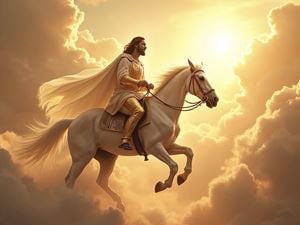
The first thing that the Second Coming will trigger is the general resurrection, when all people will be raised from the dead. In 1 Thessalonians 4:13-18, Paul writes that when Jesus returns, the dead in Christ will rise first, then "we who are still alive and are left will be caught up together with them in the clouds to meet the Lord in the air." And in Matthew 25, Jesus says that when He comes in His glory, "all the nations will be gathered before him" (Matthew 25:32).
Many people focus on the "rapture," and on the millennial reign reflected in Revelation 20, but Revelation 20:4-5 makes it clear that not every believer will be part of that millennial reign: "And I saw the souls of those who had been beheaded because of their testimony about Jesus and because of the word of God. They had not worshiped the beast or its image and had not received its mark on their foreheads or their hands. They came to life and reigned with Christ for a thousand years." (The rest of the dead did not come to life until the thousand years were ended.)
In 1 Corinthians 15, Paul talks about our resurrection bodies. He uses the analogy of a seed being planted in the ground, dying and then "reborn" as a new plant. "So it will be with the resurrection of the dead. The body that is sown is perishable, it is raised imperishable; it is sown in dishonor, it is raised in glory; it is sown in weakness, it is raised in power; it is sown a natural body, it is raised a spiritual body" (1 Corinthians 15:42-44). He goes on to say that the perishable must become imperishable so that it can live in God's eternal kingdom. At that point, to use Paul's familiar words, "death has been swallowed up in victory" (1 Corinthians 15:54).
Judgment
Scripture makes it clear that when that time comes, everyone will stand before the throne of God. In Revelation 20:12-15, John states that everyone will stand before the throne. One set of books will be opened, recording what everyone has done throughout their lives. The second book is the book of life. Each person will be judged according to what they have done during their earthly life. "Anyone whose name was not found written in the book of life was thrown into the lake of fire" (Revelation 20:15), but those whose names are written in the book of life will enter the heavenly city of God's eternal kingdom (Revelation 21:27).
Jesus Himself describes this judgment: "When the Son of Man comes in His glory, and all the angels with Him, He will sit on His glorious throne. All the nations will be gathered before Him, and He will separate the people one from another, as a shepherd separates the sheep from the goats" (Matthew 25:31-32). The standard for Jesus' judgment will include the way that people treated others – including "the least of these" (see verses 40 and 45).
In Revelation 21, the One sitting on the throne says: "Those who are victorious will inherit all this, and I will be their God and they will be my children. But the cowardly, the unbelieving, the vile, the murderers, the sexually immoral, those who practice magic arts, the idolaters and all liars – they will be consigned to the fiery lake of burning sulfur. This is the second death" (Revelation 21:7-8).
Renewal
"Then I saw 'a new heaven and a new earth,' for the first heaven and the first earth had passed away, and there was no longer any sea. I saw the Holy City, the new Jerusalem, coming down out of heaven from God, prepared as a bride dressed beautifully for her husband. And I heard a loud voice from the throne saying, 'Look! God's dwelling place is now among the people, and He will dwell with them. They will be His people, and God Himself will be with them and be their God'" (Revelation 21:1-3).
From the beginning, God's plan and desire have been to dwell among His people. Before the fall of man, God walked with Adam and Eve in the Garden of Eden. Sin broke that fellowship. When God made the covenant with Israel at Sinai, He also directed Moses to construct a tabernacle so that He could be among His people. When the nation settled in the promised land, Solomon built the Temple to serve as God's dwelling place.
But none of those temporary, earthly measures was the final answer. Jesus came to be God with us – Emmanuel. And He came to offer life: "Yet to all who did receive Him, to those who believed in His name, He gave the right to become children of God – children born not of natural descent, nor of a human decision or a husband's will, but born of God" (John 1:12-13). That confirms the statement in Revelation 21 that those whose names are written in the book of life will be part of God's eternal kingdom – because they have become God's children.
So what will life in God's kingdom be like? The language of Revelation is necessarily symbolic; John is trying to describe a spiritual reality with words that cannot fully describe it. Rather than focusing on the "building materials" – streets of gold, gates of pearl, walls made with precious stones – consider the description of how things function. "No longer will there be any curse. The throne of God and of the Lamb will be in the city, and His servants will serve Him. They will see His face, and His name will be on their foreheads. There will be no more night. They will not need the light of a lamp or the light of the sun, for the Lord God will give them light. And they will reign for ever and ever" (Revelation 22:3-5).
In the end, God's Kingdom will be restored to the perfect state in which He first created it "in the beginning" – and so will God's people. And we will dwell with Him in His kingdom forever!