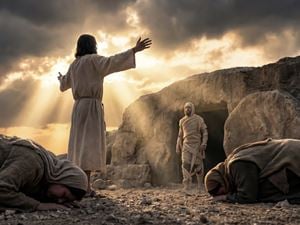
In John 11, Jesus brings His friend Lazarus back to life after Lazarus had been dead for four days. But what happened to Lazarus after that?
Lazarus was really dead, and Jesus brought him back to life.
Those who don't believe in miracles try to explain the miracle stories of Scripture by offering alternate explanations. For example, they claim that Jesus didn't really walk on the water; instead, He was wading in the shallows along the shore. So when it comes to the stories of people being brought back to life, they claim that the people weren't really dead.
At first glance, Jesus seems to support this argument by saying that people were "sleeping" rather than "dead." (For example, see Matthew 9:24). In fact, when talking to the disciples about Lazarus, Jesus first told them that "Lazarus has fallen asleep" (John 11:11). However, when it became clear that the disciples had not understood Him, he told them, "Lazarus is dead" (John 11:14-15). And when Jesus told the people to roll the stone away from Lazarus' tomb, Martha said, "By this time there is a bad odor, for he has been there four days" (John 11:39).
"Four days" was important because Jews commonly believed that the spirit of a deceased person remained near the body until the third day, just in case God brought them back to life. In the Old Testament, both Elijah and Elisha brought people back from the dead. Thus, it was not unheard of for people to be brought back to life. But by the fourth day, any hope of resurrection was gone; the spirit had left the body, and the process of physical decay had begun. When Jesus arrived in Bethany, Lazarus was really dead.
Lazarus was not the only person Jesus brought back to life.
As noted earlier, Lazarus was not the only person in the Bible who was brought back to life. And he was not the only person Jesus brought back to life, either. He raised Jairus' daughter (Matthew 9:18-26). He also brought the son of the widow of Nain back to life (Luke 7:11-15). And when John's disciples came to ask Jesus if He was "the One," Jesus sent them back to tell John that "the dead are raised" (Matthew 11:5).
So when we think about the raising of Lazarus, it's important to remember that, as great as that miracle was, it was not the only time that Jesus brought someone back to life. And when we consider what happened to Lazarus after Jesus raised him, we could ask the same question about the others who were raised – whether by Old Testament prophets or by Jesus Himself in the New Testament.
The resurrection of Lazarus was different from Jesus' resurrection.
We also need to recognize that the resurrection of Lazarus (and of every other person in Scripture who was raised) was different from the resurrection of Jesus. But in what way were these other resurrections different?
Every resurrection in Scripture other than that of Jesus was basically a "resuscitation." In other words, the dead body was revived but not transformed. After His resurrection, though, Jesus' body was different. He was still recognizable, and His body bore the scars of His crucifixion. But the very nature of His body was different. When the disciples were gathered in a locked room in the evening of His resurrection, He did not have to knock on the door and ask them to let Him in; He "came and stood among them" (John 20:19). In Luke's account, after the two disciples who met Him on the road to Emmaus recognized Him, "He disappeared from their sight" (Luke 24:31). Later, Luke says that the disciples thought He was a ghost, because He had just appeared to them. He then told them to look at His hands and feet, and He ate some food.
This is consistent with what Scripture teaches about our future resurrection. In 1 Corinthians 15, Paul says that Christ is the "first-fruits of those who have fallen asleep" (1 Corinthians 15:20). That means that Jesus' resurrected body is the prototype for what our resurrected bodies will be in God's eternal kingdom. We will still have bodies, but they will be transformed. In the latter part of 1 Corinthians 15, Paul describes this as a transformation from perishable earthly bodies to imperishable heavenly bodies (1 Corinthians 15:40-57).
But that transformation did not happen to Lazarus when Jesus raised him; he had the same body he'd had before his illness. In one sense, Jesus had healed Lazarus – He just healed him after he had been dead for four days.
What happened to Lazarus after Jesus brought him back to life?
That brings us back to the original question: what happened to Lazarus after Jesus brought him back to life?
First, he returned to his family. When Lazarus came out of the tomb, Jesus told the crowd to take off his graveclothes and let him go. The "graveclothes" would have been strips of linen wrapped around the deceased's body (think of the popular depiction of a mummy in movies or television). When Lazarus came out, he would still have been wrapped up in these strips of cloth; that's why Jesus told them to "take off the graveclothes and let him go" (John 11:44).
Second, he obviously remained a disciple of Jesus, as did his sisters, Martha and Mary. In John 12, Jesus comes to the home of Mary, Martha, and Lazarus in Bethany for a dinner that the family was giving in His honor. (Clearly, they were grateful to Jesus for bringing Lazarus back to life!) Most people remember this story because of what Mary did: she anointed Jesus' feet with very expensive perfume and wiped them with her hair (John 12:3).
But John makes it plain that this was not simply a private family dinner. "Meanwhile, a large crowd of Jews found out that Jesus was there and came, not only because of Him but also to see Lazarus, whom He had raised from the dead" (John 12:9). The word had spread quickly about what Jesus had done, and the crowds came to see Lazarus – the "evidence" of Jesus' miraculous power. The religious leaders also recognized the importance of this evidence: "So the chief priests made plans to kill Lazarus as well, for on account of him many of the Jews were going over to Jesus and believing in Him" (John 12:10-11).
That's all that scripture tells us about Lazarus. (The "Lazarus" Jesus refers to in Luke 16:19-31 is clearly not the same person.) We don't know how long he lived after Jesus brought him back to life, nor do we know how he eventually died. How long Lazarus lived, and how he ultimately died, are not truly important to our spiritual development. What is important is that Jesus died and rose again, and that He is the first-fruits of all who believe! As Jesus told Martha: "I am the resurrection and the life. The one who believes in me will live, even though they die; and whoever lives by believing in me will never die" (John 11:25-26).