
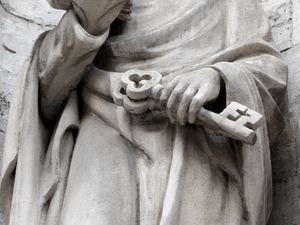
President Russel M. Nelson is going to be greatly missed. But The Church of Jesus Christ of Latter-day Saints is not without leadership because the Priesthood Keys never leave. Every one of the 12 Apostles holds all the Priesthood Keys, so voting and election are not necessary for the succession of the next prophet.
Prophet Succession in the LDS Church: Understanding Priesthood Keys and Leadership
In the Church of Jesus Christ of Latter-day Saints, priesthood keys refer to the authority to preside, direct, and govern the use of God's priesthood on earth. These keys are not just symbolic—they are the actual power to authorize ordinances, lead congregations, and guide the Church's operations. According to the Church, they are conferred by divine messengers and passed down through prophetic succession, beginning with Joseph Smith.
Only the President of the Church is authorized to exercise all priesthood keys, but each member of the Quorum of the Twelve Apostles holds all the keys collectively, ready to be activated when called to preside. This system ensures that leadership transitions are smooth and divinely guided, without the need for voting or campaigning. The keys are what distinguish the LDS Church from any other organization—they enable sacred ordinances, covenants, and eternal family sealing, according to the Church.
In the Church of Jesus Christ of Latter-day Saints, there are many roles to fill. One current calling (or church job) is to be part of the Relief Society Compassionate Service committee. This group provides meals for families when they experience difficulty, such as surgery or a new baby. They provide support and meals when there is a funeral and help elderly members who don't drive, among other needs.
When a member is asked to fill that role (called receiving a Calling), and the congregation agrees (called Sustaining), the individual is given a priesthood blessing (called being "Set Apart"). In that blessing, authority from God is given to have divine guidance and help to fulfill the church's job—delegated authority. That authority is given because the Bishop holds the Priesthood Keys needed to run the congregation, and he received those keys from the Prophet and the First Presidency.
In simple terms, Priesthood Keys are the tools God gives His servants to accomplish His work on Earth.
Fulfilling the Church's Mission
The Prophet and all the Apostles hold all the Priesthood Keys needed to run the church and fulfill its three-part mission: 1) preach the gospel, 2) perfect the saints, and 3) redeem the dead. They delegate to others the authority to do what is needed, but they do not give up the Keys. Everyone else operates under their umbrella of authority (another word for Priesthood Keys).
While all the Apostles have all the Priesthood Keys, the Prophet is the only one who exercises or uses all of them. Priesthood Keys have often seemed like a complicated and confusing topic. Many go through life letting their eyes glaze over when the subject comes up. Through careful study and discussion, however, it becomes clear that Priesthood Keys are simpler than they first appear. God's work moves forward, and His children are blessed as they serve Him. Members operate under the Priesthood Keys of their leaders, and in doing so are given an extra measure of divine assistance. Those keys do not replace the Holy Ghost; rather, they enhance the Holy Ghost's power in service through the power of the priesthood.
One example can be seen in the temple. The temple presidency gives a temple worker authority to do the job assigned in the temple. This is a delegation of authority because no one person can be everywhere at once. In the same way, God delegates authority to His children to allow them to learn and grow as they serve Him.
Even though the Church of Jesus Christ of Latter-day Saints does not currently have a Prophet, the Church is not without leadership. The First Presidency is dissolved following the Prophet's death, and all the Apostles act in unison under the authority of the President of the Quorum of the Twelve Apostles. It is tradition not to call a new Prophet until after the funeral of the one who has passed, as a courtesy to the family and in honor of his service. Even with the bi-annual General Conference happening this weekend, things will move forward smoothly because the Quorum of the Twelve is in charge.
It is also tradition that the most senior Apostle becomes the next Prophet. So, even though it is not official, everyone knows that Dallin H. Oaks will serve as the next Prophet of The Church of Jesus Christ of Latter-day Saints. In this way, God is literally in charge of who becomes the Prophet. He simply ensures the man is alive when it is his turn to serve, and many apostles do not live long enough to reach that role.
From Apostle to Prophet: The Moment Everything Changes
A striking change occurs when an Apostle is ordained as Prophet. For example, at BYU–Idaho, students often had Apostles speak. Gordon B. Hinckley, in particular, was entertaining, warm, and loved to laugh, endearing him to many. Just weeks before he became the Prophet, he spoke there, and his familiar personality shone through. But when he walked into the room as the Prophet, a visible change seemed to occur. A light shone from within him, making everything brighter.
The only difference was that he had been an Apostle before and now was a Prophet. The Holy Ghost confirmed to many hearts that this was the spiritual power that accompanies the prophet's mantle.
Such experiences strengthen personal witness of God's pattern: when He calls a Prophet, He changes the man. He makes him more than he was before, granting extra spiritual light and strength.
When Russel M. Nelson was called as Prophet, his wife Wendy expressed that she initially felt overwhelmed by the new calling, even recalling the line "Where can I run?" from the hymn Where Can I Turn for Peace. Yet two days later, the Lord gave her a powerful spiritual experience confirming that "the mantle of prophet was upon my husband." She described it as "so dramatic, so clear" that it was forever embedded in her heart and mind.
As President Oaks prepares for the mantle of Prophet, it is natural to imagine that he and his wife may feel overwhelmed. But God strengthens His servants to fulfill the jobs He calls them to.
President Oaks will be up to the challenges ahead, just as Russel M. Nelson was. Members of the Church are truly blessed to have a living Prophet on the Earth.

