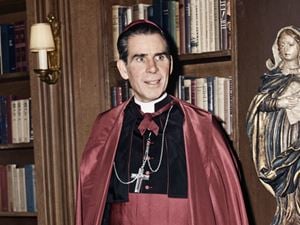
Fulton Sheen looks like a traditional saint. Dressed in full episcopal garb and with a knot of chains around his neck, all that’s missing is a halo.
America’s first television preacher, who died in 1979 aged 84, will inch closer towards becoming a saint on Thursday, in a grand beatification ceremony in Missouri. It is one step short of sainthood – the final being canonization. For each of these stages, you need to have performed a miracle.
But a Telegraph investigation raises serious questions over whether Sheen deserves his place in the Church’s hall of fame. There remain significant concerns over his potential involvement in the reassignment of a priest accused of sexual abuse in the 1960s – something the Church denies.
Pope Leo XIV has already given Sheen his blessing, saying on Wednesday that the TV star’s beatification would “inspire many others… to find new ways of spreading the gospel message”.
Donald Trump also praised the televangelist on Thursday. The US president said that he and his wife Melania Trump, who is Catholic, hoped that Sheen’s example would “help lift our nation upward and ever higher to God”.
After all, Sheen was a star during his lifetime, helping to convert an estimated 42,000 to 52,000 people to Catholicism.
He achieved such celebrity that a new word was invented to describe his contributions to the Church: televangelism. The Catholic bishop, born into a farming family in rural Illinois in 1895, was the first religious figure anywhere in the world to be given a major network TV show. He used it as his pulpit.
With high cheekbones and deep-set eyes, Sheen took to the screen each Tuesday evening to deliver a live, 30-minute sermon probing life’s great uncertainties. Debuting in 1952, Life is Worth Living became an instant success, drawing around 30 million viewers each week during its peak.
His distinctive blend of humor and gravitas frequently outperformed ratings giants including Frank Sinatra. “Quo Vadis, America?” he roared in his inaugural episode. “America, where are you going? Where are we going in this day and age?”
Within eight weeks of the program's launch, Sheen was on the front cover of Time magazine, a flattering profile in its Easter edition anointing him “the first televangelist”. A year later, he won the Emmy Award for Most Outstanding TV Personality, thanking his four writers for the gong: “Matthew, Mark, Luke and John”.
Making a Saint
The Archbishop Fulton J Sheen Foundation was launched in 1998, nearly two decades after Sheen died of heart failure while praying in the private chapel of his New York apartment, and three decades after he was made an archbishop by Pope Paul VI.
Virtually from the outset, the organization set about trying to secure a halo for its namesake. In 2002, priests from Sheen’s home Diocese of Peoria in Illinois officially petitioned the Vatican to open a cause for sainthood.
Monsignor Richard Soseman, one of the priests involved, suggested Sheen could serve as an antidote to a Catholic sex-abuse scandal that had engulfed the Church earlier that year. “At this time, when some of the untoward and sad events have been reported, it’s helpful to realise that… the Church inspires many to holiness,” Mgr Soseman said. “That’s what Archbishop Sheen was – an instrument to holiness.” The scramble to find a miracle had begun.
Saint-making is a complex process, involving time, money and opaque documents. Once a cause for canonisation has officially been lodged, a diocese sets about gathering evidence to buttress its case.
It appoints a “postulator” – essentially a cheerleader for the cause of the saint-in-waiting. In Sheen’s case, a man named Dr Andrea Ambrosi brought the pom poms. The Italian lawyer, who retired in 2022, had proposed around 300 candidates for sainthood from his office in Rome, 10 of whom he had shepherded all the way to a golden diadem.
Postulators are tasked with preparing a “positio” – a formal dossier summarizing the case for sainthood, which can often span several thousand pages. These must be translated into Latin, printed, bound into special red volumes, and hand-delivered to the Vatican – meaning they can rack up exorbitant costs, often around €500,000 (£429,000). They are never made public.
Sheen’s positio ran to 15,000 pages, according to the Catholic University of America, where he taught. Two books published in 2016, Avarizia and Merchants, by two investigative journalists, claimed that leaked Vatican documents showed costs for Sheen’s sainthood cause had spiraled to €330,000 (£283,000) by 2013.
The positio is passed to the Vatican’s Dicastery of the Causes of Saints – the Church’s saint-making committee – which assesses the life of the candidate. If it agrees the person led a life of heroic virtue or died a martyr, the Pope declares them “venerable”. Sheen earned the honorific in 2012.
But to prove that the person is truly in heaven and actively interceding for people here on Earth, a miracle is required. Human investigations into a person’s virtues can be flawed, the Church explains, so it must instead rely on a sign from God.
Miracles must be beyond scientific explanation, and the Pope gives them the final nod. Once confirmed, a person is beatified – a formal declaration by the Church that someone is worthy of public veneration. A second miracle is required for canonization, in which they are rubber-stamped as a saint.
The process was designed to weed out chancers from being hallowed in the heavens. Just 62 saints were crowned in the 150 years before Sheen’s case was put forward, his own diocese stated in 2002.
But sweeping changes to saint-making rules have seen a flurry of halos handed out in recent decades. In 1983, Pope John Paul II reduced the mandatory waiting period before a sainthood bid could be opened from 50 years after a person’s death to just five. It allowed the Polish pope, who died in 2005, to beatify and canonize more people than all his predecessors combined.
Pope Francis, who died in 2025, went even further – authorizing 912 saints during his 12 years as pope. He made 800 saints in one fell swoop in 2013 by canonizing the “Martyrs of Otranto”, a town of 15th-century Italians who were massacred by Ottoman invaders.
Pope John Paul II and Pope Francis each personally canonized more saints than in the past 500 years combined. Supporters of the shortened timeframe argue it provides more scope for eyewitnesses to weigh in on a potential sainthood, and ultimately creates holy figures relevant to contemporary Catholics. But some argue that living witnesses leave greater room for skeletons to creep out of the closet.
Carlo Acutis, an Italian boy who died from leukemia aged 15 in 2006, became the first “millennial saint” when he was canonized in September 2025. Earning the nickname “God’s influencer”, he was made the patron saint of the internet, after the Church concluded he was behind the healing of a young Brazilian boy in 2013 and a 21-year-old Costa Rican student in 2022.
His fast-tracked path to sainthood attracted controversy from both believers and non-believers, who questioned whether an ordinary teenager could have exhibited the exceptional qualities needed for sainthood in his short life. Subsequent interviews with his school friends pointed to a devoted but unremarkable student. Some raised questions over his wealthy family’s involvement, with Acutis’s mother admitting they supported the costs leading to his canonization.
The Miracle
The Sheen Foundation was on the hunt for a miracle when it received a phone call in December 2010 saying the American televangelist had brought a baby back to life.
Bonnie Engstrom, a Catholic stay-at-home mother, had given birth three months earlier under traumatic circumstances. Despite a healthy pregnancy, her planned home birth quickly went wrong when the baby’s umbilical cord knotted itself in her womb, cutting off vital oxygen supply. The knot tightened as the child descended the birth canal.
“I held him for a moment and he was blue. He was not moving or breathing, and his arms and his legs just dangled. They were totally limp,” said Bonnie, speaking to The Telegraph over the phone a week before Sheen’s beatification ceremony.
Having already given birth twice at home, Bonnie and her husband, Travis, a high school physics teacher, had medical back-up. When the midwife laid the baby on their bedroom floor and started performing chest compressions, they panicked.
The Engstroms both grew up just outside Peoria, Illinois, where Sheen cut his teeth as a young priest. He was something of a local celebrity to them, and Bonnie began watching old episodes of Life is Worth Living during her third pregnancy.
“Watching his shows reminded me of spending time with my grandpa. Both of them grew up on farms in central Illinois and had a lot of wisdom and just a really good sense of humor,” she said.
She and Travis decided that if they were having a baby boy, they would name him James Fulton, and “put him under Sheen’s patronage”. When the midwife struggled to find a pulse in the makeshift maternity ward in their bedroom on Sept 16, 2010, Travis grabbed a cup of water and performed an emergency baptism on the baby, praying to Sheen for him to intervene.
“When I think back on it, I feel like James was super far away from me, even though he was right in front of me,” said Bonnie. “But in my head I was just saying Fulton Sheen’s name over and over again. ‘Fulton Sheen, Fulton Sheen, Fulton Sheen.’”
A female friend they had invited over to help with the birth called 911, and sat thumbing a rosary while they waited for an ambulance to arrive. During the 20-minute or so wait, the friend had a mystical experience involving Sheen, said Bonnie. “In her mind’s eye, she could see Bishop Sheen lying prostrate in the cathedral,” she said. Bonnie sat on the floor in a state of shock.
When the paramedics finally arrived, they hooked baby James up to a heart monitor inside the ambulance. They tried giving him adrenaline to reverse cardiac arrest, but still, nothing.
A neonatal medic rushed James into an emergency ward at the OSF Saint Francis Medical Center, ordering staff members to try different drugs on the baby. One by one, they failed to produce a response, with the team quickly running out of options.
“And finally, the nurse said: ‘OK, we’re going to try for five more minutes, and then we’re going to call it,’” Bonnie said, breaking into tears. “James’s heart did not start beating. Everyone stopped working to call the time of death. And it was at that time that his heart started to beat again.”
James’s heart rate monitor reading suddenly shot up to 147 beats per minute – a healthy rate for a newborn baby. The Engstroms claim he had been without a heartbeat for 61 minutes – a length, they believe, that was not a coincidence.
Sheen’s backers have pointed to the rigorous holy regime he kept throughout his 60-year priesthood as proof of his virtuous life, including rising at 5.30am each day for an hour of uninterrupted prayer.
“I think that Fulton Sheen made a Holy Hour, and when that Holy Hour was over, that is when Jesus Christ brought James back to life,” said Bonnie.
The Tribunal
There were said to be two miraculous moments. First, when James survived the weekend. Medical experts had been bracing for multiple organ failure. Typically, a newborn baby deprived of a heartbeat and oxygen begins to face irreversible organ damage within five to 10 minutes.
James was transferred to a neonatal intensive care unit, where his condition was stable but critical. Bonnie was what she describes as a “mommy blogger” at the time, and took to her website asking people to pray. “The day he was born, Sept 16, 2010, if you go back to my blog that day… I said we need to pray for a miracle, and if a miracle happens we’re gonna attribute it to Fulton Sheen.”
The tale lit up online. The Engstroms received a flood of messages from Catholics around the world saying they were praying for baby James. Comments came rushing in from the UK, Germany, Poland, Italy, Australia, Canada, the Philippines. Classrooms of Catholic schoolchildren contacted them to say they had prayed for James in their morning assemblies. “It was so amazing,” said Bonnie, her voice wavering. “People were so good.”
James remained in an intensive care unit for a month and a half after he was born, and received a follow-up MRI when he was three months old. Bonnie was at her mother’s house when she received the results: a perfectly normal, healthy brain. Her mother, a devout Catholic, had one overwhelming response: “It’s a miracle. You have to call the Sheen Foundation.”
Already preparing Sheen’s positio, the Sheen Foundation was all ears. “They ended up being very interested in this story of a baby who was dead for an hour and came back to life,” said Bonnie.
The non-profit organisation launched a tribunal into the alleged miracle in 2011. Dr Ambrosi was part of the tribunal, flying over to interview members of staff at the Peoria hospital. Some of them were Catholic, but not all. It was around the time of Prince William’s wedding. Bonnie remembers telling Dr Ambrosi’s secretary: “I gotta get home and watch this thing.”
The second half of the miracle would come gradually, as James grew up. Over the years, James met all of his developmental milestones – feeding himself Cheerios, running around, learning to ride a bike. “All of that felt like an affirmation of the miracle that had happened,” Bonnie said. “We could bring the receipts, as they say.”
Years passed as the Vatican reviewed its findings, and the Engstroms carried on with their lives. Another baby arrived in 2012, this time a girl, and four more children followed. In July 2019, the family was informed that Pope Francis was personally scrutinizing the miracle. Bonnie was told to expect a phone call, but a friend arrived there first, tagging her in a Facebook post to say the Pope had approved it.
The Intervention
Parish notices were sent out inviting Catholics from around the world to come and witness Sheen’s beatification on Dec 21, 2019, in the Cathedral of St Mary in Peoria, Illinois.
But on Dec 2, 2019, the Vatican suddenly pulled the plug. It was not initially clear why, until the Diocese of Peoria filled in the gaps a few days later. A number of bishops in the US bishops’ conference had raised concerns that Sheen may have been involved in reshuffling priests accused of sexual abuse. They said they were requesting a pause in the sainthood process “to allow for further review of his role in priests’ assignments”.
Bishop Salvatore Matano of Rochester had privately written to the Vatican in November 2019 requesting a delay until the allegations were considered. He was concerned that Sheen’s name may be cited unfavorably in a report by the New York State Attorney. At the time, the Diocese of Rochester was facing bankruptcy proceedings over a string of lawsuits alleging historic sexual abuse by clergy.
Among those accused was Gerard Guli, a former priest in the Diocese of Rochester, who was stripped of his religious honors following sex abuse allegations. The central question was whether Sheen, who served as the Bishop of Rochester between October 1966 and October 1969, had given Guli a ministry assignment while aware of the allegations. Guli worked in the Diocese of Rochester from his ordination in 1956 until 1963, and again from 1967 until 1989.
The Diocese of Peoria quickly went on the defensive and accused the Diocese of Rochester of trying to “sabotage” Sheen’s beatification. A spat ensued. In the end, the Diocese of Peoria launched its own investigation and passed its findings to the Vatican.
In February 2026, Bishop Louis Tylka of the Diocese of Peoria announced that the Vatican had cleared the way for Sheen’s beatification to resume. A new date was set for Sept 24, 2026. Neither the Holy See nor the Diocese of Peoria ever released their findings or the underlying evidence.
In 2018, the Diocese of Wheeling-Charleston in West Virginia published the names of 13 clergy members who had served in the diocese and been accused of sexual abuse elsewhere. Guli was on the list. The document, seen by The Telegraph, included claims that he had committed “abuse incidents involving adults in the Diocese of Rochester” in around 1960. The file stated that those allegations were “reported to the Diocese of Rochester in 1963” – three years before Sheen became bishop there. It said Guli was later struck off by the Diocese of Rochester.
The Diocese of Wheeling-Charleston told The Telegraph that “everything we disclose in our Credibly Accused Elsewhere List was provided by the Diocese of Rochester”, and that it did not publish individual staff files. The Diocese of Rochester did not respond to The Telegraph’s requests for comment.
In response to The Telegraph’s findings, the Diocese of Peoria confirmed for the first time that Sheen was aware of sex abuse allegations against Guli while he was Bishop of Rochester.
It said Guli had written to Sheen in 1967 requesting an assignment in Rochester after he “became aware of his parents’ ill health and moved back” home to take care of them.
The diocese said that Sheen was by that point “aware of Gerard Guli’s past, which is why he refused to offer him an assignment when he was Bishop of Rochester”.
However, a contemporaneous news report appears to link Sheen to at least one of Guli’s appointments within the Diocese of Rochester after that date. A notice in the Syracuse Herald-Journal, a local New York newspaper, on Nov 25, 1968, said that “Bishop Fulton J Sheen has announced the transfer of the Rev Gerard J Guli from St Francis Church, Auburn to the post of assistant pastor at St Ambrose Church, Rochester”.
After The Telegraph shared the newspaper clipping with the Diocese of Peoria, it appeared to refute the claims in the 1968 report altogether. In a statement, the diocese said there was “no evidence that Gerard Guli was ever assigned to St Francis, Auburn, or at St Ambrose, Rochester” – the two churches listed in the report.
However, further archival material uncovered by The Telegraph places Guli at his own leaving party inside St Francis Church, Auburn in 1968. A report in the Syracuse Herald-Journal from Dec 5, 1968 said that Guli and other “former assistant pastors at St Francis Church, Auburn, were honoured at a farewell party in St Francis School Hall.” “Father Guli was recently transferred to St Ambrose Church in Rochester,” it added, alongside a photograph of Guli with fellow priests from St Francis Church, Auburn.
A notice in the same newspaper three days earlier announced that the farewell party was set to take place. It repeated the statement that “Rev Gerard Guli, formerly of St Francis Church, recently transferred to St Ambrose Church in Rochester”.
A separate report in The Times-Union, another local newspaper in New York, from Aug 14, 1971, confirmed Guli was performing church services at St Ambrose Church three years later. A wedding scrapbook in its Brides Book for Greater Rochester series said: “Today, at 10am in St Ambrose Church, Peggy [Perona] became Mrs William T Stephany, in a ceremony performed by Father Gerard Guli.”
Three months later, Guli was moved on again. Another notice from the Times-Union on Nov 27, 1971, headlined “priests reassigned”, said that “the Rev Gerard J Guli, assistant pastor of St Ambrose, [is] to be assistant pastor of St Michael’s Church, Rochester”.
The findings will raise serious questions over the thoroughness of the Diocese of Peoria’s investigation into Sheen, which it shared with the Vatican.
The Diocese of Peoria insisted it “undertook a thorough investigation that was presented to the Vatican, demonstrating that Bishop Sheen did not assign Gerard Guli”.
The diocese told The Telegraph: “As part of our investigation, we deposed Gerard Guli who testified in 2019 that Bishop Sheen refused to give him an assignment. Gerard Guli indicated that Bishop Sheen would never entrust him with an assignment.
“Later, Bishop Dennis Hickey, Auxiliary Bishop of Rochester, and Vicar General, did allow Gerard Guli to say Mass at a convent in the parish of Guli’s parents, but not in a parish.
“In 1971, Bishop Hogan assigned Gerard Guli as pastor of Ss Isidore & Maria Torribia Parish, Bradford, NY. Gerard Guli offended again in 1989… The Diocese of Peoria has proven that Bishop Sheen had no part to play in assigning Gerard Guli or returning him to active ministry.”
Guli, who died in 2024, was later charged with sexually assaulting a woman with dementia in a nursing home in 1989, and received a five-year probation sentence. He was placed on administrative leave by the Diocese of Rochester and continued to receive a salary, according to reports at the time.
Anne Barrett Doyle, the co-director of the Bishop Accountability website, called on both the Vatican and the dioceses to release their files on Sheen.
“Bishop Matano took an extraordinary step when he halted the beatification, when he sounded that alarm. That is never done. And it wasn’t just him, he consulted other bishops,” she told The Telegraph.
“This wasn’t just a baseless fear that [Bishop] Matano had. It’s very likely that they knew something, or they would not have taken this unusual step of halting this process.”
“We need to see the documents. We need the evidence,” she added. “On what basis did they decide that Sheen was a worthy candidate for sainthood?”
$1M Sponsorship Packages
Sheen is set to be beatified on Thursday in the culmination of a week-long pilgrimage schedule. The ceremony was moved from its planned Peoria venue to accommodate a bigger crowd, and will now take place in a 66,000-seat football stadium in St Louis, Missouri.
The event is a big deal in the Catholic Church – and a major fundraising opportunity. The Sheen Foundation has been promoting sponsorship packages for as much as $1m, which promise a shoutout during the beatification Mass, social media mentions, and tickets to the Sheen Awards – a new event that will recognise people spreading the word of God.
A merchandise website has sprung up selling Sheen hoodies, mugs, water bottles and football jerseys. “As Sheen on TV,” says one T-shirt on sale for $28. The ultimate prize is a Sheen relic, which churchgoers can apply for by sending a donation to cover postal costs.
Tickets to the event start at $15, despite Church rules prohibiting entrance fees for a Mass. Bishop Tylka told The Pillar, a Catholic media outlet, earlier this year that it was necessary to offset the costs of a major event. “Canon law says that you cannot charge to go to Mass in a church. We’re not in a church,” he said.
The Diocese of Peoria told The Telegraph that Sheen’s beatification Mass will cost more than $4.5m, and that “minimal [ticket] expenses are required to meet the fees imposed by Ticketmaster which handles all events at the Dome at America’s Center”.
A home-grown saint can significantly boost a town’s economy. More than 620,000 pilgrims visited the tomb of St Carlo Acutis in the Italian town of Assisi in the first eight months of 2025 alone, according to the National Catholic Register. The religious industry virtually props up the entire economy of Lourdes, the French town connected with St Bernadette, with pilgrims bringing in an estimated €300m each year.
Modern-day saints have not been immune to criticism, but it has not dented their popularity. Mother Teresa, who was made a saint by Pope Francis in 2016, has faced scrutiny over the quality of her medical care in India, but remains a household name.
To critics, such allegations are a symptom of a canonisation process that welcomes saints too soon after their deaths – for they are human, after all.
To believers, that is precisely what makes them relatable. Sheen, for example, was said in contemporaneous reports reviewed by The Telegraph to have played tennis at a private club most mornings, lived off hamburgers, driven a big, black Cadillac and had light tan make-up applied to his face before his primetime TV show.
US port documents reviewed by The Telegraph show he frequently stayed at five-star hotels on trips abroad, while Sheen’s own newspaper columns included sentences such as: “Man was made to till the garden, woman to be the helpmate”. The Passion of Fulton Sheen, a 1972 memoir published by the Rev D P Noonan, his former assistant, claimed Sheen was a “prima donna”, “arrogant”, “spoiled, emotional, moody, cold, ambitious, and moralistic”.
Does that make him any less of a saint?
Sheen himself said in a 1957 column he wrote for the Bangor Daily News in Maine: “There are saints in heaven that once were rotters, greedy, murderers and thieves. But there is not one in heaven who did not eventually become humble.”
Catholic Revival
Pope Leo XIV, who, like Sheen, was born in Illinois and became the first American pope in 2025, will have the final say over a potential halo for the televangelist. He has already hinted he is minded to grant one.
Speaking from St Peter’s Square on the eve of Sheen’s beatification, the leader of the Catholic Church said: “May the example and the intercession of this holy bishop, known for his evangelising work to the media, inspire many others likewise to find new ways of spreading the gospel message with joyful enthusiasm.”
The Pope has already advanced six causes for sainthood this year, while a further 100 Americans have active cases, according to the Saints on Their Way database.
It comes amid something of a Catholic revival in the US, with many dioceses seeing a surge in adult baptisms. Among recent converts is JD Vance, the US vice-president, who became Catholic in 2019 and published a memoir about his transformation in June.
Sheen will become the first American-born male saint if he is canonised – and there may never have been a better time for it. The Diocese of Peoria is reportedly considering another proposed Sheen miracle, which could qualify him for sainthood.
William Cash, a former editor of the Catholic Herald, told The Telegraph: “America is keen to have new saints as there are so few. Sheen would make an ideal new American saint so long as his slate is clean.
“He would be a very popular US saint to a whole generation of baby boomer US Catholics, as he was the best known Catholic in America for a generation.”
Until then, Bonnie will count her blessings that it was, she believes, her son whom Sheen chose to save. The family jokes that James, who just turned 16, is like Harry Potter – “the boy who lived”. “But I guess we have found the Weasley families of the world, and they just treat him like a normal kid,” said Bonnie.
She said that being mother to a miracle child had been fun and exciting for the most part, but at times overwhelming.
“In the whole history of the Church, and in all the amazing things, even going back to the creation of the world, God brought my son back from the dead… To me, that is on the same level as when he raised Lazarus from the dead, when he split the Red Sea.”
This article was originally seen on The Telegraph.