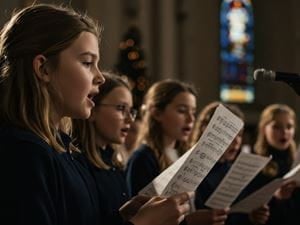
For those who grew up in the Church and are now at the "other end" of the age spectrum, the Church's traditional hymns hold special meaning. People of that generation often wonder, "What happened to the hymns? Why don't we sing them anymore?"
Here's a list of seven classic hymns that most of us don't hear in church anymore, with some suggestions of why churches don't sing them very much. (The songs are not in any particular order.)
‘And Can it Be?’
Amazing love, how can it be? That Thou, my God, shouldst die for me!
Do you remember singing those words, with gratitude welling up in your soul? Written almost 250 years ago by Charles Wesley, his lyrics still express incredible wonder at God's love. He left His Father's throne above, so free, so infinite His grace; emptied Himself of all but love, and bled for Adam's helpless race. 'Tis mercy all, immense and free; for O, my God, it found out me!
Why don't churches sing this beautiful song anymore? Some of the language is a bit cumbersome, and the melody can be challenging (especially in a day when many people don't read music, and churches don't use sheet music). But what theology!
God's amazing love, His incredible grace, the freedom we have in Christ, and joy of knowing that He has forgiven our sin and done away with our condemnation – amazing love, indeed!
‘The Church's One Foundation’
Here's another song that is largely overlooked in today's worship rotations – and again, the theology is so rich that the Church needs to hear it. The Church's one foundation is Jesus Christ, her Lord; she is His new creation by water and the Word: From heav'n He came and sought her to be His holy bride; with His own blood He bought her, and for her life He died.
And the second verse stresses the unity that Jesus Himself prayed for (John 17:22-23): Elect from every nation, yet one o'er all the earth, her charter of salvation, one Lord, one faith, one birth; one holy name she blesses, partakes one holy food, and to one hope she presses, with every faith endued.
What might it mean for churches to sing those words today? To be reminded of Christ's call for His followers to be one, as He and the Father are one: elect from every nation, yet one o'er all the earth?
‘A Mighty Fortress is Our God’
Written by Martin Luther at the very onset of the Protestant Reformation, this song reminds believers that God Himself is our fortress. Some of the words may be unfamiliar to modern ears, but they are worth the effort to understand!
A mighty fortress is our God, a bulwark never failing. Our Helper He against the flood of mortal ills prevailing. For still our ancient foe doth seek to work us woe; his craft and power are great, and armed with cruel hate; on earth is not his equal.
But even though we are not equal to Satan's power, God is more than enough!
We will not fear for God hath willed His truth to triumph through us: the Prince of Darkness grim, we tremble not for him; his rage we can endure, for lo! His doom is sure, one little word shall fell him. No matter what may come, God is our fortress: Let goods and kindred go, this mortal life also; the body they may kill: God's truth abideth still. His Kingdom is forever.
While churches today may shy away from talk of Satan's power and spiritual battles, God's truth still abides!
‘Onward Christian Soldiers’
For many modern churches, the thought of "warfare" and "spiritual conflict" is a little too dark and heavy. People want to be encouraged, to feel good about themselves. But Scripture is clear that the Church is engaged in an eternal battle against Satan and the forces of evil. And to be sure, there are many times that people use the imagery of spiritual warfare to support physical violence and conflict.
The third verse of this hymn summarizes the Church's view of this spiritual battle: Like a mighty army moves the Church of God; brothers, we are treading where the saints have trod; we are not divided, all one Body we – one in faith and Spirit, one eternally.
And the chorus reminds the Church who its leader is: Onward, Christian soldiers—marching as to war, with the cross of Jesus going on before.
‘Calvary Covers it All’
This hymn may not be as familiar to some readers. Many who grew up in the church fifty or sixty years ago may not even recall it. But the chorus of this beautiful song encapsulates the core of Christian witness: Calvary covers it all. My past with its sin and stain, my guilt and despair, Jesus took on Him there, and Calvary covers it all.
The verses lead worshipers through the fundamentals of the gospel:
-
Verse 1 – How that Jesus alone for my sin did atone, and Calvary covers it all
-
Verse 3 – How matchless the grace when I looked on the face of this Jesus, my crucified Lord; my redemption complete I then found at His feet, and Calvary covers it all
-
Verse 4 – How blessed the thought that my soul by Him bought shall be His in the glory on high; where with gladness and song I'll be one of the throng, and Calvary covers it all.
Do you remember that song? Do you remember how you felt the first time you heard those words and realized that Calvary covers it all?
‘For He is so Precious to Me’
Why don't churches sing this song? Like some of the others on the list, the music may be a bit challenging. The melody may not be as "catchy" or "singable" as today's worship songs. But when it comes to expressing our love for Jesus, this song does it beautifully! So precious is Jesus, my Savior, my King; His praise all the day long with rapture I sing; to Him in my weakness for strength I can cling, for He is so precious to me.
Like several other hymns on this list, the verses of this song set forth the progression from salvation to spiritual growth to our eternal hope:
-
He stood at my heart's door in sunshine and rain, and patiently waited an entrance to gain; what shame that so long He entreated in vain, for He is so precious to me.
-
I stand on the mountain of blessing at last; no cloud in the heavens a shadow to cast. His smile is upon me, the valley is past, for He is so precious to me.
-
I praise Him because He appointed a place where someday, through faith in His wonderful grace, I know I shall see Him, shall look on His face, for He is so precious to me.
Amid everything the world offers, the Church needs to be reminded of how precious Jesus is!
‘Just as I Am’
A number of the songs on this list may have fallen out of favor because the melodies are hard to sing. Some may find the language difficult to access. Imagery of war, or "patriarchal" language (like "brother" and "Father) may turn some people off. Those reasons are understandable, though each objection could be easily overcome if churches were motivated to sing them.
But Just As I Am may be in a different category. Are churches avoiding this song, and others like it, because they emphasize the lostness of people without Christ? Just as I am, without one plea but that Thy blood was shed for me. That sounds "exclusivist," as though people without Jesus have no "plea" to make. That's not a message the world wants to hear, and it's not one many churches are willing to share.
Some hymnals may not even contain all six verses of the song, but the imagery of human lostness and depravity rings throughout:
-
To rid my soul of one dark blot
-
With many a conflict, many a doubt; fightings and fears within, without
-
Just as I am, poor, wretched, blind; sight, riches, healing of the mind; yes, all I need, in Thee to find, O Lamb of God, I come, I come!
-
Just as I am, Thou wilt receive, wilt welcome, pardon, cleanse, relieve; because Thy promise I believe.
-
Now to be Thine, yea, Thine alone, O Lamb of God, I come, I come!
Perhaps some churches find this song too negative. Others may believe it's too aggressively evangelistic. But today's Church, like churches across the ages, needs to hear the message of human sinfulness and divine forgiveness. Jesus still "bids us to come to Him," just as this song says. And people still need to come to Him!
So what happened to the hymns? In many cases, they were set aside not because they lacked truth, but because they demanded something of the worshiper. They ask us to think deeply about sin, grace, sacrifice, unity, and perseverance. They are not always easy to sing, and they are rarely easy to dismiss.
This is not a rejection of modern worship music, which often expresses genuine praise and devotion. But when the Church loses the hymns, it risks losing some of the theological depth and spiritual formation they provided. The truths these songs proclaim have not changed, and neither has the God they exalt.
Perhaps the question is not whether we should sing these hymns again, but whether we are still willing to hear what they have been saying all along.