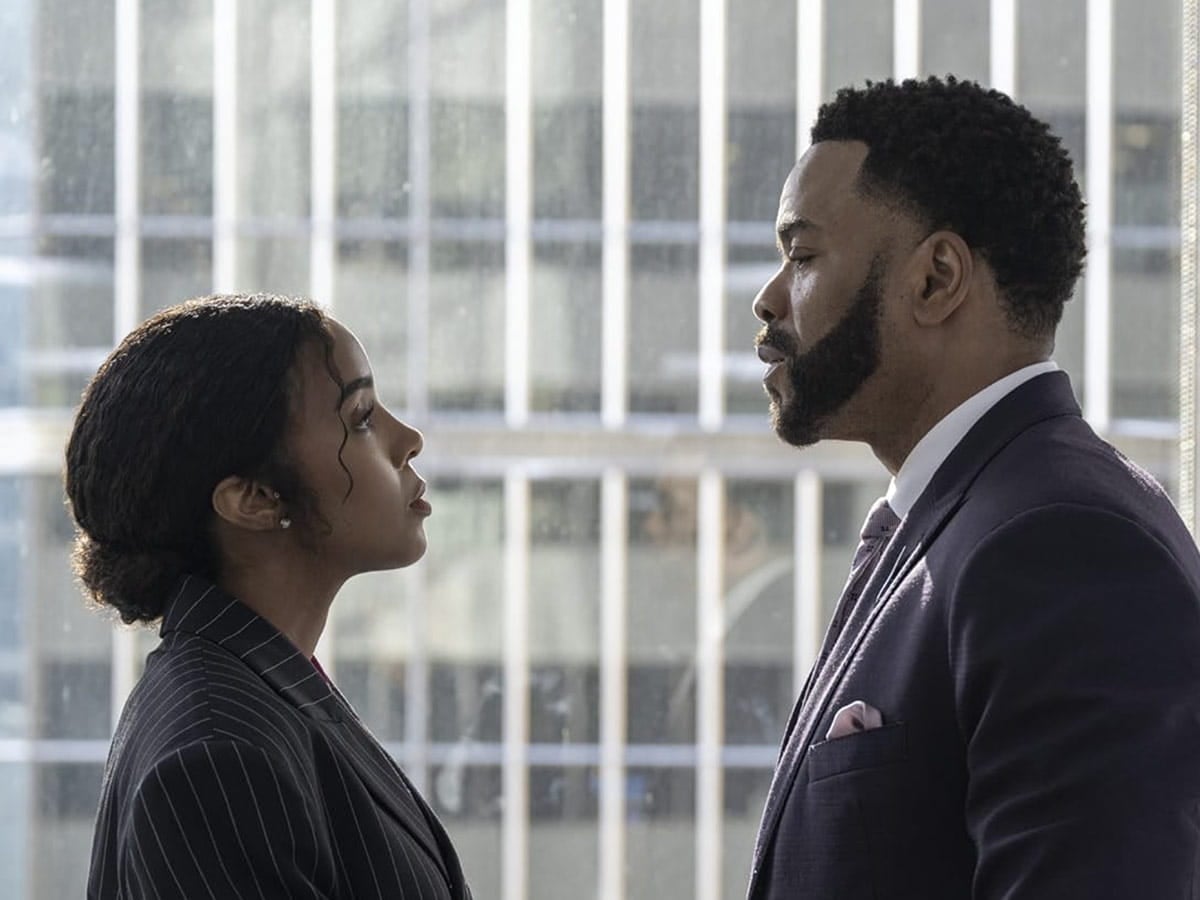
Ryan Coogler's Sinners treated the Jan. 22 Oscar nominations as its personal buffet, gobbling up a record-breaking 16 nominations. The film captured a nom in just about every conceivable category it could've, including nods for Michael B. Jordan (Actor in a Leading Role), Wunmi Mosaku (Actress in a Supporting Role), and 73-year-old Delroy Lindo (Actor in a Supporting Role), along with a Best Director nomination for Coogler himself.
And this Oscar bounty landed at the feet of a horror film—a genre that typically scares away Academy support. Before this year, only eight horror films had ever been nominated for Best Picture. And only one, 1991's The Silence of the Lambs, has ever won the Oscar's biggest prize.
Certainly, Sinners brought something special and utterly unique to this year's Oscar party—a film that manages to be frightening, thoughtful and very entertaining. Its themes challenge us. Its music thrills us.
But as the title suggests, ruminations on faith form the beating heart of Sinners—conflicting streams of Christianity course through its cinematic veins. When we bite into Sinners, we encounter the salty blood of belief. And it won't be to everyone's taste.
Nothing But the Blood
Let's begin with the vampires. They're nasty, hungry creatures in Sinners, ready to devour any human within striking distance. They're very much in the Bela Lugosi, I'm-not-a-creature-of-the-dark mold: glib of tongue, convincing of manners and ever-so-capable of leading the unsuspecting to their doom. And vampires often lure their victims through traditional, Christian-tinged temptations: One uses sex to seduce her quarry. Another uses gold. (The vampire's coins, tellingly, seem to come from ancient Rome.)
And they come with their own music, too: beautiful, powerful music that beckons the unwary, like the song of the ancient Sirens luring sailors to their deaths.
These vampires come with typical vampiric weaknesses, of course. They can't enter an abode unless they're invited in. They don't like wooden stakes. And sunlight is painfully, grotesquely fatal.
But—and this is important—they don't seem to have a particular aversion to Christianity. Sure, holy water is namechecked as a weapon in Sinners. But vampires have no problem saying the Lord's Prayer. And when we dig deeper into Sinner's themes, we understand why. The film suggests that vampires aren't the only forces ready to suck the lifeblood from us: Christianity itself can do the same.
Well, That Sucks
We need to stress that Sinners isn't a straight-up condemnation of Christianity. Ryan Coogler—raised in the Baptist church and educated in Catholic schools—has made films that carry positive Christian echoes, especially in Black Panther and Black Panther: Wakanda Forever. And we see some positive hints of Christian faith even in Sinners.
But overall, the film paints Christianity as a tool of subjugation, not salvation. And it begins with Sinners' real protagonist, Sammie, a.k.a. "Preacher Boy."
Sammie (played by Miles Caton) is indeed the son of a preacher—a strict man who worries that Sammie's love of the blues will bring about his destruction. He encourages Sammie to give up his guitar and get back to church. "You keep dancing with the devil, and one day it's gonna follow you home."
Preacher Boy's struggle to balance his love of the blues with his traditional religious upbringing serves as a microcosm of one of Sinners' most important subtexts: The way that (according to the film) Christianity has tried to squelch and sap the lifeblood of its (often unwilling) converts.
A character named Delta Slim (Lindo) tells Sammie that Christianity was forced on African Americans. We learn that the movie's head bloodsucker, Remmick (Jack O'Connell), was also forced to convert in his native Ireland centuries ago.
But the movie acknowledges that Christianity's influence can be complex and not altogether bad. Remmick admits that the words of the Lord's Prayer still give him comfort, in spite of his vampirism. A character who practices in African-rooted magic and medicine also wears a cross around her neck. We see an important cameo from a couple of vampire hunters hailing from the Choctaw nation, which has largely embraced Christianity as part of its heritage for the last two centuries. "God … be with you," one hunter says.
But the real power here? It's not Christianity. It's the music.
My Lips Will Shout For Joy
In Sinners, music is indeed a powerful force—capable of bringing not just people together, but melding the past and future itself. It can indeed be a joyful, exuberant power—but it's a dangerous one, too. And Sammie's music ultimately does draw the vampires to the doorstep of a makeshift speakeasy, run by twin gangsters Smoke and Stack (both played by Michael B. Jordan).
Perhaps Sammie's father is wise to be wary of Sammie's emotional, unpredictable blues. Because in Sinners, the preacher's traditional faith seems to be no match for it.
For all Sinners' layered spiritual complexity, in the end, we're given a more humanistic tale—where the magic of music and the spirit of creativity are more important than self-denial and the worship of God. Sinners turns its legalistic, subjugative form of Christianity into a sort of vampire itself.
That's a false dichotomy, of course—and perhaps Coogler himself knows it.
Certainly, Christianity has been misused throughout history. But Christ still stands at the center of our faith—and far from taking our lifeblood, He gave us his own. Far from taking life, He gives it.
And don't buy the tropes that Sinners buys into—that the devil has all the good music: God encourages us to "make a joyful noise," and creativity has been an important facet to faith from the beginning. From Davidian psalms to the raps of Lecrae, music has been a part of Christian practice for, literally, millennia. Some of the greatest creative works of history—from art to literature to music—have been in the service of God and Christ.
Creativity is essential in Christianity. But in our faith, that creativity is used to glorify the Lord. In Sinners, it's for themselves.
Sinners is an excellent movie. For all its R-rated content (and there's a lot of it), it's a cinematic tour de force, worth all its Oscar accolades. But ultimately, it tells us that we can find salvation in ourselves. And that's a dangerous notion to invite through your door.