
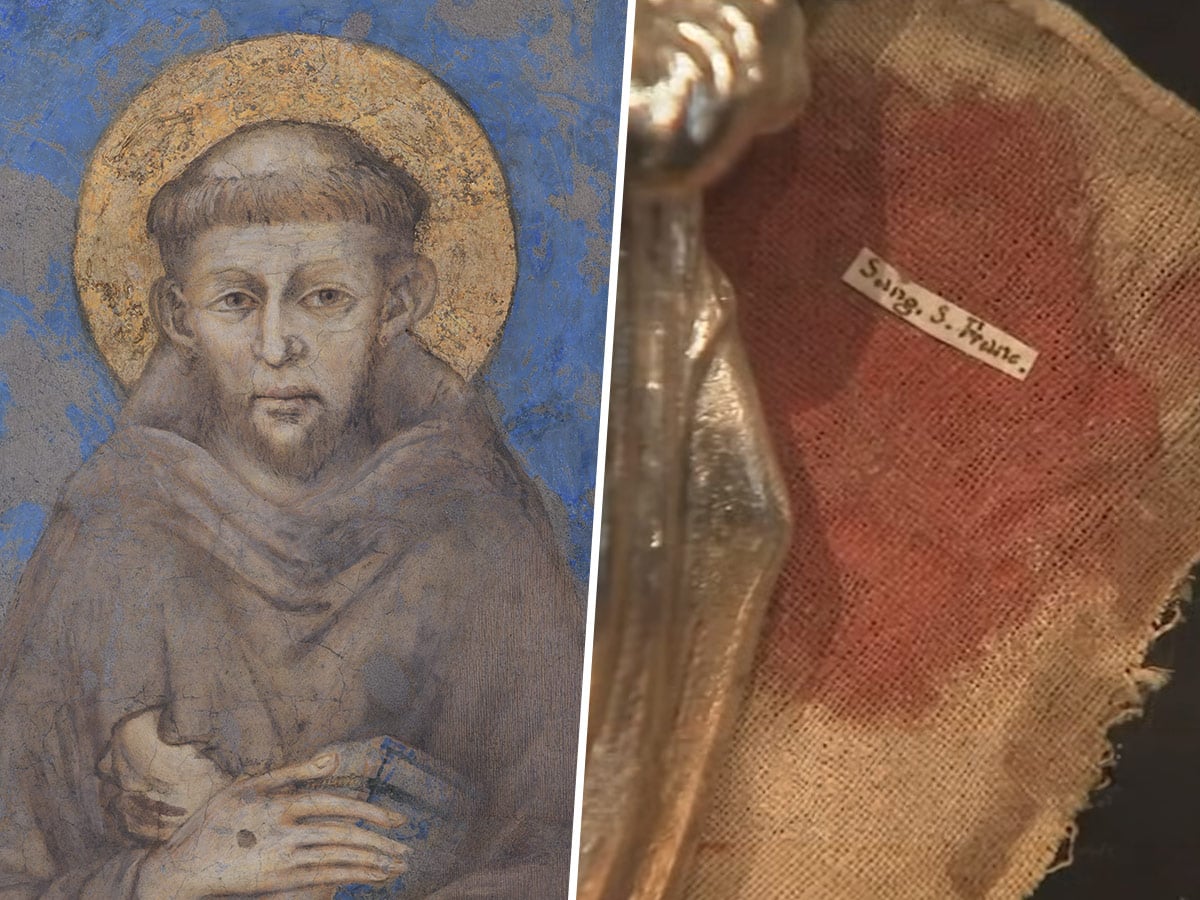
A mysterious, bloodstained cloth believed to have belonged to St. Francis of Assisi nearly 800 years ago is drawing attention in San Francisco, where visitors have a rare opportunity to see one of Christianity’s most treasured relics and confront a central question: how has it remained so strikingly red?
The centuries-old bandage, believed to contain the saint’s blood, has left Italy for the first time and is on display at the Cathedral of St. Mary of the Assumption through November 28. The exhibition marks the 800th anniversary of St. Francis’s death, one of the most beloved figures in Christian history.
Its appearance makes the relic especially intriguing. Despite being nearly eight centuries old, the bloodstains on the cloth still appear remarkably red, raising questions about how the artifact has survived so long.
Known as the Bandage Relic of the Stigmata of Saint Francis of Assisi, the cloth is believed to have been used to cover wounds that mysteriously appeared on the saint’s body during a religious experience in 1224.
According to Christian tradition, St. Francis was praying on Mount La Verna in Italy when he experienced a vision of a seraph, a six-winged angel. Following the encounter, he reportedly developed the stigmata, wounds resembling those Jesus Christ suffered during His crucifixion.
The wounds remained with Francis until his death in 1226, becoming one of the most extraordinary and widely discussed events of his life.
“He then has these wounds for the rest of his life that link him on a spiritual level to Christ,” Candida Moss, a professor of theology at the University of Birmingham, told Fox News Digital.
The exhibition also includes a painted panel depicting St. Francis, dating to approximately 1290, offering visitors another glimpse into the early history of the Franciscan movement.
Born around 1181 in Assisi, Italy, Francis grew up in a wealthy merchant family and initially dreamed of becoming a knight. But after experiencing a profound spiritual transformation, he abandoned his comfortable lifestyle and devoted himself to serving God, caring for the poor and embracing a life of simplicity.
He eventually founded the Franciscan Order, which emphasized poverty, humility and compassion. His teachings and example continue to influence Christians around the world.
Francis is also remembered for his extraordinary love of animals and nature. Stories of him preaching to birds and showing kindness to creatures of all kinds helped establish his reputation as the patron saint of animals.
“He starts off just like everyone else. He wanted to be a knight,” Moss explained. “And then he changes his life. He ministers to the poor. He has all of these stories about him preaching to birds.”
“These are all really endearing stories about a man devoted to God,” she added.
Although St. Francis is a Catholic saint, his influence extends well beyond the Catholic Church. Moss noted that he is also admired by Orthodox Christians, Anglicans and Lutherans.
The relic’s arrival in San Francisco carries special meaning because the California city was named in his honor.
“I think this will become temporarily a pilgrimage site,” Moss said.
The unusual appearance of the bloodstained cloth has raised questions about its authenticity and preservation.
The relics associated with St. Francis have a documented history tracing back to the monastery where he died, but not every artifact attributed to him has proven genuine.
Moss pointed to a tunic once believed to have belonged to the saint that was kept in Florence, Italy. Carbon dating eventually revealed that the garment was made approximately 150 years after Francis lived.
She suggested that the tunic was likely a “pious forgery,” an object mistakenly presented as an authentic religious relic.
Although other objects associated with St. Francis have been dated to the appropriate historical period, the bloodstained bandage currently on display has not undergone the same scientific testing, according to Moss.
That leaves one of the exhibition’s biggest mysteries unanswered: Why does the blood still appear so red after nearly 800 years?
“Now, for religious people, the explanation might be [that] this is miraculous in some way,” Moss said.
“But there has been no scrutiny of this particular relic, which is the most important of the Francis relics,” she continued. “So we can’t really say for certain why it is that it seems so well-preserved.”
For believers, the relic offers a tangible connection to a man whose devotion to Jesus continues to inspire Christians eight centuries after his death. For historians, it represents an extraordinary piece of medieval religious history, even as questions about its origins remain.
Moss emphasized that the opportunity to see such significant artifacts outside Italy is exceptionally rare.
“I think [this] is a really singular opportunity to come into contact with really high-status relics,” she said.
“This is a really important part of church history, and it’s worth seeing for yourself.”
 Read Previous Post