
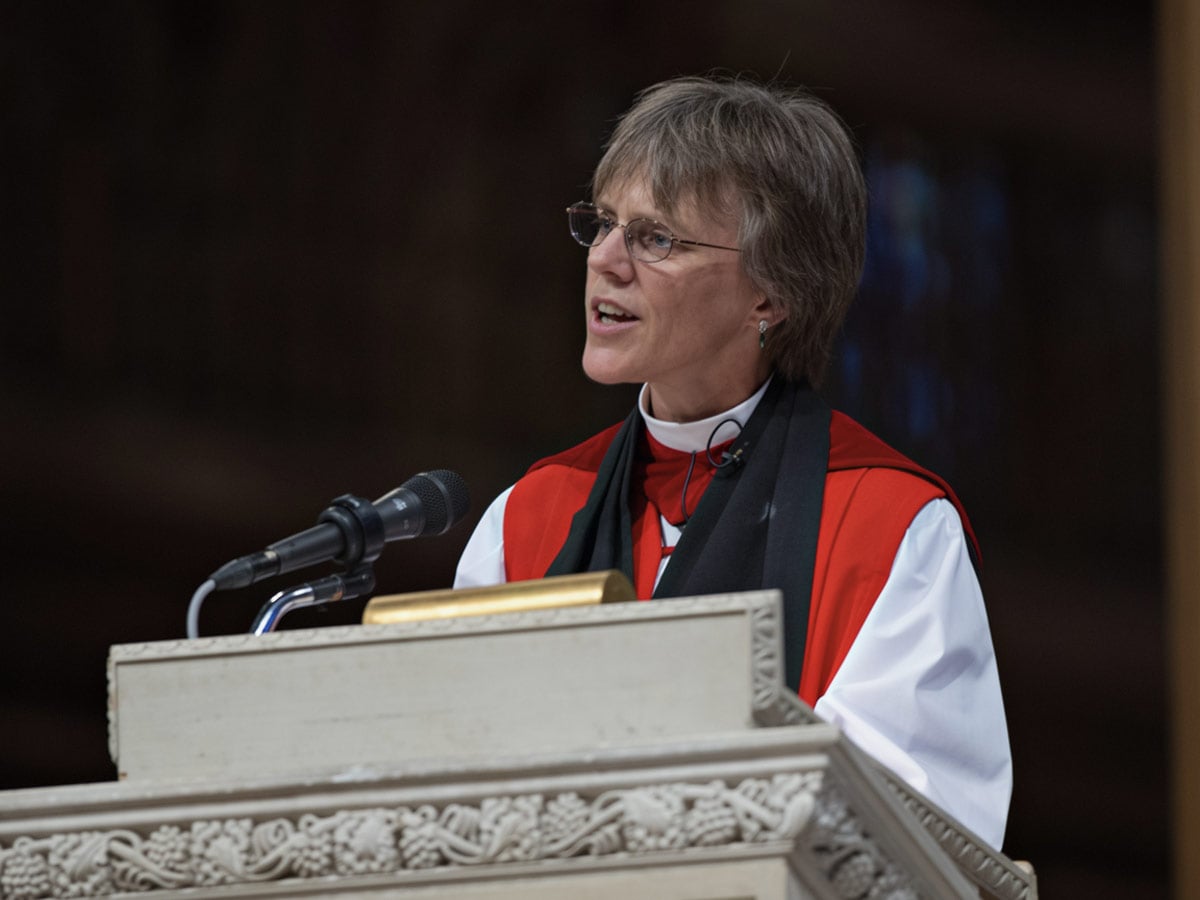
Episcopal Bishop Mariann Budde, who drew national attention after directly confronting President Donald Trump from the pulpit during an inaugural prayer service, has announced plans to step down in 2028.
Budde, 66, said Saturday that she will conclude her tenure as bishop of the Episcopal Diocese of Washington in June 2028, ending a 17-year run leading the diocese.
“I have not come to this decision lightly or alone, and it will not be easy to say goodbye to the diocese I love,” Budde wrote in a letter announcing the transition.
The diocese plans to elect its next bishop in January 2028, as it prepares for the transition.
“I hope that you know that serving as your bishop is one of the great blessings of my life,” Budde wrote. “I am praying for all involved, and especially for the one God is preparing to serve as the tenth bishop of the Diocese of Washington.”
Budde became a household name far beyond the Episcopal Church following the Service of Prayer for the Nation at Washington National Cathedral in January 2025, one day after Trump began his second term.
With the president seated in the front row, Budde used part of her sermon to appeal directly to him on behalf of LGBT individuals and immigrants.
“In the Name of our God, I ask you to have mercy upon the people in our country who are scared now,” she told Trump.
Budde specifically mentioned “gay, lesbian, and transgender children” and immigrants who work in agriculture, restaurants, hospitals and other industries, including those who lack legal documentation.
Her remarks quickly sparked a national debate over politics, Christianity and the proper role of the pulpit.
Progressives praised Budde for using the high-profile service to advocate for people she believed were vulnerable, while many conservative Christians accused her of turning a worship service intended to promote national unity into a political lecture.
Rob Pacienza, senior pastor of Coral Ridge Presbyterian Church in Fort Lauderdale, Florida, was among her critics, arguing that Budde’s message ultimately created the division it claimed to oppose.
“I think the irony was she attempted to preach on unity, but her rhetoric and her very unwelcoming spirit — from the beginning to the end of her message — actually created more division in the end,” Pacienza said.
The sermon has continued to follow Budde. Earlier this year, Virginia Theological Seminary received a sculpture honoring the moment. The seminary also recently announced the publication of Have Mercy: Following Jesus in Politically Perilous Times, a collection of essays inspired by Budde’s remarks.
Budde became the ninth bishop of the Episcopal Diocese of Washington in 2011. Before coming to Washington, she served for nearly two decades at St. John’s Episcopal Church in Minneapolis, including 18 years as rector.
She said she plans to spend the remainder of her tenure preparing the diocese for its next bishop and ensuring a smooth transition to new leadership.
 Read Previous Post