
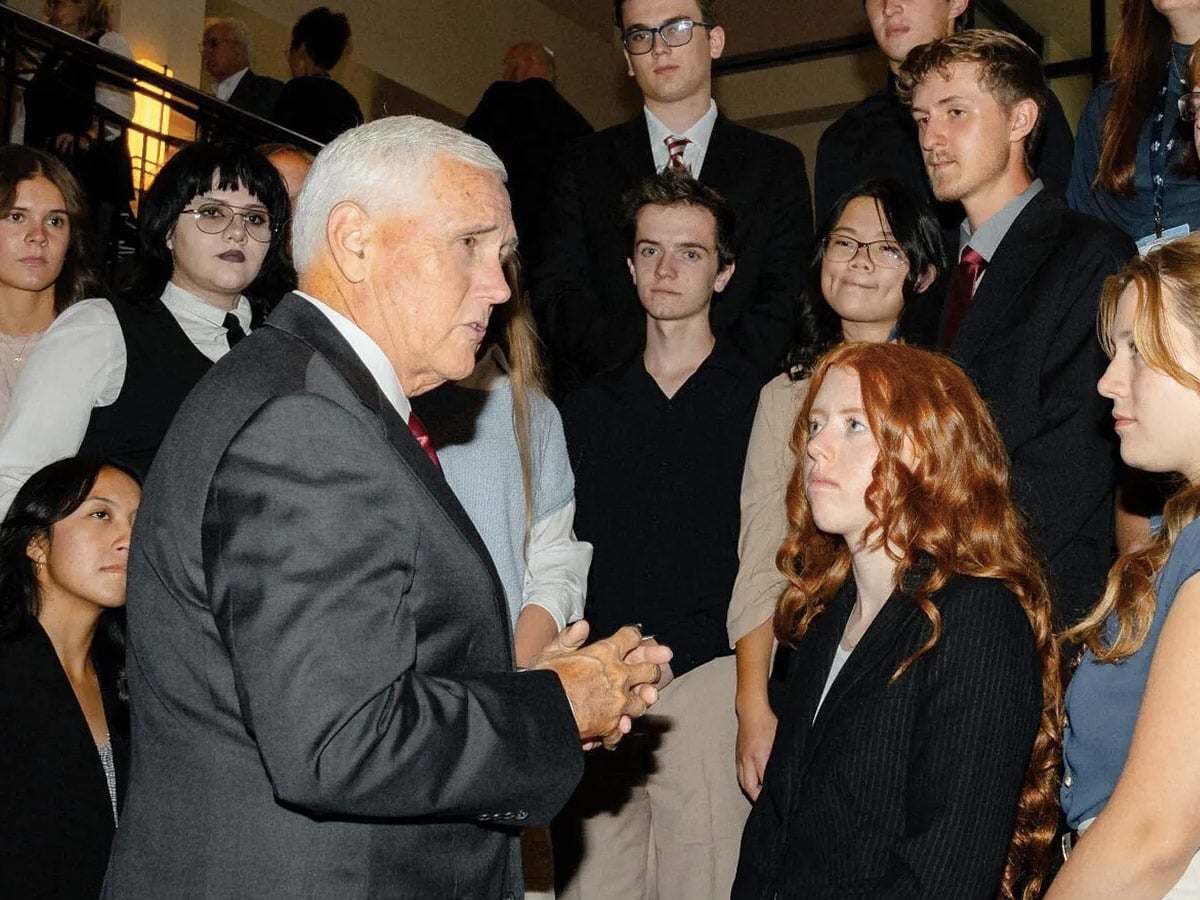
One of Colorado Christian University’s newest staff members won’t be on campus much this fall, but when he is, he’ll be easy to spot: former vice president Mike Pence.
The Indiana politician is joining the university for the 2026–2027 academic year to lead lectures and classroom discussions after helping produce an online course there this summer. Pence, who served under President Donald Trump from 2017 to 2021, will travel to the Denver-area campus once a month as a visiting faculty member.
Like many prominent politicians who leave office, Pence has recast himself as an academic. After abandoning his presidential election campaign in 2023, he taught a course at Grove City College in Pennsylvania, then taught for a semester at George Mason University in Virginia.
In a statement, Pence called his newest job an honor, describing Colorado Christian University (CCU) as a place of academic excellence and Christian principles.
“Throughout my years in public service, I have seen the importance of preparing leaders who understand that faith, freedom, character and constitutional government are inseparable from the future of America,” Pence wrote. “We are in a pivotal moment as a nation and it will be a privilege to join the ongoing work of CCU in raising up the next generation of great American leaders.”
Over the summer, Pence participated in an online course taught with CCU facility based on his recent book, What Conservatives Believe: Rediscovering the Conservative Conscience, according to CCU president Eric Hogue. The course took a broad view of American conservatism and had 28 attendees between the ages of 16 and 60.
It wasn’t Pence’s first appearance at the school. He’d spoken there previously following Trump’s 2024 election, warning against populism. He also spoke this summer the CCU-hosted Western Conservative Summit.
The tour of conservative schools forms part of Pence’s broader push against Trump-style conservatism. Advancing American Freedom, a think tank Pence founded, has sought to position itself as an alternative to groups like the Heritage Foundation, which has drifted rightward in the MAGA era and published the controversial Project 2025 initiative.
Hogue told CT that when he became president of CCU in 2023, he formed a friendship with Pence after inviting him to campus as part of a series of lectures highlighting high-profile figures who align with the school’s mission and values. Their wives bonded over their backgrounds as teachers, and the men connected on their interests in Christian higher education.
“Mike Pence is the same guy at the podium that you have a cup of coffee with at the diner,” Hogue said. “He is what everybody would expect of a great Hoosier, a believer, and a lover of Jesus Christ.”
Hogue noted Pence’s drop in popularity among Trump-supporting conservatives after Pence conceded the presidential election in 2021 and spoke out against the January 6 Capitol riots.
“We have ostracized him for having an oath, his hand upon the Bible, to defend the Constitution of the United States, and he did, and we dislike him for it,” said Hogue, who feels there is a reckoning coming for the conservative movement.
Hogue anticipates the lectures this school year will cover a variety of conservative issues, including tariffs, free trade, Israel relations, abortion, socialism, and Trump. In his praise of Pence, Hogue said the Republican party needs to center on a more traditional conservatism, likening Pence’s philosophy to Ronald Reagan or Barry Goldwater.
CCU has made itself a home for conservative political influencers. Earlier this spring, it hosted a full day of events with prominent conservative radio host Hugh Hewitt. In May, former secretary of education Betsy DeVos spoke at the school’s commencement.
Hogue said he believes the move to add Pence will strengthen CCU as a center for conservative scholarship and a hub for the future of American political thought. He said he anticipates some portions of the Republican movement will dislike bringing Pence on staff, but he hopes it could open the door to conversations.
“Maybe this is an example for those that might have a difference of opinion, and maybe we could break down some of those barriers and we can talk again,” Hogue said.
John Fea, senior fellow at Lumen Center, a Christian study center at the University of Wisconsin–Madison, said CCU’s hiring of Pence is a statement about the type of conservativism the school supports. Hogue is advocating for a more “optimistic kind of conservatism than necessarily the kind of grievance-driven populism” associated with Trump, Fea said.
“I think he’s drawing a line in the sand, putting down a stake to suggest that we are going to stand for this older, Reagan-type conservatism,” Fea told CT.
There’s a battle over post–World War II conservativism happening, according to Fea, with some trying to return to the traditional definition and standings of the party while the populist segment is in power under Trump.
Cedarville University political science professor Mark Caleb Smith said Pence’s involvement is a signal to traditional Republicans—potential students, donors, and alumni—of the kind of conservativism that CCU condones.
“You’re signaling to constituents what your ideological disposition is,” Smith said.
Article written by Jack Panyard and originally appeared on Christianity Today.
 Read Previous Post