
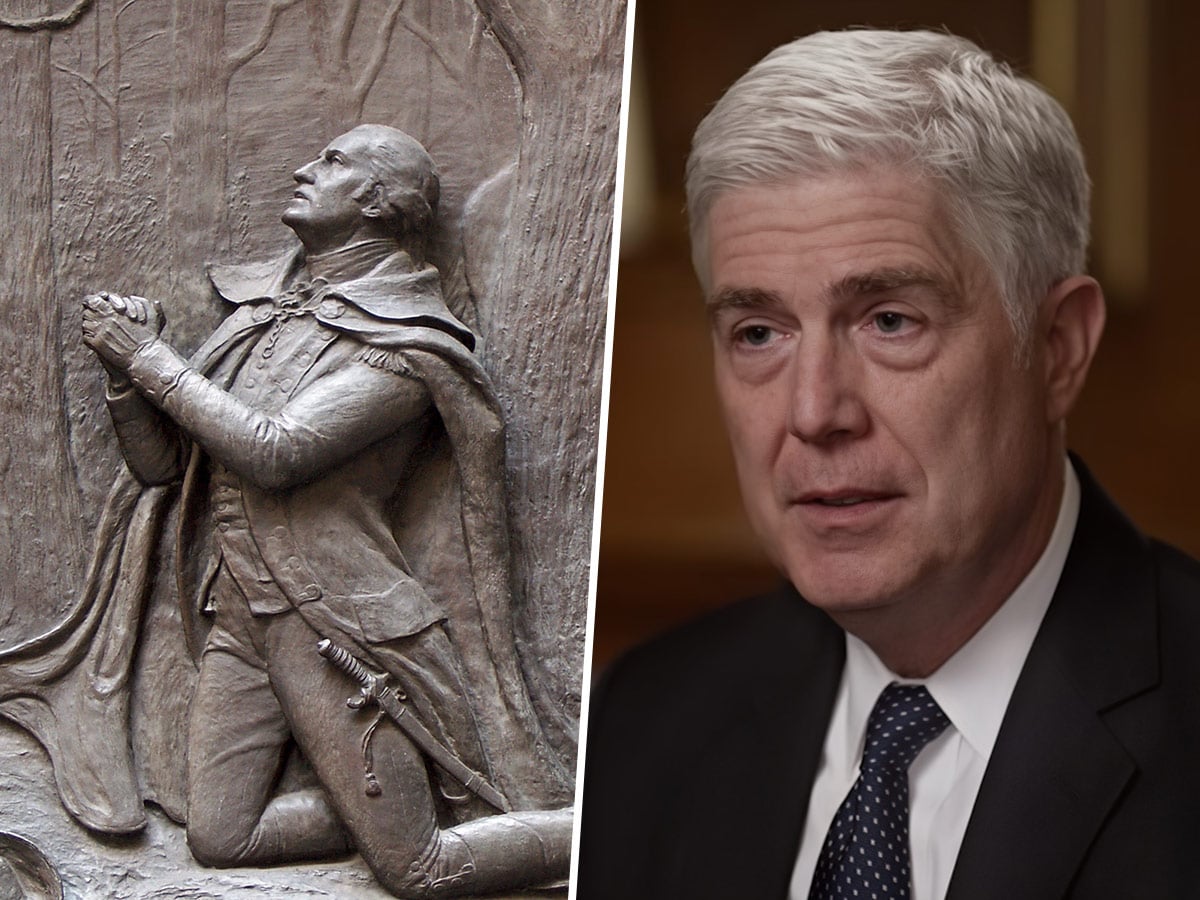
Supreme Court Justice Neil Gorsuch has dipped his toes into America’s Christian Nationalism debate. Justice Gorsuch joined hostess Margaret Hoover on PBS’s “Firing Squad with Margaret Hoover” to reflect on America’s 250th birthday and his new children’s book, Heroes of 1776, a look at some lesser-known heroes of the American Revolution. He told Hoover his hope for the book was that it would expose young people to American heroes of the past and provide them with inspiration. Regarding the United States after 250 years, Gorsuch described himself as an optimist, saying, “I see problems with civic education…Are we going to disagree? Yes, we’re going to disagree. But that’s the way the whole system works. And if you look over 250 years, what we’ve achieved, I don’t know why you wouldn’t be optimistic about America.”
During the conversation, Gorsuch touched on the idea of America being founded as a Christian nation, a pillar of so-called Christian nationalism. “I just don’t see it that way. We have a First Amendment for crying out loud. No established religion,” he said. “We were founded, a lot of our colonies, for our religious pluralism, right? And the opportunity to practice your own faith in your own way,” he told Hoover. “And we were never supposed to be a nation that was about one race or one religion, it was about those ideas. And those things are perfect ideas that speak to every human heart and that unite us all.”
Gorsuch’s words sparked controversy amongst conservatives, who have argued over the exact meaning of Christian Nationalism. “Christian Nationalism” has become a catch-all phrase for anyone who expresses a belief in the founding principles of the United States as being Christian. At times, it seems to be used by those who push for a white American society with Christianity set as the nation’s established religion. At other times, however, it appears to refer to anyone who stated that America’s founding principles were based on Christian concepts. John Daniel Davidson, Senior Editor for The Federalist, pushed back against Gorsuch. “The tell here is in the phrase ‘founded as a Christian nation.’ No one is actually arguing that,” he wrote on X. “The argument is that America was founded by a Christian PEOPLE, and therefore derives its form of government on obviously Christian principles. To survive as a nation, we must be the kind of people who adhere to and respect those principles. Which is to say, we must continue as a predominantly Christian people.”
Even Gorsuch himself, when describing the principles of the Declaration of Independence, noted their reliance on a belief in God. “The Declaration [of Independence] has three ideas at its heart: That we’re all created equal, every one of us. And that each of us has rights given to us by God, not from government, right. And third, that we have the right and the power to rule ourselves.” He called such ideas “radical” for 1776. Which God those innate rights come from seems to be the crux of the Christian nationalist argument. In a religious pluralist society, it could refer to any god albeit Allah, Buddah, or Jesus Christ. The Federalist’s Brianna Lyman, however, cited letters from founding fathers like John Adams to point to a specifically Christian God. “The general Principles, on which the Fathers Atchieved Independence, were the only Principles in which, that beautiful Assembley of young Gentlemen could Unite…And what were these general Principles? I answer, the general Principles of Christianity, in which all those Sects were United,” Adams wrote to Jefferson, the author of the Declaration of Independence, in 1813. “In other words,” wrote Lyman, “Gorsuch is partially right: the Founders did codify ‘ideas’ — but those ideas came from somewhere, and that somewhere was Christianity.”
 Read Previous Post