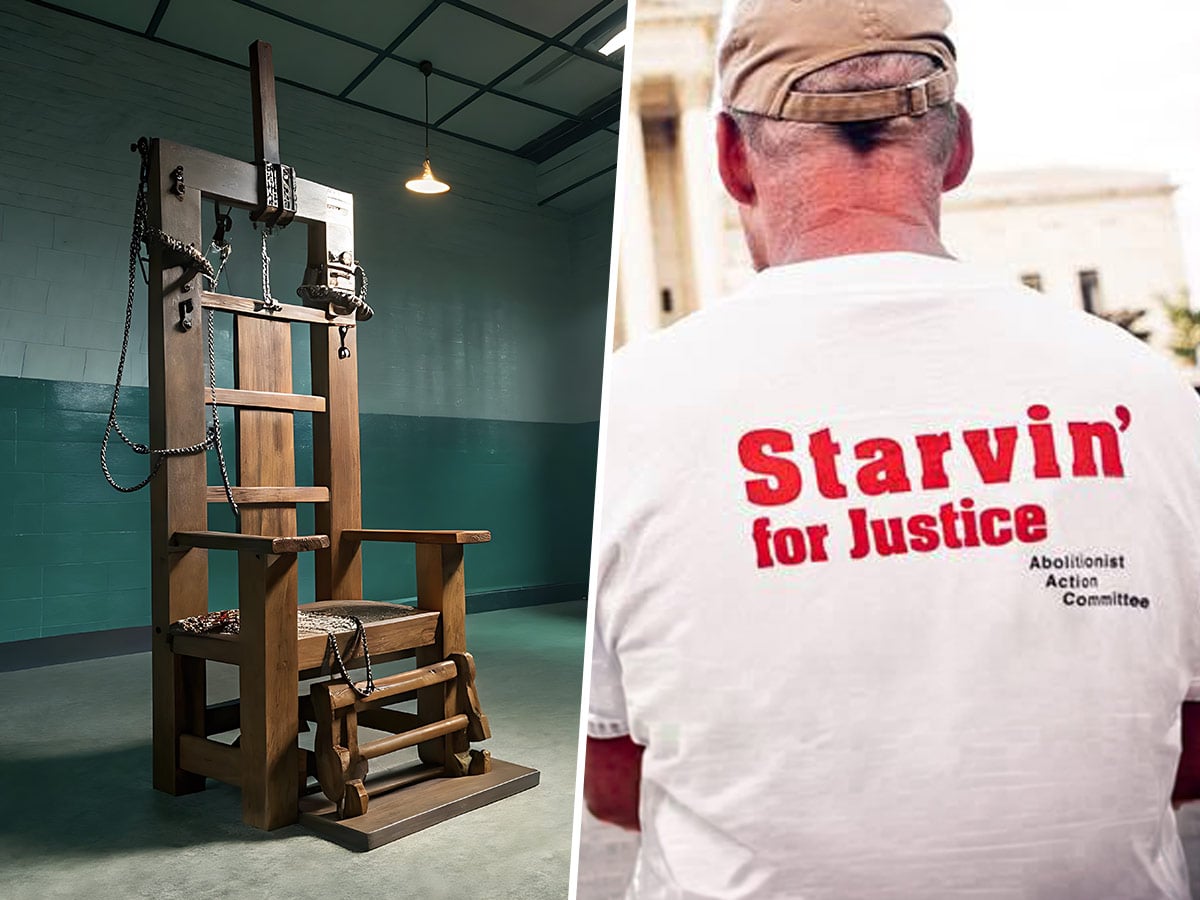
For many Christians, the debate over the death penalty is more than a political issue—it is a deeply personal question of faith, forgiveness, and the value of every human life. As the nation marked the 50th anniversary of the Supreme Court decision that reinstated capital punishment, dozens of faith leaders, murder victims’ family members, and anti-death penalty advocates gathered outside the U.S. Supreme Court with a unified message: God calls His people to choose life, not execution.
The demonstration, known as “Starvin’ for Justice,” featured participants taking turns fasting to commemorate the July 2, 1976, Gregg v. Georgia decision, which marked the restart of the modern era of the death penalty in the United States after a brief nationwide halt.
Among those participating was SueZann Bosler, whose story has become a powerful testimony of forgiveness. In 1986, Bosler survived a brutal attack in which the same man who murdered her father, Church of the Brethren minister Rev. Bill Bosler, stabbed her in the head. Although overcoming the trauma took years, she eventually honored her father’s opposition to capital punishment by spending a decade working to have her attacker’s death sentence commuted.
“It saved my life, forgiveness,” Bosler said, reflecting on her journey.
Her story resonated with many gathered outside the court, where protesters endured triple-digit temperatures as they prayed, fasted, and spoke with passersby about alternatives to capital punishment.
Art Laffin, a member of the Dorothy Day Catholic Worker community and one of the protest organizers, said Christians should look to Jesus’ example when considering the issue.
“God commands us not to kill,” Laffin said. “It’s not an option, it’s a command.”
Laffin, whose own brother was murdered, pointed to Christ’s words from the cross, where Jesus prayed for those responsible for His crucifixion. Rather than responding to violence with more violence, Laffin said Christians are called to love their enemies and seek healing.
“The best way to honor my brother is to work for the prevention of violence,” he said.
According to advocates, faith communities have played a significant role in efforts to abolish or limit the death penalty in several states, including New Jersey, New Mexico, Connecticut, and Virginia. More recently, religious leaders were among those urging then-President Joe Biden to commute dozens of federal death row sentences before leaving office.
Even so, capital punishment remains legal in 27 states, though four of those currently have moratoriums on executions. Last year saw an increase in executions nationwide, fueled largely by Florida, renewing efforts among many faith-based organizations to advocate for reform.
Catholic leaders have been especially vocal. Pope Francis declared in 2018 that the death penalty is “inadmissible,” leading to a revision of the Catechism of the Catholic Church that describes capital punishment as “an attack on the inviolability and dignity” of every person.
Catholic bishops in Florida have repeatedly appealed to Gov. Ron DeSantis to halt executions, including the recent execution of 74-year-old Dusty Ray Spencer, the oldest person executed in the state’s modern history.
Many advocates also point to concerns about wrongful convictions. Krisanne Vaillancourt Murphy, executive director of Catholic Mobilizing Network, noted that more than 200 people sentenced to death in the United States have been exonerated since 1973.
“More than 200 people on death row have been exonerated since 1973,” she said, calling it “a sobering reminder that our criminal legal system is fallible, and that the death penalty is irreversible.”
The conversation remains complicated within American Christianity. A Pew Research Center survey found that many religious Americans—including a majority of Protestants—continue to support capital punishment for those convicted of murder. Some prosecutors have also cited Old Testament passages while arguing for death sentences.
Yet Jewish and Christian opponents alike argue that Scripture ultimately points toward mercy, redemption, and God’s power to transform lives.
The Rev. Jack Sullivan Jr., a Disciples of Christ pastor whose sister was murdered, reminded Christians that some of the Bible’s most influential figures—including Moses, David, and Saul before becoming the apostle Paul—had committed acts of violence before God redeemed them.
“How do we know that on death row, there isn’t another Moses or Esther or David, or Mary or Saul?” Sullivan asked.
Christian author Shane Claiborne echoed that conviction, arguing that belief in redemption should shape how believers approach justice.
“There’s something deeper that should connect us,” Claiborne said, “which is this profound sense that no one’s beyond redemption and that our government is not infallible.”
As America reflects on five decades since the landmark ruling—and approaches the nation’s 250th anniversary—participants in the fast hope Christians will continue wrestling with what biblical justice truly looks like. For those gathered outside the Supreme Court, the answer begins with recognizing that every person is made in the image of God and that the gospel’s message of forgiveness extends even to those who have committed the gravest crimes.
 Read Previous Post