
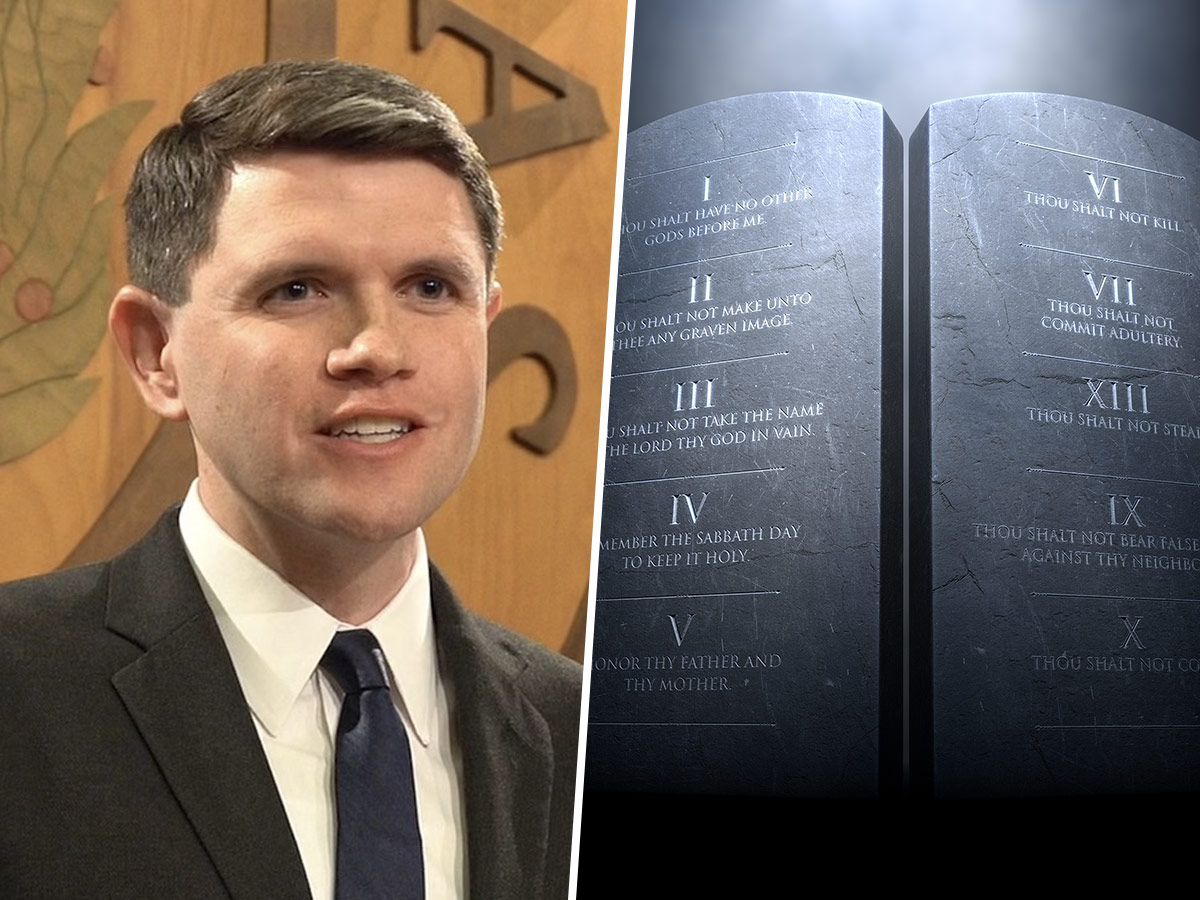
A fierce debate over faith, freedom, and the role of government is unfolding in Texas after a federal court upheld a law requiring public school classrooms to display the Ten Commandments — and one Christian lawmaker is speaking out against it.
Texas State Rep. James Talarico, a Democrat and self-described Christian, is drawing national attention after criticizing the Fifth Circuit Court of Appeals’ 9–8 decision, which allows the state to enforce the mandate. The court ruled the law does not violate the Constitution’s Establishment Clause or Free Exercise Clause, stating that challengers failed to show it “substantially burdens their right to religious exercise.”
But Talarico sees the issue very differently — not just legally, but spiritually.
“I think this is an unconstitutional decision,” he said during an appearance on CNN. “I also think this is a deeply un-Christian decision, because we are supposed to be loving all of our neighbors, particularly our neighbors of other faiths.”
Talarico, who is also a Presbyterian seminarian and former public school teacher, framed his argument around what he believes is a core Christian principle: loving others without coercion. “I don’t want anyone forcing their religion down my throat, and I certainly don’t want the government forcing a religion down my throat,” he said. “So why would I do that to any of my neighbors?”
He emphasized that his faith calls him to love people of all backgrounds — “not just my neighbors who look like me, not just my neighbors who vote like me, not just my neighbors who pray like me,” but also “Jewish, Muslim, Buddhist, Hindu, Sikh, agnostic and atheist neighbors.”
Talarico also warned against what he called “Christian nationalism,” adding, “The only thing worse than a tyrant is a tyrant who thinks they’re on a mission from God.”
His comments have sparked strong reactions from both sides of the political and cultural divide.
Texas Attorney General Ken Paxton, who defended the law in court, celebrated the ruling as “a major victory for Texas and our moral values.” He argued that the Ten Commandments have had “a profound impact on our nation” and said it’s important for students to learn from them daily.
After Talarico took a swipe at Paxton’s moral authority, Paxton fired back on social media, accusing the lawmaker of being “completely and totally morally bankrupt.” Others echoed similar criticism, questioning how a professing Christian could oppose displaying biblical commandments in schools.
Still, Talarico doubled down on his stance, insisting that true faith cannot be legislated. “Jesus taught us to love God and love neighbor, because there is no love of God without love of neighbor,” he said. “I don’t want the government forcing a religion down my throat.”
He also argued that keeping a clear boundary between church and state ultimately protects the integrity of both. “When the church gets too cozy with political power, it loses its prophetic voice,” he said.
The issue is quickly becoming more than a legal debate — it’s shaping into a broader conversation within the Christian community about how faith should be lived out in public life. As Texas moves forward with the law, believers on all sides are wrestling with a deeper question: What does it truly mean to honor God while loving one’s neighbor in a diverse society?
 Read Previous Post