
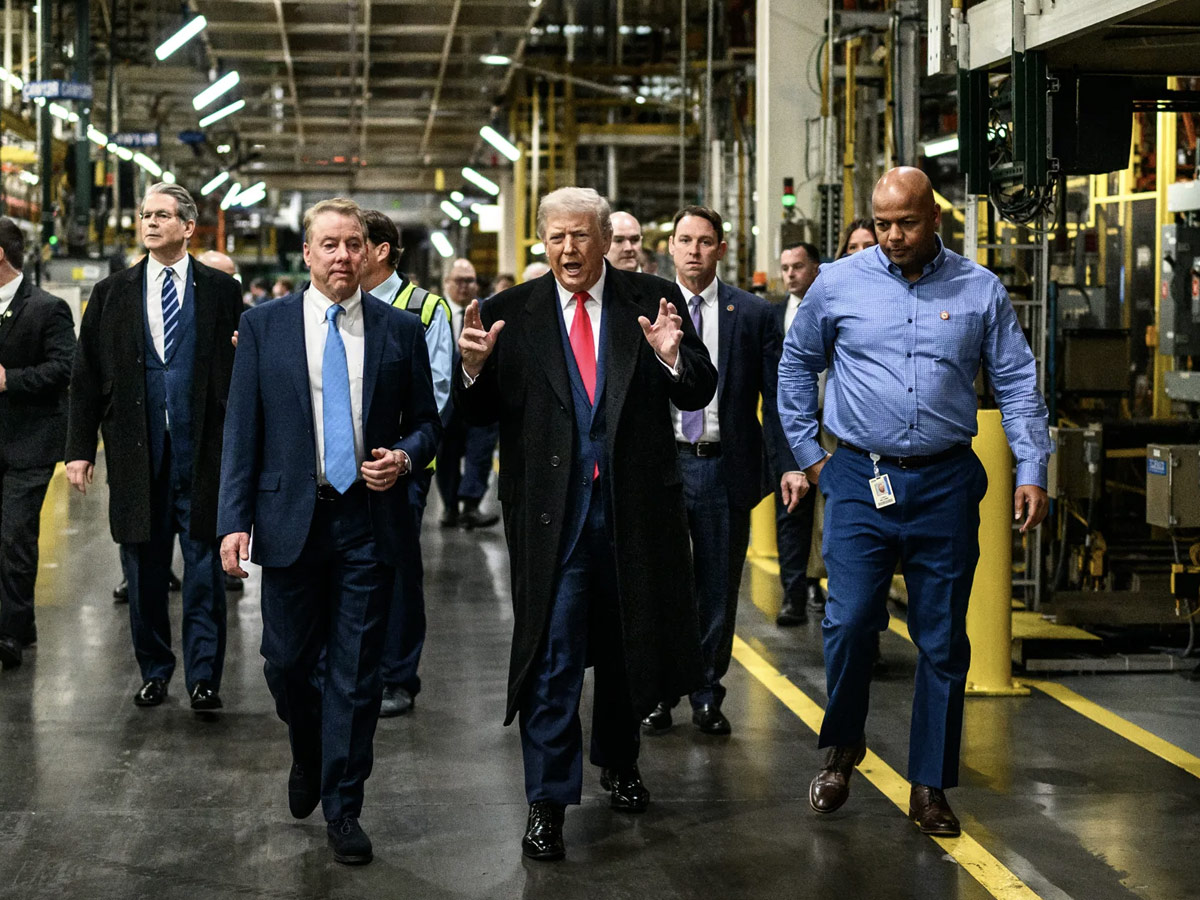
In March 2020, as Joe Biden campaigned for the presidency in Michigan, he got into a verbal confrontation with a factory worker who accused him of trying to “take away people’s guns.” Many conservative religious folks were aghast at this language, saying that it was improper for someone who aspired to lead the country.
Fast forward almost six years. On a visit to a Ford Motor Company factory last week, President Trump was called a “pedophile protector” by one of the workers. Trump responded by mouthing “f*** you” twice, and then “flipping the bird” to the worker. So what is the evangelical response now?
Tony Perkins, who helped found and who leads the Family Research Council, decried Trump’s actions this week. “We need to reverse this coarsening of our civic conduct. Pray for our leaders to be role models, setting the example of civil dialogue, even when there is disagreement. Then we each need to do the same.”
In the abstract, it is hard to argue that our civic conduct and dialogue has become coarsened. Unfortunately, such conduct and language is nothing new for President Trump. Last year, Franklin Graham wrote Trump a letter asking him to stop using such language in his speeches. Trump acknowledged Graham’s letter and advice, but publicly stated that he didn’t agree. And although Graham suggested that perhaps Trump was moderating his language, his words and actions over the past year have not reflected any such change.
From Trump’s perspective, why should he change? As noted, his vulgarity is nothing new.
- Last week, he called Republican senators who supported a War Powers resolution designed to limit his actions in Venezuela. The call to Sen. Susan Collins was described as a “profanity-laced rant.”
- During his campaign against Kamala Harris, he referred to her as “a s*** vice-president.”
- In discussing the conflict between Israel and Iran last summer, he complained that “they don’t know what the f*** they’re doing.”
- Last summer, at a meeting of the White House Faith Office, he referred to his indictments as “bull****.”
- And back in 2016, Time Magazine wrote about cursing in politics when some supporters of Jeb Bush ran an advertisement attacking Trump’s language as “unpresidential.”
So, “salty” language from President Trump is nothing new. Another reason why he might not see any reason to change it is that he has plenty of defenders.
After last week’s confrontation at the Ford plant, Steven Cheung, White House spokesman, described the incident this way: “A lunatic was wildly screaming expletives in a complete fit of rage, and the President gave an appropriate and unambiguous response.”
Well, that’s the real issue, isn’t it? Is such language (and gestures) ever “appropriate”?
Many Christians would say “no.” As Franklin Graham noted in his letter to President Trump last year, Jesus addressed this subject in Matthew 12: “You offspring of vipers, how can you, being evil, express any good things? For the mouth speaks from that which fills the heart. The good person brings out of his good treasure good things; and the evil person brings out of his evil treasure evil things. But I tell you that for every careless word that people speak, they will give an account of it on the day of judgment” (Matthew 12:34-36).
Not surprisingly, President Trump’s defenders justify his language as being “authentic.” Last year, his press secretary, Karoline Leavitt, said that Americans appreciate his language as “saying what they are feeling,” and maybe lack the courage to say themselves. The coarsening of our civic conduct and dialogue that Tony Perkins decried is not a figment of anyone’s imagination. If anything, President Trump is not saying things that people are afraid to say; they are following his example. (Even those on the other side of the political divide, as a quick review of social media will demonstrate.)
Most evangelical Christians would probably agree that such language and actions are not appropriate for anyone, let alone the President of the United States. The problem is that after years of excusing the President’s language and attitudes toward others, “Evangelicals” don’t have the credibility to complain about it now.
Unfortunately, this pattern of excusing the President continues; Tony Perkins is practically the only evangelical leader who has spoken out against last week’s incident. And any time that another leader offers critical comments, they also excuse him by talking about “all the good that he’s done.”
So why is this important? If the President’s policies are what’s important, why should Christians care about his language?
To quote Jesus: “For the mouth speaks from that which fills the heart.” As Jesus also said in Matthew 12, “the tree is known by its fruit” (Matthew 12:33). So how can Christians defend the “goodness” of the policies – the “fruit” – when what “fills the heart” is anger and bitterness?
The question is not isolated to last week’s incident. Christians are called to love everyone, both neighbors and enemies. When anger and bitterness, and even disgust, is commonly expressed toward political opponents, everyone is diminished. As Tony Perkins noted, we need to reverse this coarsening of our civic conduct. We need to pray for our leaders to set a positive example. When they do, we need to follow that example. When they don’t, we need to acknowledge that – and do what is right even when our leaders do not.
It’s not just about the language; it’s about what the language reflects. “The good person brings out of his good treasure good things; and the evil person brings out of his evil treasure evil things.” The “careless words” we speak are not just what might be considered coarse or profane. The more dangerous careless words are the ones that justify what God has condemned. “Woe to those who call evil good, and good evil” (Isaiah 5:20).
 Read Previous Post