
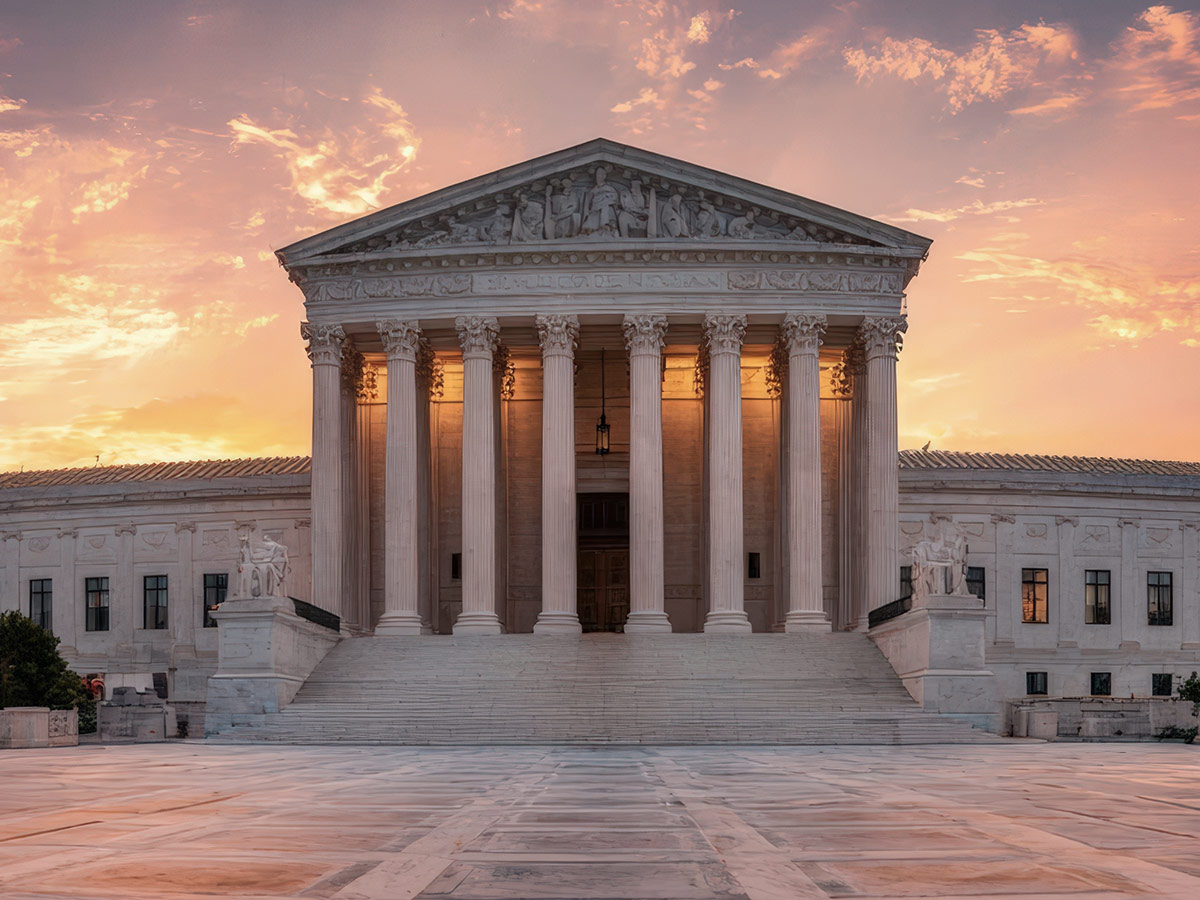
On December 5, the Supreme Court agreed to accept the Trump Administration’s appeal of the lower court ruling in Trump v. Barbara, one of the so-called “birthright citizenship” cases. (Likely, the Court’s decision in this case will also resolve the other cases.)
In January, President Trump issued an executive order that would eliminate birthright citizenship for people born in the United States to parents who have no permanent legal status here. What is so important about this case, and how do Scripture and Christian teaching intersect with this issue?
What is Birthright Citizenship?
Essentially, “birthright citizenship” refers to the principle that anyone born in the United States is automatically a citizen of the United States. The United States is not the only country that currently grants citizenship on this basis; most countries in North and South America do as well. In contrast, many European countries have adopted restrictions based on the legal status of the child’s parents, a measure similar to what President Trump’s executive order seeks to implement.
What Did the Fourteenth Amendment Do?
Prior to the Civil War, the Supreme Court decided the case of Dred Scott v. Sanford. Dred Scott was a slave who was taken to free territory, where he resided for several years. He claimed that he gained his freedom by living in free territory (a principle commonly called “once free always free”). The Supreme Court ultimately ruled that Dred Scott could not bring a suit in federal court because African Americans could not be citizens of the United States.
The decision in Dred Scott’s case was issued in 1857; in four years, the United States was engulfed in a civil war, largely over the issue of slavery. After the conclusion of the war, the United States adopted two new amendments to the Constitution. The Thirteenth Amendment specifically declared that slavery was outlawed in the United States and all of its territories. The Fourteenth Amendment addressed several issues related to the Civil War, including the establishment of what became known as “birthright citizenship.”
The first section of the Fourteenth Amendment states: “All persons born or naturalized in the United States, and subject to the jurisdiction thereof, are citizens of the United States and of the State wherein they reside. No State shall make or enforce any law which shall abridge the privileges or immunities of citizens of the United States; nor shall any State deprive any person of life, liberty, or property, without due process of law; nor deny to any person within its jurisdiction the equal protection of the laws.”
This language was directed toward any “State” because the states had previously enacted laws restricting the rights of certain classes of people – namely, slaves and former slaves. There was no need for the Fourteenth Amendment to prohibit the Federal government from restricting the rights of citizens, because the Constitution already guarantees these rights. Although Congress has the power to pass laws relating to citizenship, any law that Congress might pass that infringes on Constitutional rights would be subject to being invalidated by the Supreme Court.
In 1898, the United States Supreme Court ruled that the Fourteenth Amendment applied to all individuals born in the United States. That case involved a child born in California to parents who were Chinese citizens. The Court specifically held that while the Fourteenth Amendment may have been intended to address the rights of African Americans, the language of the Amendment clearly applied to anyone born in the United States, “including all children here born of resident aliens.”
Congress subsequently enacted a federal statute (8 U.S.C. § 1401) which codifies the language of the Fourteenth Amendment. The first clause of that statute states: “The following shall be nationals and citizens of the United States at birth: (a) a person born in the United States, and subject to the jurisdiction thereof.”
What is at Stake in the Debate Today?
President Trump’s Executive Order of January 20, 2025, seeks to restrict birthright citizenship to children of people who are either citizens or have permanent legal status in the United States. The Executive Order claims that “the Fourteenth Amendment has never been interpreted to extend citizenship universally to everyone born within the United States.” He focuses on the phrase “subject to the jurisdiction thereof” to argue that people without legal status are not “subject to the jurisdiction” of the United States.
This argument ignores the Supreme Court’s decision in the case of the Chinese child in 1898. In fact, the Chief Justice in that case made the same argument in his dissent. Why would the Chief Justice have argued that the child’s parents were not “subject to the jurisdiction of the United States” if the Court’s decision did not find that they were? Logically (and legally), jurisdiction flows from both physical presence and citizenship. For example, foreign businesses that operate in the United States are subject to jurisdiction here, even if they are not American corporations. And people who are in the United States are subject to its jurisdiction for their actions here, regardless of their citizenship. Undocumented migrants are certainly subject to the jurisdiction of federal immigration authorities, as we have all regularly seen.
The Executive Order also identifies certain categories of individuals who are born in the United States but are not citizens, citing the text of 8 U.S.C. § 1401. However, that argument overlooks the fact that Congress established those categories, not the executive order. Article I, Section 8 of the Constitution states that Congress has the power to “establish a uniform Rule of Naturalization…” (Clause 4). Congress has done so in 8 U.S.C. § 1401. The fact that this is an “enumerated power” of Congress means that it is not within the executive branch’s power.
How Can Christians Respond?
These are the legal and historical aspects of this issue. But how should Christians respond? On one hand, Scripture directs us to “submit to the ruling authorities” (for example, Romans 13:1-2). We have laws governing immigration, and it is the government’s responsibility to enforce them.
On the other hand, the Bible also directs us to care for those who are marginalized. God frequently directs His people to care for widows, orphans, aliens and strangers who are among them. (For example, see Exodus 22:21 – “You shall not oppress a stranger or torment him, for you were strangers in the land of Egypt.”) It is not hard to see passages like that as a call for us to welcome people from other countries, particularly if their only crime is seeking a better life here.
In the broader context of immigration, Christians should welcome people and assist them. After all, someone did that for our ancestors when they first came here! And we can encourage our political leaders to make it easier for people to immigrate here legally, so that desperate people are not faced with the choice of staying in bad situations or trying to come here illegally.
Clearly, the issue of birthright citizenship is open to many different viewpoints. A Pew Research Center report earlier this year found that people were nearly equally split on the question of whether children of people who immigrated here illegally should have citizenship rights.
Birthright citizenship grants legal status and standing to all children born in the United States, regardless of their parents’ immigration status. After all, those children didn’t break any laws by being born here! If we’re striving to be a “Christian nation,” we should start with the biblical call to care for those who cannot fend for themselves. And as Christians, we should lead the way!
 Read Previous Post