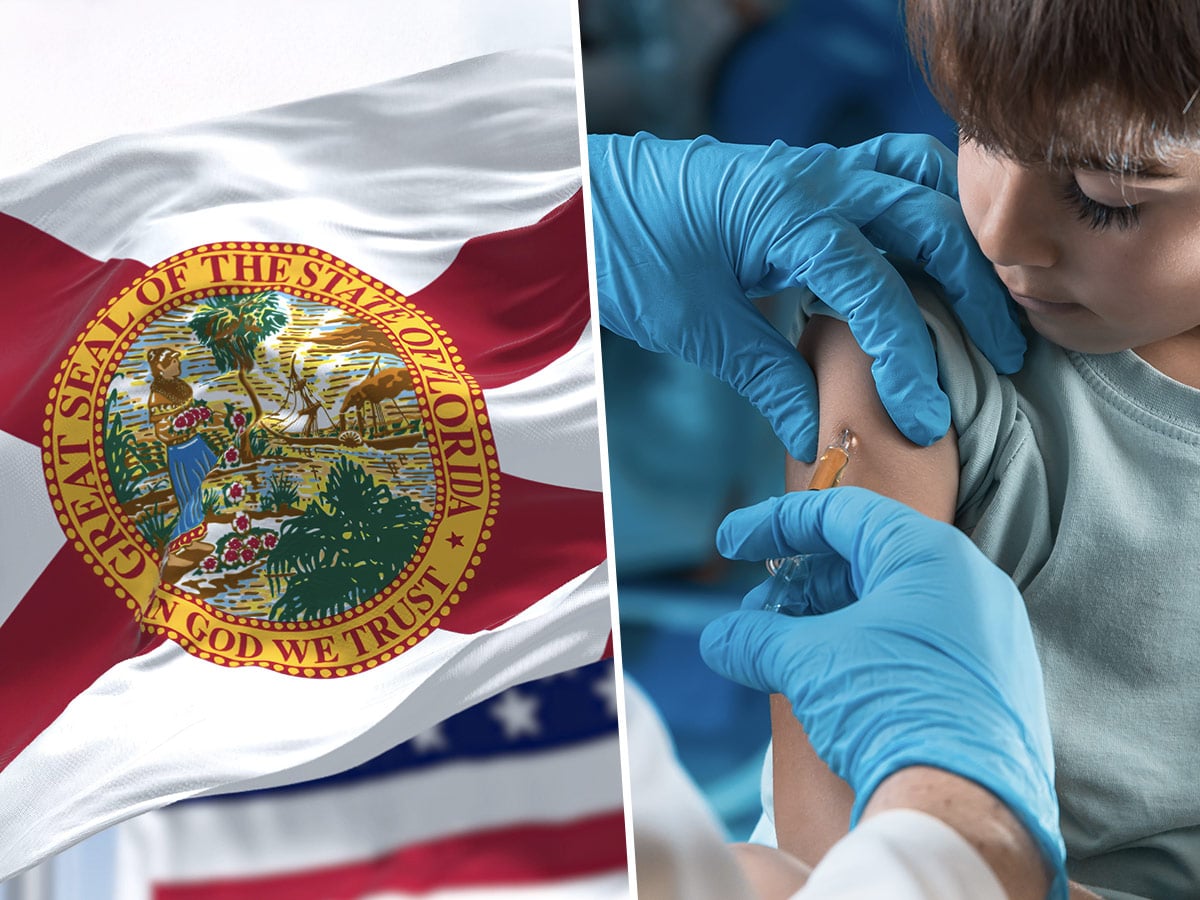
Florida’s surgeon general, Joseph Ladapo, announced on September 3 that Governor Ron DeSantis and the state Department of Health will work to end all vaccine mandates in the state.
“Every last one of them is wrong and drips with disdain and slavery,” said Ladapo. He told his audience that lawmakers “do not have the right to tell you what you put in your body. They don’t have the right to tell you what your kids have to put in your body.”
The announcement comes at a pivotal time in American politics. On September 4, U.S. Secretary of Health and Human Services Robert F. Kennedy Jr. appeared before a Senate Finance Committee hearing. Kennedy called for a reworking of the CDC and cast doubt on data supporting the reliability and effectiveness of vaccines.
Historically, vaccines have virtually eradicated several deadly diseases. In 1980, the World Health Organization declared the global eradication of smallpox. In 1994, the Americas were certified as polio-free due to high rates of immunization. Thanks to vaccinations, measles was eliminated in the US in 2000.
However, there are several arguments bolstering the anti-vaccine movement. First, the movement pursues what DeSantis calls “medical freedom“—the right for people to decide for themselves whether to obtain a vaccine. Second, key figures like Kennedy have suggested that vaccines lead to detrimental effects, like autism.
The debate over vaccines involves disputed statistics on vaccine efficiency, beliefs about an individual’s freedom, parents’ decisions over whether children should be vaccinated, and contentions over how much power the government should have in mandating citizens’ health practices. However, this debate is not a completely secular one.
As the debate around vaccines continues, faith leaders weigh in and add theological weight to the conversation. In fact, Ladapo began his announcement by affirming that “your body is a gift from God. What you put into your body is because of your relationship with your body and your God.”
Several Christian leaders have made theological arguments against vaccination mandates. Perhaps the most extreme opposition has come from leaders who claimed, largely during COVID-19, that vaccines are the mark of the Beast. Albert Ixchu in Florida, for example, was one pastor who made such claims to his congregation.
However, religious opposition to vaccine mandates has been less extreme. For some religious leaders, vaccine mandates place an undue burden on religious liberty. During the COVID-19 pandemic, several lawsuits were filed, with plaintiffs claiming that vaccine mandates infringed on their “sincerely held religious belief” against taking vaccines.
These beliefs were often based on two different arguments. The first resonates with Ladapo’s view that since the body is a gift from God, it should not be polluted with vaccines. The second is a belief that taking a vaccine would make one complicit in abortion, as certain COVID-19 vaccines were developed using fetal cell lines.
But other faith leaders oppose DeSantis and Ladapo’s plans to remove vaccine mandates. The Rev. Dr. William J. Barber II argues that “[v]accines for polio, measles, and other diseases are gifts from God. True religion teaches that we are supposed to love our neighbor. Vaccines are one way we can love our neighbor as we love ourselves.”
Vaccines for polio, measles, & others diseases are gifts from God. True religion teaches that we are supposed to love our neighbor. Vaccines are one way we can love our neighbor as we love ourself.
— Rev. Dr. William J. Barber II (@RevDrBarber) September 3, 2025
A commentator who goes by the username Bonhoeffers Child [sic] online shared a critique of Robert F. Kennedy’s hearing. The commentator argues that opposition to vaccines is “the direct fruit of Prosperity Gospel teaching.” The prosperity gospel holds that the expression of sincere faith in God results in temporal, material prosperity—wealth, health, and happiness.
As Bonhoeffer’s Child concludes their Substack note,
A Faith that bloomed during plagues, and saw believers care for those stricken … now prefers dead people to caring for others via a wee jab of a vaccine needle. The Faith that was built upon the idea of “Take me, instead”… now demands to be put first and to hell with all others.
Literally.
Religious leaders who support vaccinations do not have trouble with questions of medical freedom. Rather, they see vaccine mandates as crucial to the common good and public safety. Leaders who are averse to the mandates, however, fear government overreach and even spiritual pollution.
 Read Previous Post