The New York Times and other outlets say Evangelical leaders are relishing the new atmosphere at the White House and greater access to the president. After his inauguration, President Trump established a new White House Faith Office in the West Wing, where he regularly invites allied pastors to pray with him.
His Evangelical supporters are delighted, seeing this as a fulfillment of his campaign promise to “bring back Christianity”. Hymns are sung in the Roosevelt Room, prayers “in Jesus’ name” are offered in the Cabinet Room, and hands are outstretched in the Oval Office, as pastors declare that Trump is being established as a king by the Almighty.
Many of President Trump’s conservative Christian supporters believe that God himself intervened to save him from an assassination attempt last summer, and there is a general sense among his followers that Trump has a divine mission to eradicate the separation of church and state. Many Evangelicals are rejoicing that they have a second chance to see their values become enshrined in law.
Evangelical leaders are excited about their increased access to the president. Rev. Samuel Rodriguez, president of the National Hispanic Christian Leadership Conference, said: “This is a different reality. It comes with unprecedented access and an unparalleled commitment to affirming our Judeo-Christian value system.”
The Faith Office is led by Trump’s personal pastor, Paula White-Cain, who takes communion there on a daily basis, offering it to anyone who might want to join her. The shelves are stacked with Bibles and a book titled “The Christian History of the Constitution of the United States of America: Christian Self-Government.” A prominent plaque depicts Trump’s raised fist after the assassination attempt in Butler, Pa.
Last Monday, the White House began a weeklong Easter celebration. While Evangelicals see this as a wonderful celebration of their faith, others see it in a more threatening light. Though the White House has previously hosted an iftar and a Passover, concerned detractors, including many Christian groups and individuals, argue that the extent of the Easter celebrations shows how Christianity is being esteemed above other faiths in America.
Beyond his group of allied Evangelical pastors, Trump has clashed with Episcopalian, Mainline Protestant, and Catholic faith leaders and faith-based organizations over his attempts to scrap refugee resettlement, reduce immigration, and end foreign humanitarian aid.
The notion of a White House faith office is not a new one. In the early 2000s, President George W. Bush ran a faith office that distributed federal funds to faith-based groups committed to providing social services.
Trump’s critics argue that while President Bush’s faith office was busy performing the authentic Christian duty of serving the poor, President Trump’s faith office has abandoned charity and exists to promote Christian Nationalism – ending the separation of church and state and enforcing Evangelical ideals on a multicultural nation.
Many faith groups, leaders, and individual Christian believers have spoken out against Trump’s policies. Famously, Episcopal bishop Mariann Edgar Budde pleaded with Trump at the inaugural prayer service at the Washington National Cathedral, asking him to “show mercy upon the people in our country who are scared now”. Last week, a multi-denominational coalition of leading Jewish groups issued a statement saying the president’s campus crackdowns were making Jews less safe.
President Trump is fighting at least five major lawsuits filed by religious groups during the first two months of his term. The lawsuits center on Trump’s halting of the federal refugee program in January and the treatment of refugees in general. These cases highlight a serious, faith-based pushback to Trump’s attempt to reshape the federal government and dramatically harden immigration policy. Religious resistance has been unflinching, including in the courts.
One lawsuit, filed on Feb. 11, has a broad list of plaintiffs representing 27 religious groups, including entire denominations such as the Episcopal Church, Presbyterian Church (USA), the African Methodist Episcopal Zion Church, the Union for Reform Judaism, and the United Synagogue of Conservative Judaism.
The thrust of the case is that the “plaintiffs’ religious scripture, teaching, and traditions offer clear, repeated, and irrefutable unanimity on their obligation to embrace, serve, and defend the refugees, asylum seekers, and immigrants in their midst without regard to documentation or legal status.”
Evangelical leaders are certainly celebrating their access to Trump. They are rejoicing in his Christian Nationalist agenda and the faith-based events taking place in the White House, but it is not the case that Christians in general celebrate with them. The opposition of Christian denominations, leaders, and individual believers is as impassioned and sustained as the support of Evangelicals.
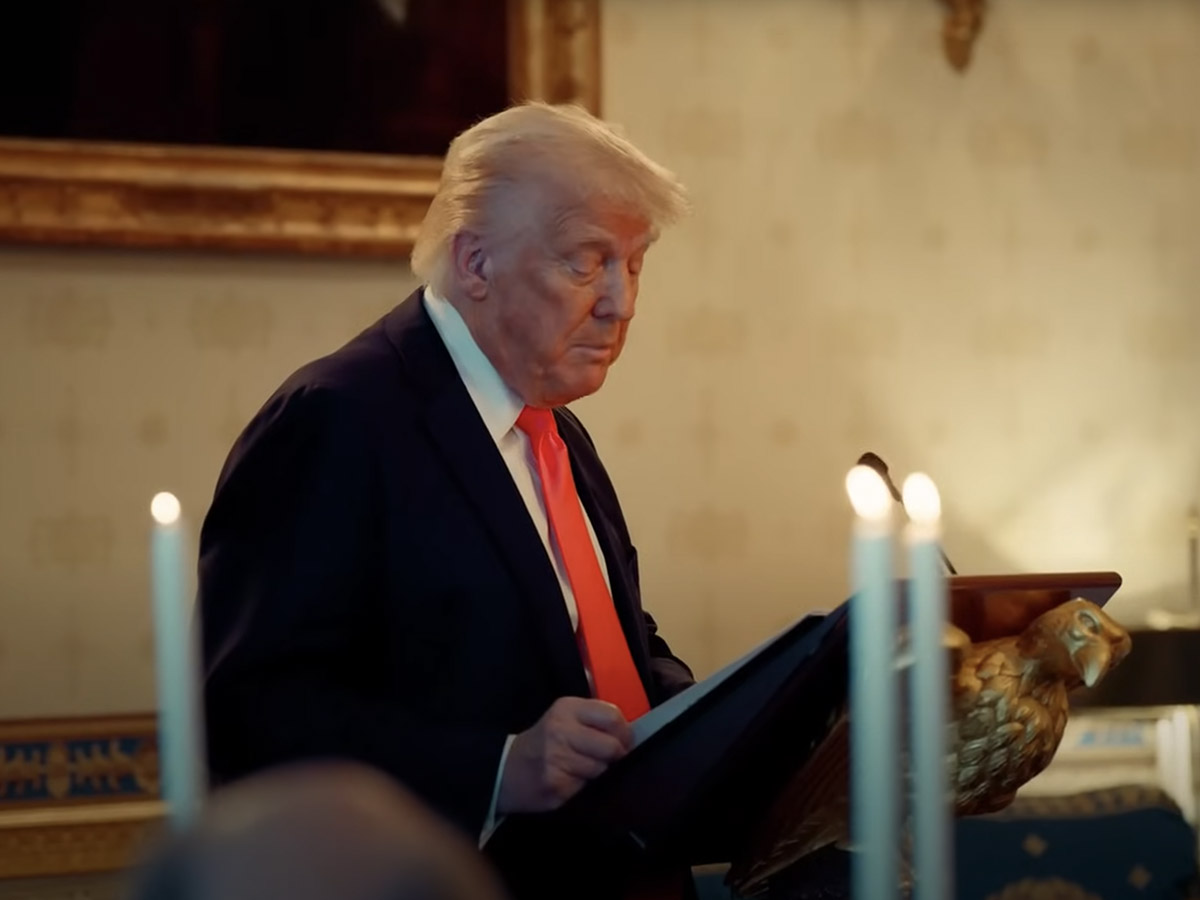
The White House dinner and prayer services during Holy Week were attended by allied pastors, while dissenting voices were absent.
 Read Previous Post