
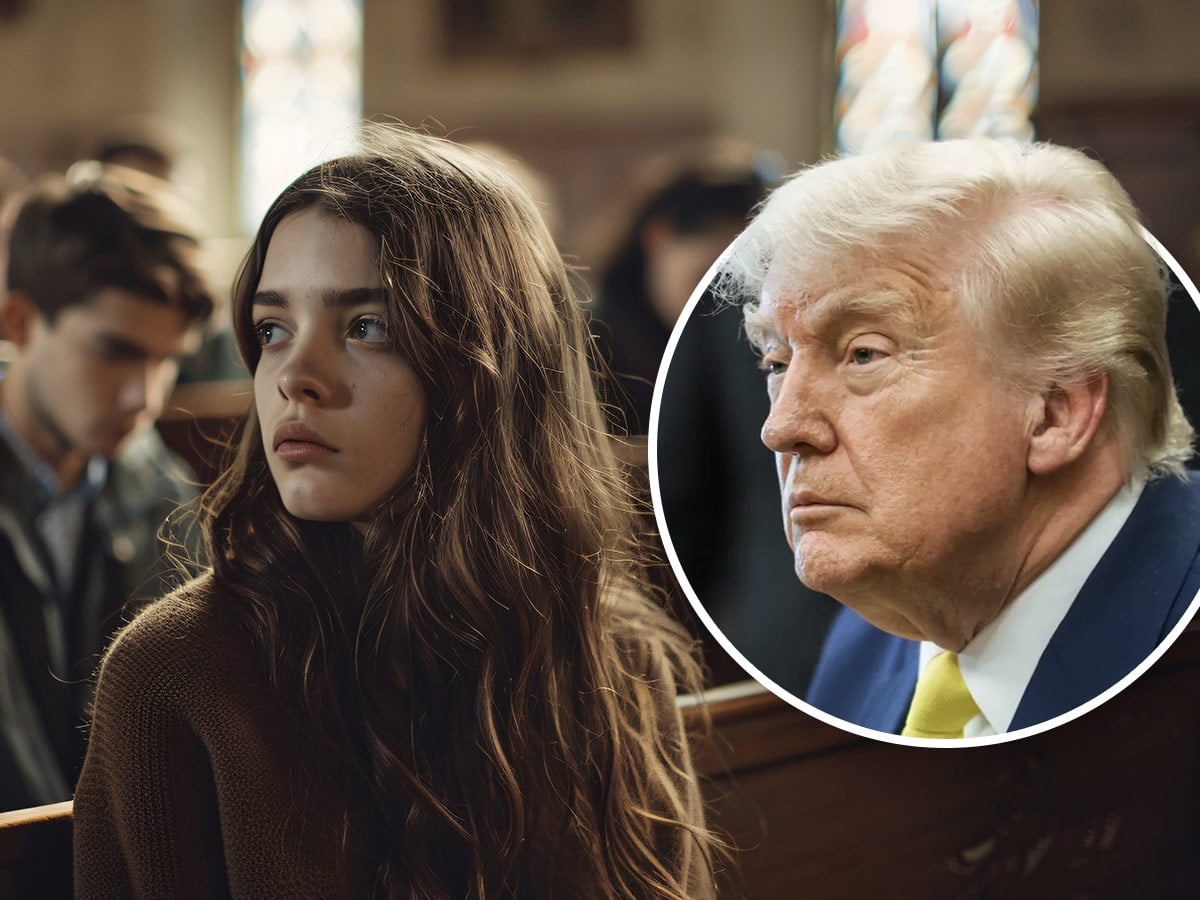
The faith habits of Gen Z continue to paint a complex and confusing picture as a recent study reveals that around half of Gen Z may be staying out of church for political reasons. The Billy Graham Center Research Institute conducted a survey of 2,365 Gen Z adults (ages 18-28) through NORC’s AmeriSpeak panel from August 9 to Sept. 26, 2024. Forty-eight percent of respondents agreed in some manner with the statement “Christians’ support of Trump has made me less likely to go to church.” 19% strongly agreed with the statement. Overall, 52% disagreed with the sentiment, with 21% strongly disagreeing.
President Trump’s support from evangelicals, particularly white evangelicals, has long been a pillar of all three of his presidential campaigns. His second term has been highlighted with promises of recommitments to faith in public and the conservation of the United States’s Judeo-Christian values. It has also earned some concern and discussion amongst conservatives and liberal alike about religion’s role in government and avoiding the slippery slope of so-called “Christian nationalism.”
At the same time, reports have shown a growing spiritual interest amongst Gen Z individuals, yet their church engagement remains low, something the study’s chief investigator, Rick Richardson at Wheaton College, acknowledged. “We realized that spiritual interest among Gen Z young adults is quite high but engagement with churches has decreased over time. There has been an upturn recently mainly among men and often with more traditional denominations like Catholicism,” he told The Christian Post. The research found that political partisanship within a church served as a major demotivator to Gen Z.
Of course, blaming Christian support of Trump for a lack of church attendance could be just a bogeyman, given that Gen Z tends to lean left and a significant share of them identify as having no religion. The data shows that the more an individual leans Democrat, the more strongly support for Trump will keep them from attending church. Seventy-six percent of those who identified as Strong Democrats agreed that Trump support kept them from church while, unsurprisingly, only 25% of those that identified as Republicans said the same. Religious affiliation was also a huge factor, with 72% of those who identified as atheist blaming a perceived association between Trump and Church for why they weren’t attending. The lowest number was amongst Protestants at 30%. However, the study did not explore whether Trump was the only reason certain Gen Z individuals were less likely to attend church. “Young adults are not looking for churches to agree with them on every issue,” said Richardson. “But they are looking for churches and pastors to be deeply honest and direct about where they are at and why.” He urged churches to be more transparent and authentic in order to reach the younger generations. “Knowing the why helps young adults trust and reengage again.”
 Read Previous Post