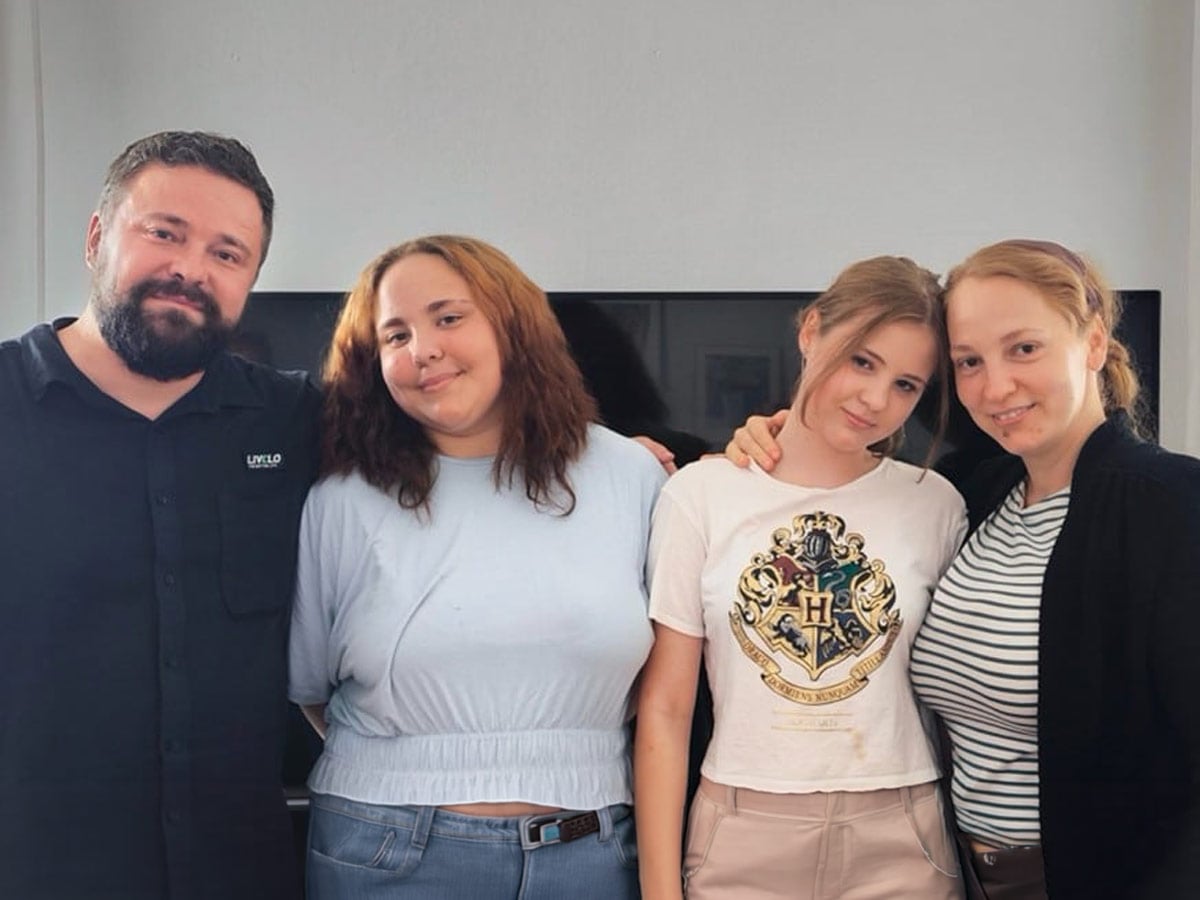
A Romanian Christian family at the center of a years-long international custody battle is asking for help from the United States after Swedish authorities refused to return their two daughters, a case that has sparked growing concern among religious freedom advocates.
Supporters gathered outside the Swedish Embassy in Washington, D.C., on Friday to stand with Daniel and Bianca Samson, who have been separated from their daughters, Sara and Tiana, since December 2022. Demonstrators carried signs, prayed together and called for the girls to be reunited with their parents, while similar rallies were held in Stockholm, London, Copenhagen and Brisbane.
The family’s ordeal began after Sara, who was 11 years old at the time, made what her parents say was a false allegation of abuse following a disagreement over household rules that prohibited her from wearing makeup or owning a smartphone. Although Sara later admitted she had lied, and Swedish prosecutors found no evidence of abuse, authorities removed both girls from the home.
According to Daniel Samson, Swedish social services later pointed to the family’s Christian lifestyle as evidence of what officials described in court as “religious extremism.”
Samson said authorities cited the family’s frequent church attendance, their decision not to have a television in the home, restrictions on makeup and painted fingernails, and the reading of Bible stories as reasons to keep the children in state custody. He said officials even characterized some Bible passages as “violent.”
The case has become a rallying point for supporters of parental rights and religious liberty, particularly within Romanian Christian communities worldwide.
Among those speaking at Friday’s demonstration was Pastor Cristian Ionescu, senior pastor of Elim Romanian Pentecostal Church in Chicago and president of the Romanian Pentecostal Churches’ Union in the United States. Having fled communist Romania decades ago, Ionescu said the case reminds him of the dangers of government interference in family life and religious practice.
“I see a surge of socialist and communist politicians, and this is always associated with a totalitarian society,” Ionescu told Fox News Digital. “In Romania, they didn’t confiscate the children from the families, but they were trying to educate them in a worldview and in a system contrary to Christian values, and parents that did not cooperate were persecuted.”
He added, “I hope I will never see this in America. This is why I left Romania almost 40 years ago. America used to be a cradle of true civilization, Christianity. Now it’s changing and not for the better, but I hope we will still hold the front line.”
The case has also drawn the attention of Romanian lawmakers. In June, Romania’s Senate unanimously approved a declaration calling on Sweden to return the girls to their families immediately. Romanian Sen. Titus Corlatean, who introduced the measure, traveled to Washington to support the Samson family and accused Swedish authorities of ignoring repeated diplomatic appeals.
“There was no reciprocity in this relationship, no positive answer. It was a simulation of cooperation,” Corlatean said.
He argued that because Sara and Tiana are Romanian citizens rather than Swedish citizens, Sweden is violating international law by continuing to hold them against both their families’ wishes and the Romanian government’s requests.
Corlatean also expressed concern about the emotional toll the separation has taken on the children. According to Daniel Samson, both daughters have attempted suicide multiple times while in state custody, and his oldest daughter has since been transferred to an adult psychiatric facility.
“It’s horrible, and it’s a desperate situation,” Corlatean said, adding that the girls repeatedly ask to return to their parents while alleging that social workers have falsely claimed they do not want to go home.
Samson said the situation has only worsened since the family began speaking publicly. He claims they have now been completely barred from seeing their daughters and fears Swedish authorities intend to change the girls’ names, which he believes could be a step toward forced adoption.
After losing 14 court cases in Sweden, including a final appeal earlier this year, the family’s legal options have largely been exhausted. In March, the European Court of Human Rights ruled the case inadmissible, effectively ending their appeals through that court.
Supporters are now hoping international pressure will succeed where the legal system has not.
Corlatean pointed to the 2015 case involving Romanian-Norwegian Christian parents Marius and Ruth Bodnariu, whose five children were temporarily removed by Norwegian authorities before being reunited with their family after widespread international attention and diplomatic involvement.
“There were a number of congressmen, members of the Senate, and also through the State Department that signing letters, [asking] questions and putting pressure on the Norwegian case at the time,” Corlatean said. “It was very helpful. So there is already a precedent of good cooperation.”
Swedish officials have declined to discuss the specifics of the Samson case. The Swedish Embassy said it cannot intervene in individual legal matters and emphasized that Sweden protects the constitutional rights and freedoms of all people regardless of religion.
The embassy also stated that Swedish social services are staffed by professionals with specialized knowledge of children’s welfare and that local social welfare committees are responsible for ensuring children grow up in safe environments.
As the legal battle appears to have reached its end, the Samson family’s supporters say they are placing their hope in diplomatic efforts, public awareness and prayer, believing that international attention could still help bring Sara and Tiana home.
 Read Previous Post