Americans’ deep division over capital punishment made the news again last week when the Justice Department announced it would allow the use of firing squads to execute federal inmates on death row. Political and religious leaders were quick to respond, and social media exploded with comments.
Acting Attorney General Todd Blanche announced the decision on April 24th. Reactions from political and religious leaders, Christians and the general public have ranged from “it’s long overdue” to “it’s regressive and brutal.” Despite the division, Americans’ support of the death penalty has declined over the last half-century.
In making the announcement, Blanche said the federal government is re-authorizing single-drug executions using pentobarbital. President Joe Biden halted federal executions in 2021 after medical and scientific research indicated there is “significant uncertainty” regarding whether the use of pentobarbital causes “unnecessary pain and suffering.”
Blanche was critical of the Biden administration, saying it “inflicted untold damage on victims of crime, and, ultimately, to the rule of law itself.” But the Catholic Church and Protestant denominations, including United Methodists, Episcopalians, Evangelical Lutherans and others, point out that Jesus’ teachings focus on love, forgiveness and mercy. And while these denominations officially oppose executions, many Catholics and most white Protestants support the death penalty.
Opinions about capital punishment and execution methods are split along America’s political and religious divide. Many conservatives who support capital punishment believe that carrying out executions is a legitimate function of government, and they use the Bible to support their beliefs. In Genesis 9:6, for example, God tells Noah and his sons, “If anyone takes a human life, that person’s life will also be taken by human hands.”
The Southern Baptist Convention is one of the denominations that supports capital punishment. Many of its member churches also support political leaders, such as Donald Trump, who actively encourage states to expedite executions. Trump and his supporters make the following arguments:
- Americans want the federal government to take a stronger stand against crime, they argue.
- By moving ahead with executions, the federal government is standing with victims’ families. Court-ordered executions are often delayed for years while cases are appealed. Many supporters of the death penalty believe delaying punishment prevents victims’ families from getting closure.
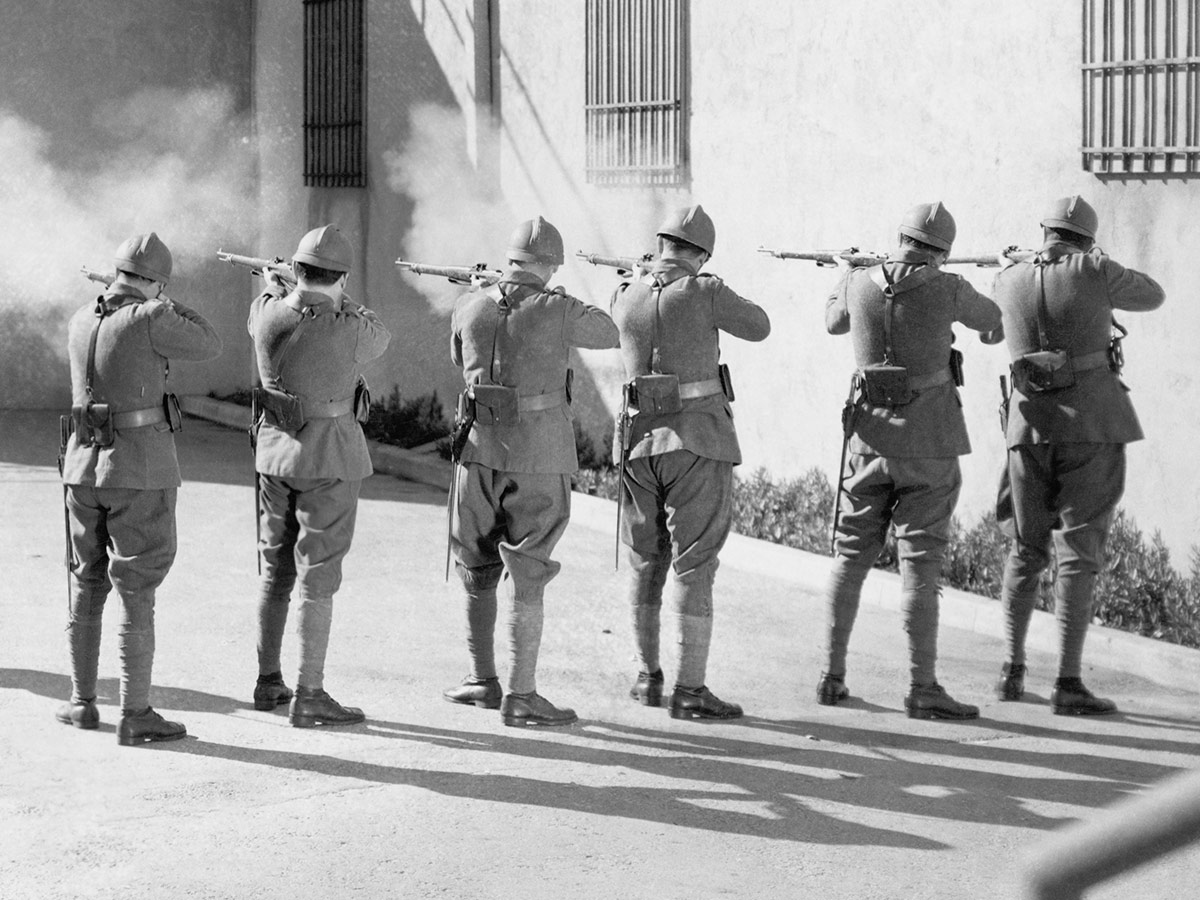
- Some people support the use of firing squads to expedite executions when lethal drugs are not available.
- Others cite economic reasons for using firing squads, saying they are more cost-effective than imprisoning inmates on death row for several decades.
Opposition to the Death Penalty, Federal Firing Squads
A deep division over capital punishment and firing squads exists between the Trump administration and the Vatican. The Catholic Church opposes all forms of capital punishment on moral grounds, saying the death penalty is an attack on human dignity.
Pope Leo quickly condemned the Trump administration’s decision on firing squads. The pope argued that effective detention systems make capital punishment unnecessary. The following are several other arguments that opponents of the death penalty and firing squads use:
- Some say they are inhumane and archaic. U.S. Sen. Tim Kaine (D-VA) said the use of firing squads puts the U.S. in the category of countries with poor human rights records.
- U.S. Rep. Ayanna Pressley of Massachusetts called the Trump administration’s decision to reinstate firing squads a “shameful disregard for human life.”
- Some opponents point out that expediting executions increases the danger of innocent people being put to death. They point to past instances of death row inmates being cleared of crimes.
- People on social media argue that “wealthy men in suits who have never seen (an execution) up close or engaged in violence now seemingly (are) obsessed by it.” Many fear the Trump administration intends to use firing squads against political enemies.
Differing Reactions on Social Media
Many social media users who support firing squads favor an eye-for-an-eye justice, swift punishment and cost-efficient executions. But some people posting on social media say firing squads are barbaric, immoral and move the U.S. closer to dictatorship.
Donald Trump recently accused six Democratic U.S. senators and representatives of sedition. He called for the death penalty because they urged members of the military to refuse illegal orders. He also reposted a supporter’s demand that they be hanged. All six lawmakers have backgrounds in intelligence or the military.
Trump also insisted on death for journalists covering the war in Iran, saying they are guilty of treason for reporting what he called “fake news.”
But numerous people condemned Trump on social media. One person on Facebook wondered about the demands for death, saying, “Does that include government officials committing treason? Asking for a nation.” Another wrote, “This lunatic administration will start televising executions as pay-per-view soon.” Still another person commented. “Let me guess…. No trial, just executive order.” And numerous people on social media insisted, “Let Trump try it out,” “Trump first,” “HIM FIRST,” and similar comments.
One writer on Facebook posted these words: “I’ve changed my position on the death penalty and now disagree with it. How can we show the forgiveness that’s outlined in Matthew 6:14-15 or Ephesians 4:32? Another said, “I’m sure we’ve all heard of terrible criminals, including murderers, who found Christ, and their testimony bore witness to the goodness of God… Who are we to take away that opportunity?”
The federal government has not previously used firing squads in executions for federal crimes, according to the Death Penalty Information Center. Twenty-three states and Washington, D.C., have abolished the death penalty, and 27 states allow executions, although several governors have halted them for now.
Five states that permit executions — Idaho, South Carolina, Mississippi, Oklahoma and Utah –– have approved firing squads, typically when drugs for lethal injections are unavailable. The federal death penalty applies to all 50 states. It is rarely used, although a record 13 federal executions were carried out during Trump’s first administration.
 Read Previous Post