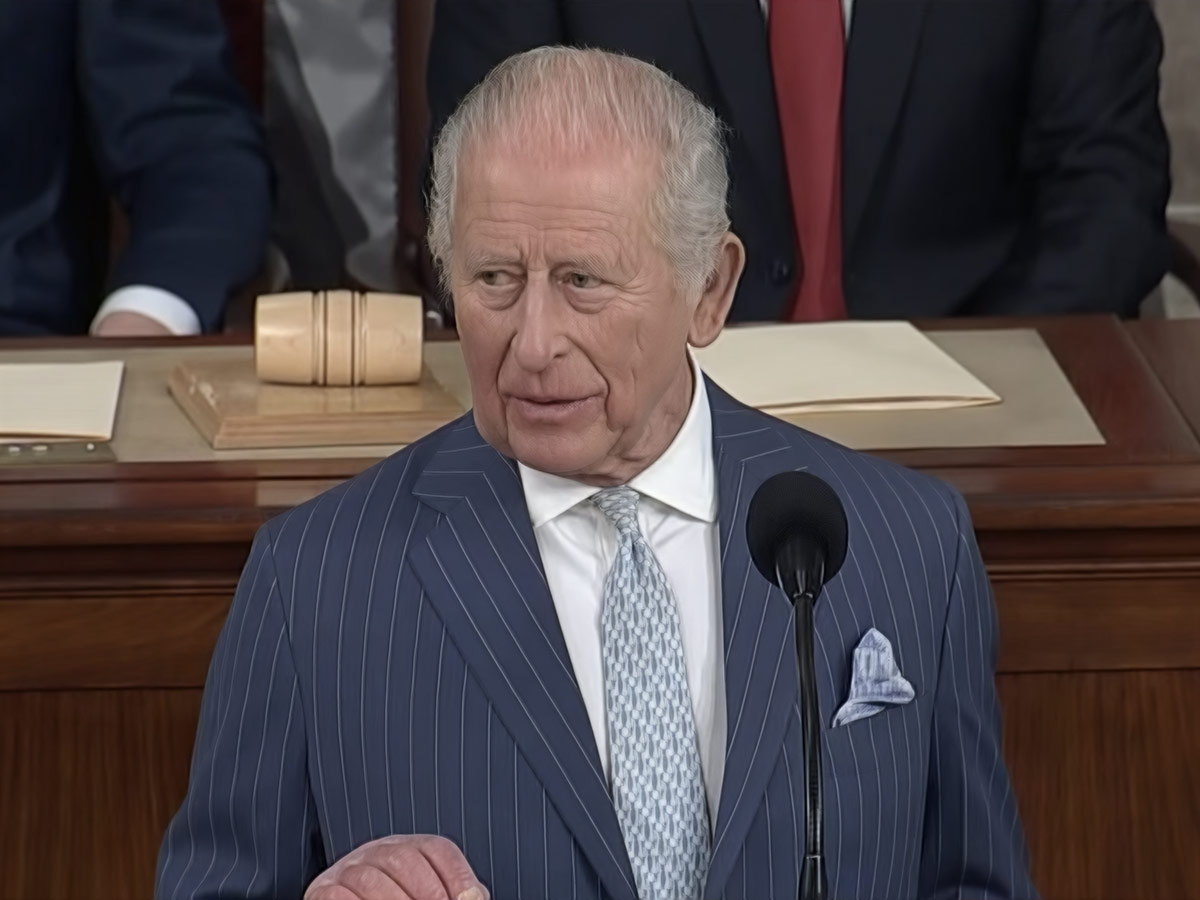
King Charles stood before a joint meeting of the United States Congress and said something both beautiful and true.
“For many here – and for myself – the Christian faith is a firm anchor and daily inspiration,” he said, adding that we are still in the season of Easter, “the season that most strengthens my hope.”
His words were met with warm applause, and there were roughly a dozen standing ovations. In an age when many world leaders avoid discussions about faith, King Charles spoke plainly about Christianity as something that steadies a nation and strengthens an individual.
But it’s easy to praise Christianity in a country like America… and especially in Congress where references to faith still demand respect. It’s much harder to do so in Charles’ own country, where freedom appears to be on trial as a culture grows hostile to the Christian faith.
That is precisely why the monarch’s words matter, and why they raise a harder question.
King Charles is the Supreme Governor of the Church of England. He carries the historic title Defender of the Faith If Christianity is truly Britain’s anchor, why is it not being defended more forcefully by the man tasked with protecting it?
The King broke no rules when he didn’t deliver an Easter message this year. It’s not a fixed annual tradition like the Christmas broadcast. He did, however, find words for Ramadan and Eid.
Good leadership isn’t just about custom, but also clarity. If Easter does strengthens hope and if Christianity is a firm anchor, then silence at this time speaks volumes to a British where faith is under attack.
The silence does not prove Charles disbelieves what he said. But it does make his words ring hollow. We also see that when Christians live their faith in public, tolerance becomes at best selective.
It seems that in Britain, Christianity is welcome when ceremonial. It’s safe in coronations, cathedrals, hymns, stained glass, royal language, and national memory. Recent events prove that living as a Christian In Britain isn’t quite so easy.
Pastor Steve Maile, a 66-year-old pastor and grandfather, was recently arrested while preaching in Watford, just north of London. Police cited suspicion of a religiously aggravated public order offence. Christian outlets reported that he had been preaching, singing hymns, and criticizing Islam before police intervened. Maile denies any wrongdoing.
The case of Pastor Dia Moodley in Bristol raises the same concern. He faced police arrest after open-air preaching that addressed Islam and transgender ideology.
If Christianity can only speak when it is vague, unchallenging, and unlikely to offend, it seems Britain doesn’t see Christianity as an anchor but as background music.
Perhaps the most shocking British faith story in recent months is that of Isabel Vaughan-Spruce in Birmingham. She was arrested after standing and praying silently near an abortion facility. No sign. No words. No obstacles.
West Midlands Police later paid her £13,000 after conceding claims connected to wrongful arrests, false imprisonment, assault and battery tied to a search, human-rights breaches, and restrictive bail conditions.
That should alarm everyone, not only Christians.
A government that treats silent prayer as suspicious has moved beyond keeping public order. It has stepped toward policing conscience. Silent prayer is not harassment. A person standing still, without a sign, shouting, blocking, or approaching anyone, should not be treated as a threat.
These examples, combined with the King’s silence, expose the contradiction. Britain is not rejecting Christianity all at once. Britain still honours God in its ceremonies and symbols, but it increasingly resists Christianity when it is lived openly and expressed plainly in public life.
Christians must be free to preach, pray, dissent, and speak moral truth in public. Not just in cathedrals. Not only during coronations or in speeches before Congress. And certainly not only when nobody is offended.
The King’s words in Congress were welcome. Christians should applaud them. But an anchor does not help its country from across an ocean.
If King Charles is to carry the title Defender of the Faith with integrity, he must defend it at home, not just while on tour in America.
Business leader Peter Demos is host of the ‘Uncommon Sense in Current Times’ podcast and author of ‘Bold Not Belligerent’. Once an outspoken critic of Christianity, he now owns a successful restaurant chain where faith actively shapes his leadership, culture and decision-making. Drawing on his own transformation, he equips Christians to engage a broken culture with truth, conviction and grace. Learn more at PeterDemos.org.
 Read Previous Post