
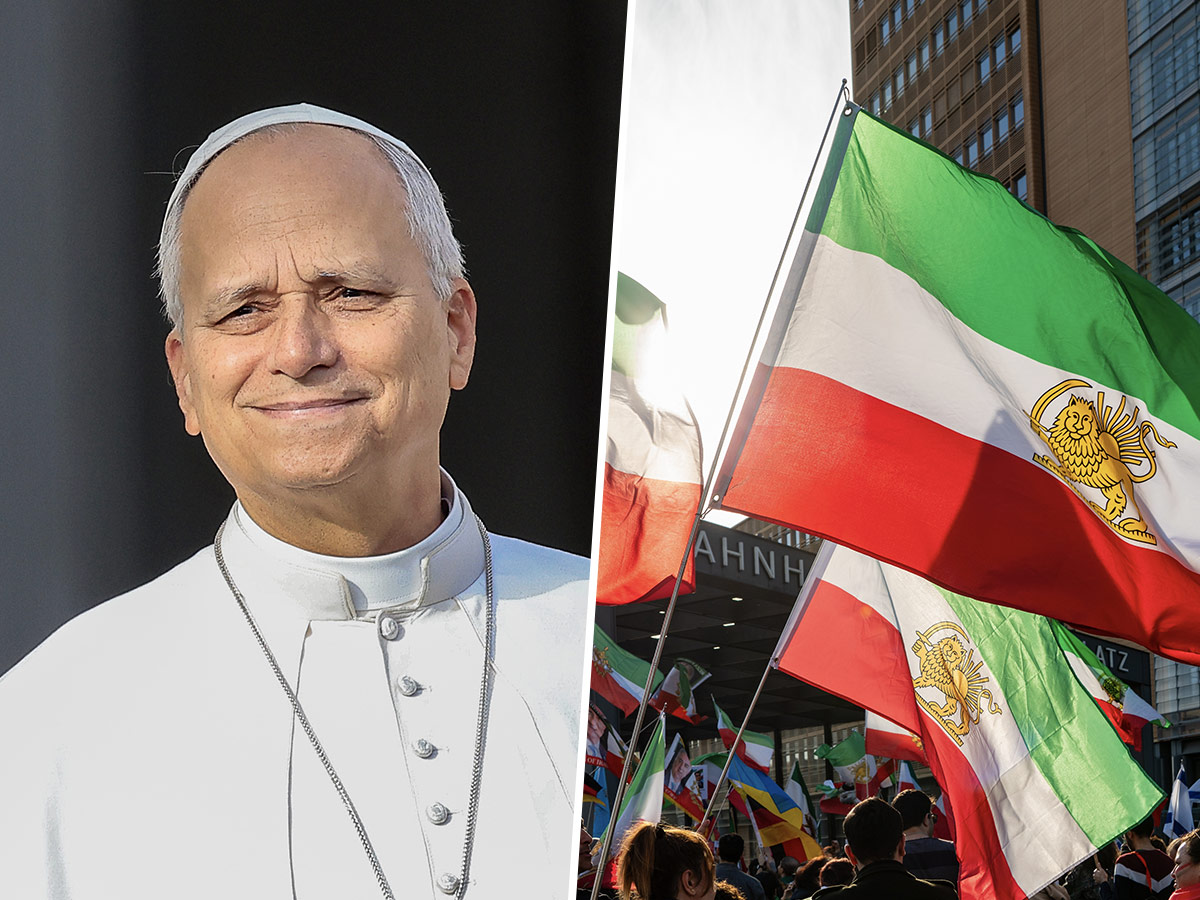
As the world reels from the joint U.S.-Israeli strikes on Iran, Pope Leo XIV has condemned the escalation, warning global leaders to halt a “spiral of violence” before it plunges into an “irreparable abyss.”
While the February 28 attacks sparked immediate and predictable political fracturing—with Washington split along partisan lines and Middle Eastern powers bracing for retaliation—the Pontiff’s Sunday address from the Vatican centered on the grave moral cost of a world where “war is back in vogue.”
After the battles of last weekend, the pope challenged the nations involved in the March 1 speech, saying: “I address to the parties involved a heartfelt appeal to assume the moral responsibility of halting the spiral of violence before it becomes an irreparable abyss.”
In January, Pope Leo said in his New Year’s address that peace is no longer sought as a gift, but that nations seek to compel peace through domination. Of course, he was not speaking only of the United States, but the Trump Administration’s recent actions in the Caribbean, Venezuela, and now Iran certainly illustrate Pope Leo’s point.
The pope reiterated the theme of his New Year’s address Sunday by saying: “Stability and peace are not built with mutual threats nor with weapons that sow destruction, pain and death, but only through a dialogue that is reasonable, authentic and responsible.”
Any student of history knows that wars have always been a part of human society. Pragmatists might argue that because wars are a nearly constant part of human existence, it is futile to try to stop them. Cynics may wonder what good it will do for a religious leader to call nations to peace. After all, global conflict simply reflects the growing conflict on a micro-scale; people argue with each other, and conflict within families seems to grow more prevalent and serious with each passing year.
What good can a message from the pope – or from any other religious leader – do?
As the spiritual leader of over 1.4 billion Roman Catholics worldwide, Pope Leo has an obligation to guide his flock back to the teachings of Scripture and the church. Of course, approximately 20 percent of the United States population is Catholic – and Pope Leo is an American by birth. So his message to the United States and its leaders is also a call for American Catholics to recognize and follow Christ’s teachings. In fairness, his remarks were not only addressed to the United States government and American Catholics. He acknowledged the current battles between Pakistan and Afghanistan; he has previously commented on the ongoing war that Russia started against Ukraine four years ago.
So why comment now? What might Pope Leo hope to accomplish?
First, he calls Christians around the world to pray. He stated, “Let us pray together that harmony may prevail in all the world’s conflicts.” He also reminded the world that only peace, which he said is a gift from God, can heal the conflicts and wounds that ravage our world.
As is often the case, prayers for peace open the door for God to challenge His people to work for peace. Humans cannot create peace; spiritual peace results from right relationships with God and each other. But as each Christian prays for peace, God speaks and begins to show us how to be peacemakers.
As Jesus taught, “Blessed are the peacemakers, for they will be called children of God” (Matthew 5:9). But mankind cannot “make” peace through force.
In Jesus’ day, the Roman Empire hailed its Pax Romana – “Roman Peace.” But that “peace” was only accomplished through the military might and cruelty of the Empire. Once the power faded, the “peace” was gone – and the reality is that the Pax Romana was simply an enforced truce. When the Jewish people revolted, for example, the Empire quickly and forcefully crushed it. What resulted was not anything like a real peace, and modern governments cannot create peace that way either.
Pope Leo’s comments harken back to the rest of the Beatitudes (Matthew 5:3-10). The meek will inherit the earth, not the powerful. The poor in spirit will make up the kingdom of heaven, not the proud and arrogant. The merciful will be shown mercy. The pure in heart – those who desire what God wants above all else – will see God. People cannot achieve these things in their own strength; they all come through the transforming, empowering work of the Holy Spirit. When Pope Leo calls the world to pray for peace and work for peace, he simply points us back to what Jesus taught.
In contrast to the power of the Roman Empire, Jesus and His followers were weak and helpless. Jesus Himself was nailed to a Roman cross as a demonstration of the Empire’s power. But as Jesus Himself demonstrated, the power of God is far greater than any human government! The Romans crucified Him; Pilate ordered the tomb to be sealed and guarded. How did that work out?
Finally, Pope Leo was likely not speaking only to his congregation; he was also reminding other Christian leaders of Christ’s example. While many religious leaders seem more concerned with offering political justifications for attack, Pope Leo models a response that prioritizes God’s kingdom over the rulers and leaders of nations. Arguments that support violence and attacks seem to support the idea that some people and nations are more worthy of protection than others. Christ came not to be served, but to serve, and to give His life as a ransom for many (Mark 10:45); those who follow Him must be willing to deny themselves, take up their cross, and follow Him (Matthew 16:24).
To make these arguments is not to lend legitimacy to the Iranian regime nor its actions over the past many years. But Christians should be wary about adopting the logic of the world and praising the use of force to resolve conflicts. Christians should also be careful not to trust leaders who have proven themselves untrustworthy blindly. Jesus called His followers to be as innocent as doves and as shrewd as snakes (Matthew 10:16).
In this context, being shrewd does not mean claiming spiritual authority for using worldly methods. Jesus did not call us to use force and warfare to achieve peace; instead, He promised us His peace. “I have told you these things, so that in me you may have peace. In this world you will have trouble. But take heart! I have overcome the world” (John 16:33).
As followers of Jesus, Christians should not be so willing to accept the inevitability of war, and they should be very hesitant to promote war as the answer to anything. Instead, we should seek peace and work for peace – even when it means “turning the other cheek” (Matthew 5:39).
Instead of echoing political talking points – either in support or against these attacks – Christians should lead the way in calling for peace.
 Read Previous Post