
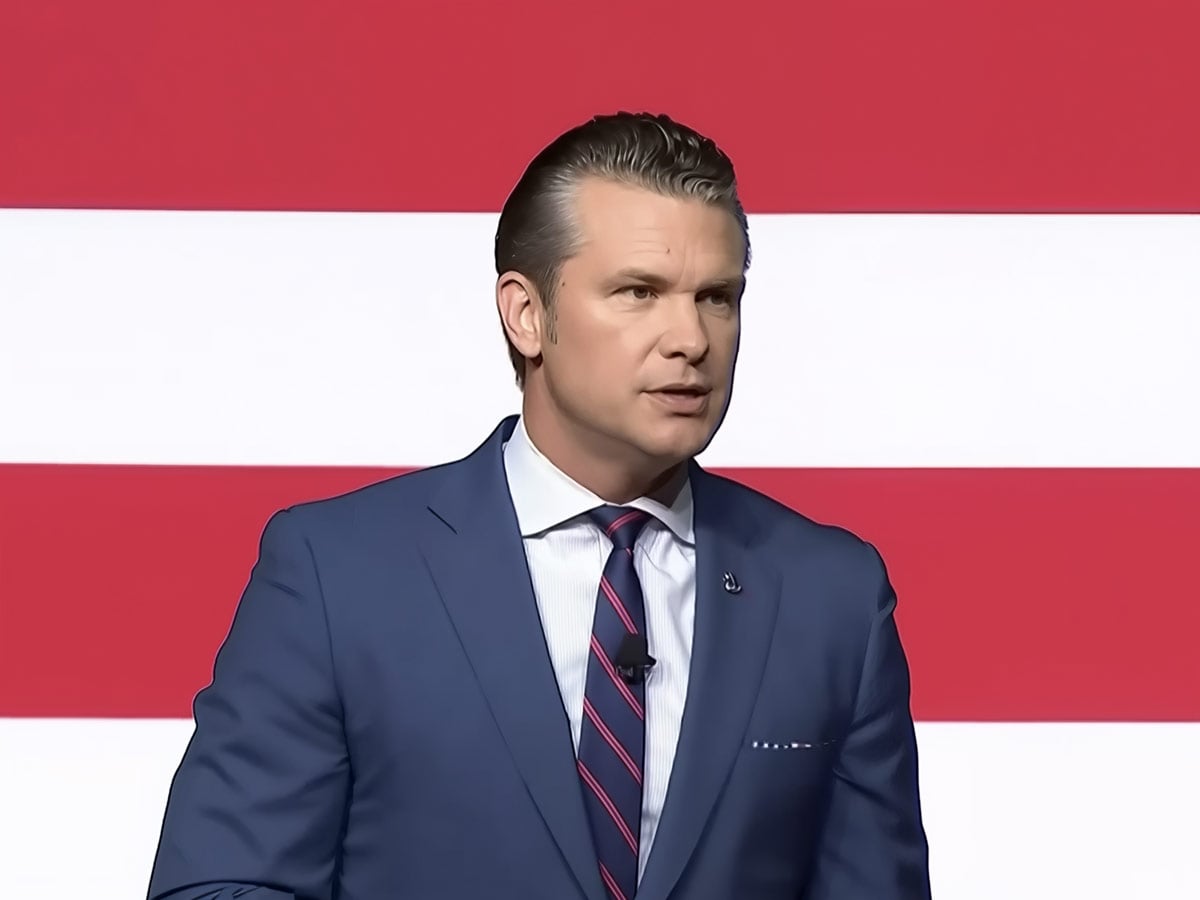
On September 29, Secretary of War Pete Hegseth summoned all senior military officers to Virginia. Speculation swirled ahead of the meeting: What was this about? What could possibly warrant such an unprecedented gathering?
At the meeting, both Hegseth and President Trump addressed the officers. But it wasn’t the President who called the meeting—it was Secretary Hegseth. And what did he say?
He focused on a few key themes: eliminating “woke” policies from the military, enforcing physical standards for service members, and establishing “male standards” for combat troops. He spoke of cultivating a “warrior ethos” among American forces.
But what does all of this mean?
First, Hegseth indicated that it means to have and enforce physical standards for military personnel. The line “no fat generals” probably caught attention, but this should really not be an issue. Who wouldn’t expect that soldiers and sailors and other servicemen and women be physically able to perform their duties? That doesn’t mean that the physical standards for senior officers should be the same as those for enlisted personnel. But one aspect of leadership is being willing to do whatever is expected of those being led. If physical discipline and fitness is important for the troops, it should be expected from all those in the military.
Another aspect of Secretary Hegseth’s remarks revolved around “male standards” for combat troops. Apparently, he believes that the physical capabilities required for female combat troops have been lowered compared to those expected of male troops.
He said, “If women can make it, excellent. If not, it is what it is. If that means no women qualify for some combat jobs, so be it…That is not the intent, but it could be the result.”
However, not everyone agrees that there has been the double standard that Hegseth believes exists. For example, Amy McGrath, a former Marine fighter pilot and 2020 Democratic Senate candidate from Kentucky, asserts that there has never been such a double standard.
“He claimed the military needs to ‘return to the male standard’ in combat jobs (of 1990!), but here’s the truth: there has never been a separate male and female standard,” she wrote. “When women entered combat roles, one standard was set, and we’ve been meeting it ever since.”
Clearly, not everyone sees this issue the same way.
The other main talking point of Hegseth’s remarks was the elimination of “woke” policies and procedures. One particular area he addressed was the Pentagon’s procedures for internal complaints and investigations.
“No more frivolous complaints, no more anonymous complaints, no more repeat complaints, no more [ruined] reputations, no more endless waiting, no more legal limbo, no more sidetracking careers or walking on eggshells,” he said.
Hegseth emphasized that sexual harassment and racial discrimination are wrong and illegal, and that such actions would be “ruthlessly” addressed. But he indicated that telling someone to shave, get a haircut, fix their uniform, show up on time or work hard would not be treated as discrimination or harassment. Allowing military leaders to establish and enforce such standards increases discipline, and presumably discipline increases both preparedness and effectiveness.
Understandably, much of the response to Hegseth’s comments – and to calling the meeting in the first place – depended on one’s location on the political spectrum. Democrats predictably attacked the calling of the meeting as well as its purpose; Republicans largely supported the administration. A couple of responses, though, are worth noting.
Nebraska congressman Don Bacon, a Republican and Air Force veteran, agreed with Hegseth’s focus on winning and deterring wars. However, he also questioned the need for an in-person gathering, saying that “a lot of this could have been done virtually.”
Mark Cancian, senior adviser with the Center for Strategic and International Studies Defense and Security Department, acknowledged that the concerns that he and others had prior to the meeting were allayed by Hegseth’s remarks.
“This was not that demand for loyalty that I and many other people had worried about at one point,” he said.
That assessment, however, seems at odds with some of Hegseth’s actual comments.
At one point, he said, “The sooner we have the right people, the sooner we can advance the right policies…but if the words I’m speaking today are making your heart sink, then you should do the honorable thing and resign.”
But how does all of this relate to Scripture? What does the Bible say about soldiers and wars? It’s important to recognize the difference in approach between the Old Testament and New Testament in regard to this subject.
In the Old Testament, “total war” was the rule. God often directed the Israelites to completely wipe out their enemies, and their failure to do so was the source of a number of problems they faced. However, the New Testament clearly takes a different direction – in large part because Jesus came to establish God’s kingdom in a new and different way. Jesus told Pontius Pilate that His kingdom is not of this world; He noted that if it were, His followers “would fight to prevent My arrest by the Jewish leaders” (John 18:36).
But the inquiry does not stop there. Soldiers were not excluded from God’s Kingdom – but they were expected to make sure their actions comported with their Christian faith. In Luke 3, some soldiers came to John the Baptist to ask them how they should repent and take part in the coming kingdom of the Messiah.
He said, “Don’t extort money and don’t accuse people falsely – be content with your pay” (Luke 3:14). In Acts 10, Peter famously proclaimed the gospel to Cornelius – a Roman centurion. He did not tell Cornelius to abandon his position; he invited Cornelius and his whole house to be baptized.
In the same way, most Christians and churches today recognize that Christian faith is compatible with military service. But Christians in the military have a responsibility to comply with God’s higher law as well as the orders of their superiors. For some people, God’s law may prove to be in irreconcilable conflict with military orders; in such a case, God’s law should prevail.
In Colossians, Paul writes: “Whatever you do, work at it with all your heart, as working for the Lord, not for human masters, since you know that you will receive an inheritance from the Lord as a reward. It is the Lord Christ you are serving” (Colossians 3:23-24). In that regard, Christians in the military should strive to be courageous, and (to borrow a familiar phrase) “be all you can be.”
But that calling should always be subject to the higher calling as a follower of Jesus. As long as the “warrior ethos” is consistent with Christian faith, there’s no problem. But if the “warrior ethos” demands attitudes or actions that are inconsistent with Christian faith, Christ’s way must come first.
 Read Previous Post