At a high-profile gathering in Washington, D.C., President Donald Trump underscored his administration’s ongoing commitment to defending religious freedom, calling faith the foundation of a strong nation.
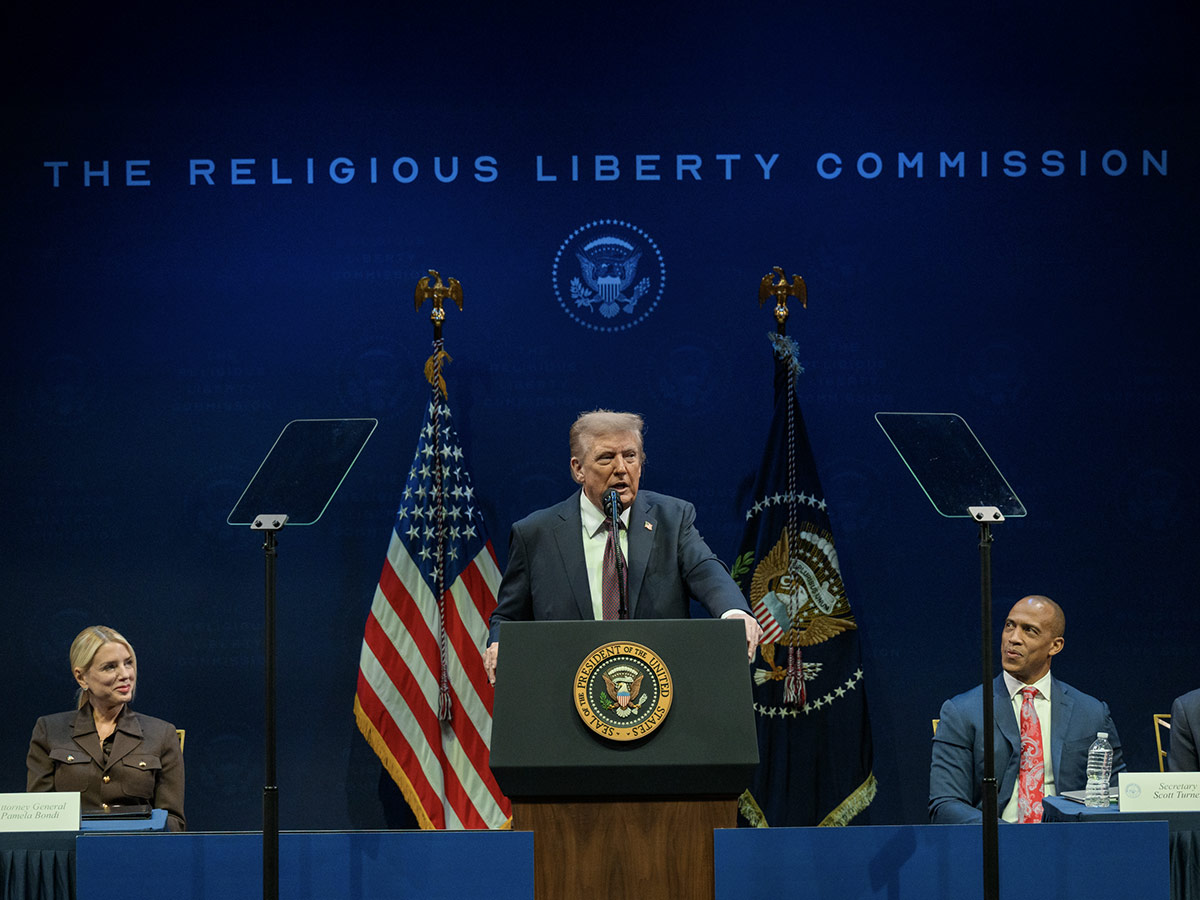
Speaking to more than 500 people at the Museum of the Bible on Monday, Trump addressed the second meeting of the White House Religious Liberty Commission. The president framed his message around the power of faith in public life and the role of Christianity in America’s history.
“When faith gets weaker, our country seems to get weaker,” Trump said. “When faith gets stronger, as it is right now … good things happen for our country. It’s amazing the way it seems to work that way. Under the Trump administration, we’re defending our rights and restoring our identity as a nation under God.”
He continued, “We are one nation under God, and we always will be. To have a great nation, you have to have religion.”
The Religious Liberty Commission was created by executive order in May and is chaired by Texas Lt. Gov. Dan Patrick. Its members include Franklin Graham, Paula White, former HUD Secretary Ben Carson, author Eric Metaxas, and Catholic Cardinals Timothy Dolan and Robert Barron.
“I believe that so strongly,” Trump said of America’s religious foundation. “There has to be something after we go through all of this, and that something is God. We go through all of this for a reason. It’s not easy, believe me.”
He emphasized that the need for such a commission is “more clear than ever” following comments from Sen. Tim Kaine (D-Va.), who recently said he found the idea of rights coming from God rather than government “very, very troubling.” Trump and several commission members argued that Kaine’s position contradicts America’s founding principles.
The president also announced forthcoming guidance from the U.S. Department of Education to safeguard students’ rights to pray in public schools.
“I am pleased to announce this morning that the Department of Education will soon issue new guidance protecting the right to prayer in our public schools,” Trump said. He cited cases like Hannah Allen, a Texas student reportedly disciplined for organizing a prayer group, as examples of why such protections are necessary.
Trump also invited 12-year-old Shea Encinas to share his testimony. Encinas explained to a kindergartner that he was required to read a book about gender ideology while in fifth grade. “It hurt a lot, but I kept trusting God,” Encinas said. “I’ve been a Christian my whole life, and Jesus means everything to me.” His remarks drew strong applause from the audience.
Trump contrasted his administration’s stance with what he described as hostility toward believers during the Biden administration. “I ended the weaponization of law enforcement against religious believers and pardoned the pro-life activists thrown in jail,” he said, earning a standing ovation.
Attorney General Pam Bondi, who introduced Trump, added that she had stopped federal agencies from “spying on Catholics.”
The gathering also included a time of prayer led by HUD Secretary Scott Turner, who rededicated the nation to God ahead of its 250th anniversary. Turner invited believers across the nation to participate in America Prays, an initiative calling Christians to intercede for healing, unity, and renewal in the United States.
“Next year, we will celebrate 250 years since that Declaration was signed,” Trump said. “As part of the grand commemoration … we’ve invited America’s great faith communities to pray for our nation, for our people, and for peace in the world.”
Turner added, “The power of prayer is real, and wonders can be done in the name of the Lord. Join me in praying for this nation — for healing, for revitalization, for opportunity, and that we remain the greatest country the world has ever known.”
The event served as both a policy announcement and a spiritual rallying point, reminding attendees of America’s historic identity as a nation “under God.” For Trump and the commission members, the message was clear: America’s strength lies not only in politics or policy but in the prayers and faith of its people.
 Read Previous Post