In the wake of Charlie Kirk’s assassination at Utah Valley University, Black Christian leaders across the country are challenging the rush to sanctify the conservative commentator’s legacy. While many mourn Kirk as a martyr, pastors like Howard-John Wesley and Jamal Bryant are calling attention to his history of racist rhetoric and divisive politics—urging churches not to confuse public grief with theological endorsement.
Their sermons, now widely circulated, reflect a broader reckoning within the Black Church about the cost of silence, the misuse of faith for political ends, and the enduring struggle for racial justice in American Christianity.
On September 10, 2025, Turning Point CEO and conservative political commentator Charlie Kirk was assassinated at an event at Utah Valley University. Kirk was pronounced dead at the nearby Timpanogos Regional Hospital.
The main suspect, 22-year-old Tyler Robinson, was apprehended after a family friend and his parents brought him to law enforcement the day after the shooting occurred. His roommate has been assisting investigators by showing text messages exchanged with Robinson about Robinson’s assassination plans.
Kirk’s death evoked numerous responses from Americans. Some celebrated the political assassination, to the horror of Kirk’s supporters and even disdain from many of his opponents. Others hailed Kirk as a Christian martyr. Some even saw Kirk’s death as a call to war against the Left.
Yet the majority of American political leaders spoke out condemning the act of violence that ended Kirk’s life. Prominent Democrats such as Sen. Bernie Sanders, Sen. Cory Booker, who delivered the longest recorded Senate speech in protest against President Donald Trump from March 31 to April 1, 2025, and Rep. Ilhan Omar have spoken out in response to the Utah Valley shooting.
There have been other responses, however, which have sought to balance the tragedy of the Kirk assassination with the reality of Kirk’s legacy.
While some Americans, such as Ezra Klein, lauded Kirk for “practicing politics the right way ” and others praised Kirk for engaging in “good faith debate,” numerous others took a more critical stance. This was especially prominent among several Black Christian leaders.
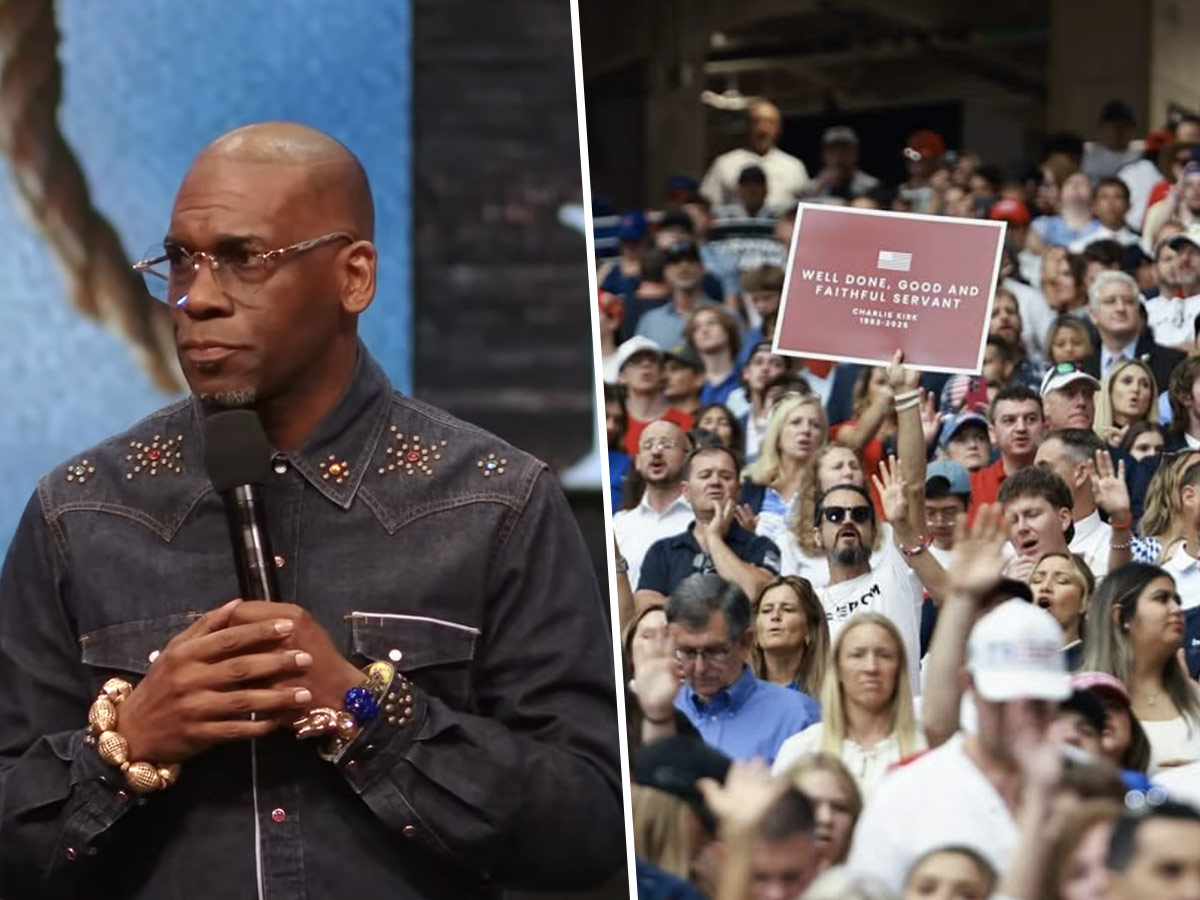
Two Black pastors in particular went viral for how they addressed Kirk’s death in their sermons. “Charlie Kirk did not deserve to be assassinated,” said Rev. Howard-John Wesley on Sunday morning, September 14. “But I’m overwhelmed . . . calling this nation to honor and venerate a man who was an unapologetic racist and spent all of his life sowing seeds of division and hate into this land.”
Rev. Dr. Howard-John Wesley: “Charlie Kirk did not deserve to be assassinated. But I’m overwhelmed seeing the flags of the United States of America at half-staff calling this nation to honor and venerate a man who was an unapologetic racist and spent all of his life sowing seeds… pic.twitter.com/rIh2cCjMk2
— Marco Foster (@MarcoFoster_) September 15, 2025
Pastor Jamal Bryant called out “having moments of silence in black churches all over the country for a man that was racist and a white supremacist.” Criticizing those comparing Kirk to Dr. Martin Luther King, Jr., Bryant said that “the only thing that Charlie Chris and Martin Luther King got in common is that both of them were killed by a white man.”
Dr. Freddy Haynes, III, Rev. Dr. Marcus Cosby, Rev. Dr. Gina M. Stewart, and Rev. William Barber are just a few of the many examples of Black pastors calling for a critical understanding of Kirk’s legacy.
These pastors condemn what they understand as racist sentiments in Kirk’s views on crime and DEI. On his show in May 2023, Kirk said that it is “happening all the time in urban America, prowling Blacks go around for fun to go target white people, that’s a fact.”
And on multiple occasions, Kirk questioned the qualifications and abilities of Black people working in customer service or as pilots. He also claimed that Joy Reid, Michelle Obama, Sheila Jackson Lee, and Ketanji Brown Jackson “were affirmative action picks” who “had to go steal a white person’s slot to go be taken somewhat seriously.”
They also point out a cruel irony in that Kirk died from gun violence, after having said that Americans must accept some deaths from gun violence to preserve their Second Amendment rights.
As Cosby said, “Gotta be careful of the positions you take. Because they might just come back and take you.”
Dr. Marcus Cosby from @WheelerAvenueBC has his thoughts about the issue in this country. Be careful of the public position we take because the #Bible says, if you live by the sword, you will die by the sword and you reap what you sow!!!#fyp #becareful pic.twitter.com/Cd3MOjh08S
— BMB Empower Network (@BmbEmpower) September 15, 2025
These reactions spurred on negative reactions from Kirk’s supporters, who insist that Kirk’s ideas on DEI or crime are taken out of context and are not racist. But as Black Christian historian Jemar Tisby lamented, “Seeing so many white Christians defend Charlie Kirk while ignoring, minimizing, and dismissing the concerns of so many Black Christians is exactly what compromise and complicity look like today.”
Some of Kirk’s Black Christian supporters, such as Marcus Rogers, have risen in defense of Kirk. As Rogers said in a YouTube video, “y’all always seem to agree with the LGBTQ and all of these worldly liberal people who hate God.” Rogers continued, saying, “If you’re preaching for the people to have a victim mentality, that is not [the] Bible.”
The sheer variety of responses to Kirk’s death can be confusing. But as Jacqlyn Reiswig wrote recently for Wilderness Dispatch, “we are remembering two different Charlie Kirks.”
Reiswig points out that most conservative Christians are remembering Kirk as a “uniter,” “a lion of the faith,” “a loving and committed husband and father,” and even a “modern-day martyr.”
However, Reiswig points out that for others, Kirk “was a man with a long and unapologetic history of spreading his racist and sexist views, one more prominent Christian whose attitudes toward his fellow human beings seemed to be shaped more by Donald Trump than Jesus Christ.”
Reiswig’s argument can help a divided nation come to terms with how deep their national divide really is. Studies show that affective polarization—or the degree to which Republicans and Democrats view each other negatively—is increasing over time. Therefore, it makes sense that Americans really are remembering two different Charlie Kirks.
As Black Christian leaders speak out against the damaging effects that Kirk’s racial comments have had on Black Americans, the seriousness of American Christianity’s political divide is made more and more apparent.
And as it has long done in American history, the Black Church continues to resist the dominant narratives of American religious conservatism by asserting the importance of racial justice, political identity, and theological integrity in the public square.
 Read Previous Post