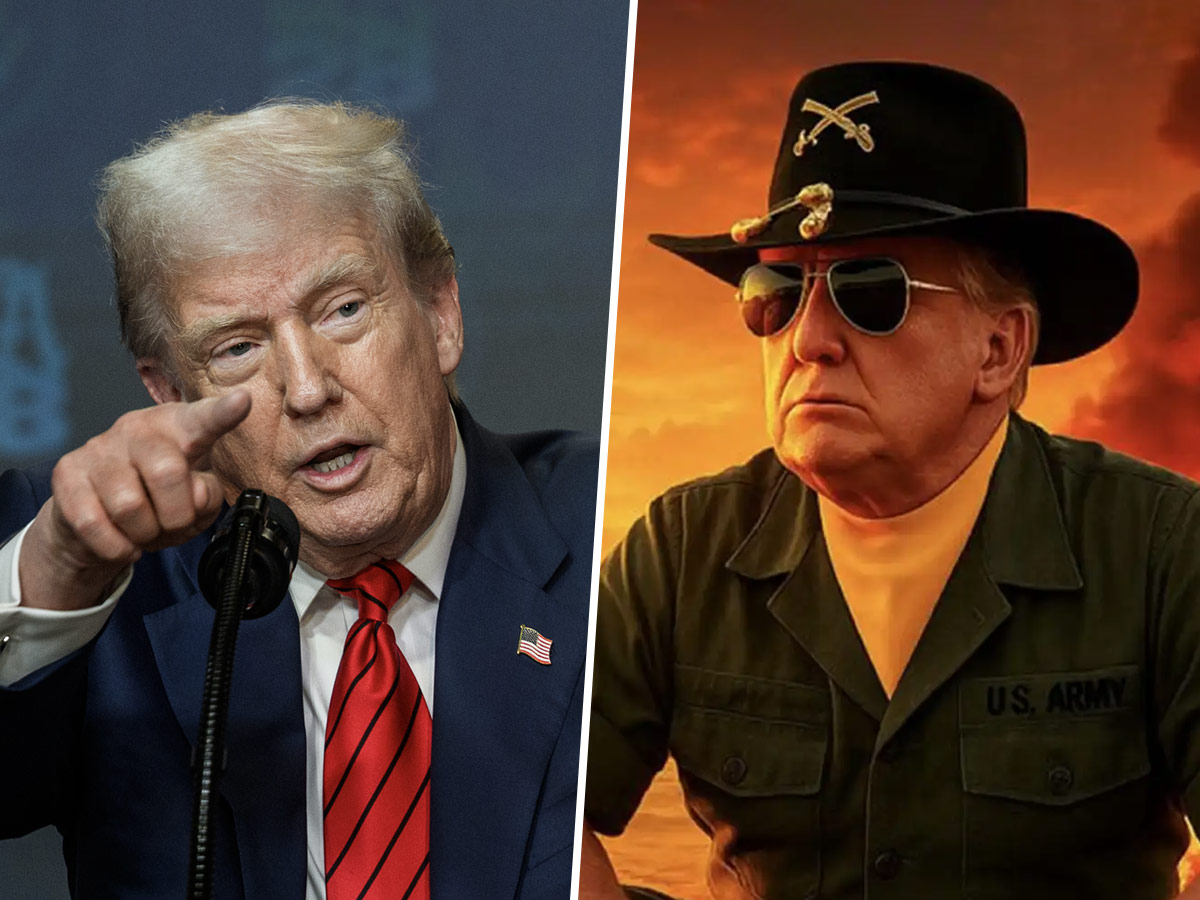
In a recent social media post, President Trump posted a meme depicting him as Robert Duvall’s character in Apocalypse Now, with the caption, “I love the smell of deportations in the morning…Chicago about to find out why it’s called the Department of War… Chipocalypse now.”
Not surprisingly, Democrat politicians responded negatively. Illinois Governor JB Pritzker said that Trump was “threatening to go to war with an American city.”
But how are religious leaders responding?
In Chicago itself, faith leaders have come together in a campaign called Faith Over Fear, protesting against ICE raids and in support of immigrants.
One such leader, Rabbi Lizzi Heydemann, said, “God stood on the side of the vulnerable and the oppressed. God split the sea for them and said to the world, the way that you treat the least among you, the strangers, the slaves, the servants, the way that you treat them is a test of your society.”
Other groups are preparing to support immigrant families with information, encouragement, and emergency resources.
However, this is not simply a recent change of policy, nor is it limited to Chicago.
At the beginning of this year, religious leaders around the country began preparing for the reality of increased ICE raids around the country, particularly in so-called “sanctuary cities.”
The Department of Homeland Security announced a change of policy in January to remove a restriction on arresting people in houses of worship, schools, and hospitals, saying: “Criminals will no longer be able to hide in America’s schools and churches to avoid arrest.”
Therefore, faith leaders’ response to the administration’s actions in Chicago is merely the latest step in the development of this issue throughout this year. Several layers to this issue make it difficult to identify “a” faith community response.
First, there is the legal aspect of the issue. Perhaps surprisingly, there is no legal “right of sanctuary” under federal law. The federal Immigration and Nationality Act states that it is a crime to knowingly or in reckless disregard of the facts to “conceal, harbor, or shield from detection” someone who has entered or remains in the United States in violation of law (see 8 U.S.C. §1324(a)(1)(A)(iii); see also On Holy Ground: Church Sanctuary in the Trump Era). Although prior policy restricted federal agents from entering worship facilities to arrest people, that policy has now changed.
The second layer of the issue is the intersection between faith and politics. Churches and church leaders who have supported President Trump are more likely to support his administration’s policy regarding undocumented migrants; those who opposed his election also tend to oppose this policy.
For example, Rev. Robert Jeffress, a Baptist megachurch pastor in Dallas, said earlier this year: “I support 100% President Trump’s goal of protecting our country from evildoers, whether from within or without. The president has authority from the Constitution and the Bible to do exactly what he’s doing.”
Other leaders, however, point to Scripture passages that call for Christians to minister to the marginalized, including immigrants, to oppose the administration’s crackdown.
Rev. Edward Anderson, a pastor in Los Angeles, noted that clergy are “not only called to preach justice but to embody it…and to lift up the sacred worth of every human life.” He referenced Biblical calls to welcome strangers, defend the oppressed, and love our neighbors.
That intersection between politics and faith reveals the third layer of the faith response: how churches (and individual believers) interpret the Scriptural directives. In the Old Testament, God directed His people to care for the widows, orphans, and strangers among them because they were strangers in Egypt. In the New Testament, Jesus famously illustrated the call to love our neighbors with the parable of the Good Samaritan. On the other hand, the New Testament writers teach that Christians are to submit to the ruling authorities.
However, Christians have long recognized that God’s authority supersedes that of the “ruling authorities.” Two examples from American history stand out. First, in the era of slavery, northern Christians saw their duty to help fugitive slaves as higher than the legal obligation to return slaves to their “owners.” And during the civil rights era, many southern churches and believers engaged in civil disobedience to protest the evils of segregation.
Obviously, there is no “one” faith response to the immigration’s heightened enforcement of immigration laws. Political responses tend toward the extremes; a Christian response must allow for the Holy Spirit’s direction on how to live out the sometimes conflicting directives of Scripture. Where is the balance point between “submitting to the ruling authorities” and “caring for the marginalized”?
The responses of faith leaders across the spectrum demonstrate the variety of ways to interpret biblical teaching.
The danger, however, is that politicians’ use of fear and anger will distract people of faith and take the focus off scriptural guidance. Calling cities “war zones” and likening law enforcement actions to military campaigns generates fear; responses that liken the president to Hitler only serve to create fear, not hope. Faith leaders need to respond from faith, not fear, to encourage believers to do the same.
As Jesus said, “In this world you will have trouble. But take heart! I have overcome the world” (John 16:33).
 Read Previous Post