
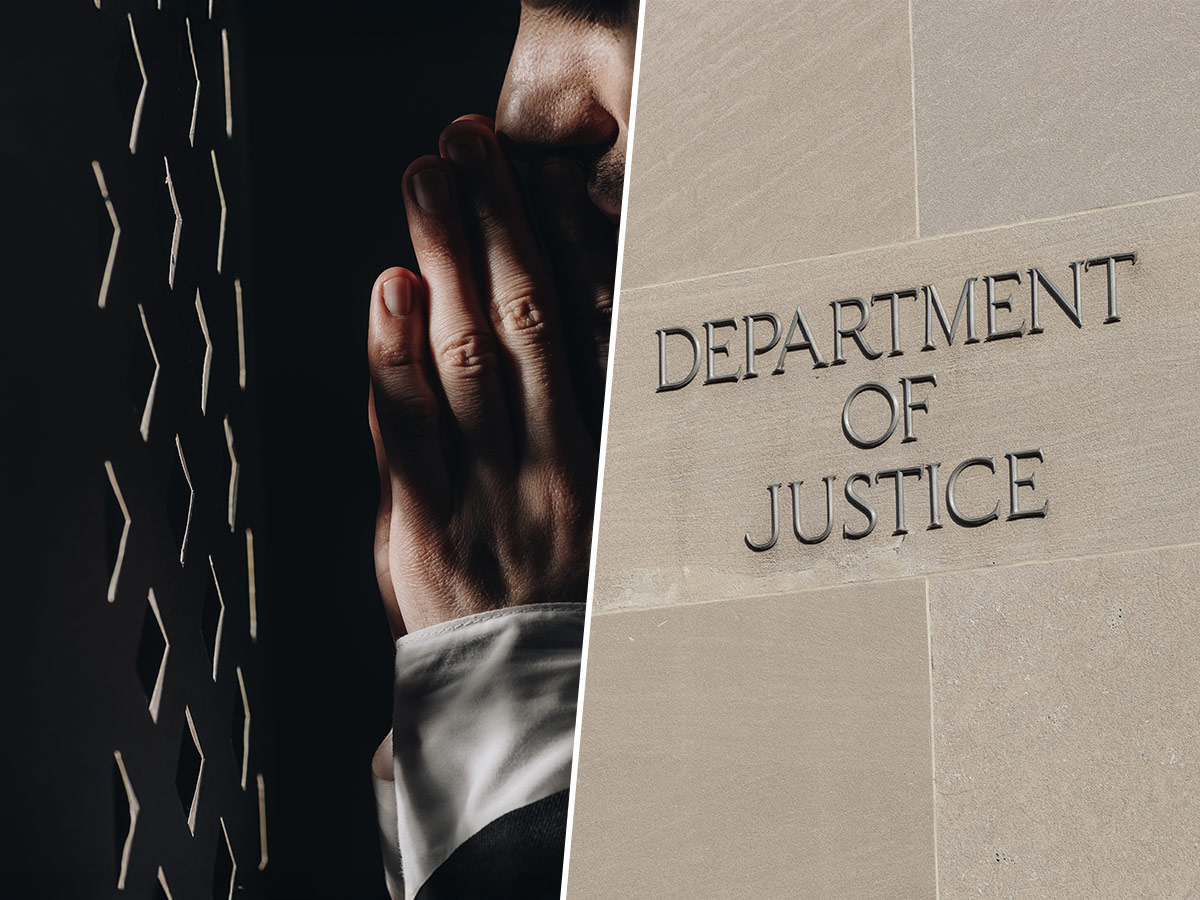
The Roman Catholic Church has instructed its priests in Washington state to defy a new law requiring clergy to report child abuse, setting up a potential clash between church doctrine and state law.
The privilege covering communications between a person and a member of the clergy has long been recognized. Every state in the United States has a statute recognizing some form of this privilege (sometimes called “priest-penitent,” “clergy-penitent,” or “religious privilege”).
With the recent enactment of its new law, the State of Washington has completely rejected the interest in promoting confidentiality of the confessional. This law, which takes effect on July 27, makes clergy members “mandatory reporters” – which means that they are required to report information relating to suspected child abuse. Obviously, that also means that clergy members cannot rely on the clergy-penitent privilege to avoid such reporting.
The Roman Catholic Church has long held that the “seal of confession” cannot be broken. For a priest to disclose information communicated to him during confession is grounds for automatic excommunication of the priest. The rationale for this is that there is spiritual value in encouraging honest confessions; if information shared with a priest during confession can be revealed against the penitent’s wishes, people would be less willing to make honest confessions.
This privilege has a long tradition within the law. Although it was not part of English common law at the time the United States was formed, the states eventually passed laws to establish the privilege. These privilege statutes were generally motivated by the desire not to place a member of the clergy in a position where they either had to violate the confidentiality of a parishioner or violate civil law.
The United States Supreme Court recognized the rationale for the privilege in Trammel v. United States, decided in 1980: “The priest-penitent privilege recognizes the human need to disclose to a spiritual counselor, in total and absolute confidence, what are believed to be flawed acts or thoughts and to receive priestly consolation and guidance in return.”
In general, churches do not oppose so-called “mandatory reporting” laws so long as the clergy-penitent privilege is preserved. For example, a church employee or volunteer who hears or observes evidence of child abuse in a non-confidential setting can and should disclose such information to the proper authorities. Most churches would agree that protection of children is important, and where there is no competing interest in confidentiality, the information should be disclosed.
Clearly, state governments – like Washington – have a compelling interest in protecting children from child abuse. Several professions are required to report suspected abuse – for example, health care providers, educators, social workers, and child care providers. Requiring such workers to report suspected abuse is generally accepted. Expanding the requirement to report to clergy, and negating the long-established privilege extended to clergy-penitent communications, is seen by many as a step too far.
The Department of Justice has announced an investigation into the matter, examining whether Washington’s law runs afoul of the First Amendment protections extended to the free exercise of religion. The DOJ’s press release announcing the investigation states that the Washington law “appears to single out clergy as not entitled to assert applicable privileges, as compared to other reporting professionals.” The DOJ position appears to be that such “singling out” of clergy interferes with the free exercise rights guaranteed by the First Amendment.
The Archdiocese of Seattle – which covers priests in the state of Washington – has warned clergy there that they cannot comply with the law and thus violate the “seal of confession.” In fact, Catholic canon law provides that a violation of the seal of confession results in an automatic excommunication. In other words, no charges or church trial would be necessary to revoke the ordination of a priest guilty of violating the seal of confession.
Washington Governor Bob Ferguson, who signed the bill into law, cast the issue in terms of “protecting Washington children from abuse” versus “this ‘investigation’ from the Trump administration.”
Victims’ advocacy groups are in favor of Washington’s new law. They see protecting children from abuse of such primary importance that other rights – including freedom of religion – must be subordinate.
This type of balancing is common in cases involving the weighing of constitutional rights. For example, in First Amendment cases involving government regulation of protected speech, courts require the demonstration of a “compelling government interest” to support restriction of free speech rights. Under a similar reasoning process, protection of children could be found to be such a compelling government interest to justify restrictions of the religious rights of clergy.
The Washington law will take effect on July 27 unless something happens before that time to delay or overrule it. Such a delay could come from at least two primary directions: a Department of Justice investigation or federal litigation against the new law. In either case, an injunction against the enforcement of the law by a federal court would probably be required to halt its application until a resolution of the challenge on the merits could be decided.
In the meantime, it is clear that the Roman Catholic Church, at least, will require its clergy to disobey the law if it requires priests to violate the confidentiality of the confessional. It is unclear whether other churches, which may not have beliefs similar to the Catholic sacrament of confession and its related confidentiality, would comply. While many other states already have laws which make clergy mandatory reporters, most of those laws provide an exception for information which would otherwise be covered by the clergy-penitent privilege.
In the short term, more people and groups across the spectrum can be expected to weigh in on Washington’s new law. What seems certain, however, is that the final resolution of this question is still quite a way down the road.
 Read Previous Post