
On the eve of the 100th anniversary of the famous “Monkey Trial,” creationists are ramping up the pressure for creationism to be taught to American children, in and out of school.
The 1925 Scopes monkey trial, dubbed the Trial of the Century, was seen by many as the beginning of the end for biblical fundamentalism’s place in schools. Even though public schoolteacher John Scopes lost the trial and was convicted in 1925 for violating The Butler Act—a Tennessee state law against teaching human evolution—the trial seemed to mark the turning of a page.
This was, in part, because William Jennings Bryan – the populist star of the prosecution team – performed poorly as an expert witness, struggling to defend the Bible’s miraculous stories, even conceding that some biblical passages should be understood “illustratively” rather than literally.
The issue was repeatedly litigated in the mid-twentieth century, but the decisions all went in the same direction. Tennessee repealed the anti-evolution Butler Act in 1967. In 1968, the U.S. Supreme Court ruled that a similar Arkansas law was unconstitutional, acting to promote religion via legislation, and in 1987, it overturned a Louisiana law that stipulated that creationism be taught alongside evolution. Similarly, a 2005 federal court barred a Pennsylvania school district from teaching “intelligent design,” a variant of creationism that argues life is too complex to have evolved by chance.
It might have looked like the Scopes Trial marked the beginning of the end for creationism in schools, but more recently, lawmakers have revived the issue. A new West Virginia law promotes the free exchange of ideas in science classrooms, allowing teachers to answer students’ questions about the origins of life. This law also opens the door for the promotion of religion in public educational institutions.
In Texas, the new “Bluebonnet Learning” curriculum, which the Texas State Board of Education approved, has resulted in fierce legal opposition for including a kindergarten art lesson that asks students to repeat the phrase “Let there be light” from the beginning of the creation story in the Book of Genesis. The curriculum also includes biblical references and an activity in which children are expected to memorize and repeat the order of creation.
Tension over evolution versus creationism in classrooms is as fevered as it has ever been, and the argument about how students should be taught is ongoing. The Scopes trial established the terrain for today’s culture-war battles, which have seen efforts to introduce Bible references in lessons and Ten Commandments displays in public schools.
Despite the legislative trend of the twentieth century, creationist belief has been resilient. Polls show that up to 1 in 3 Americans hold beliefs that are aligned with young-Earth creationism.
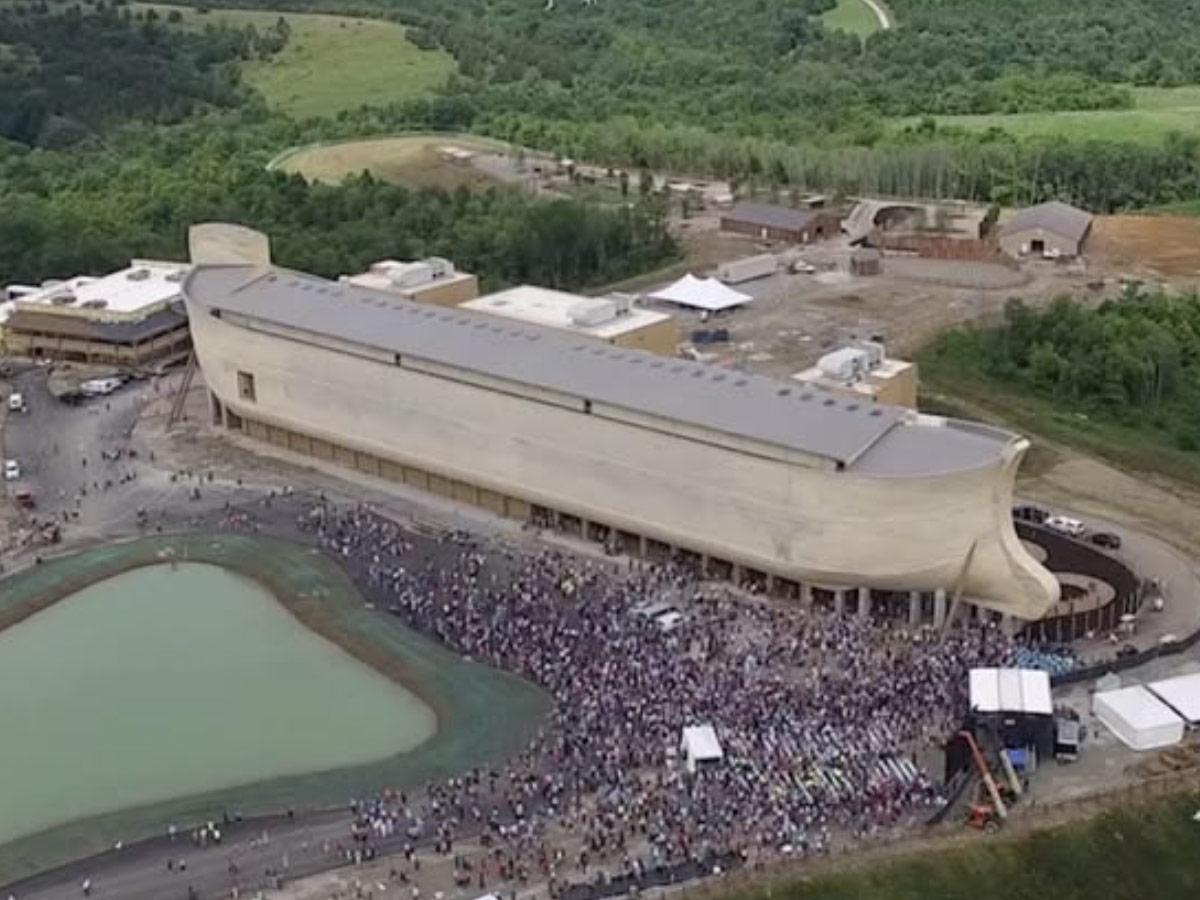
In Williamstown, Kentucky, a colossal replica of Noah’s Ark, built at a cost of $100 million and opened in 2016, draws over a million visitors per year. Ken Ham, founder of Answers in Genesis, describes the ark as “the biggest freestanding timber-frame structure in the world.” It stretches the length of one and a half football fields, has three expansive decks, and displays life-size animal models and their sleeping quarters.
Answers in Genesis say the ark is designed to demonstrate that Noah and his family could successfully manage a vessel of that size with its thousands of animal inhabitants. The ark is presented as an object lesson to show that the biblical story of Noah’s flood should be taken as a literal, historical event—that Noah, his family, and his cargo floated safely above a global flood that had drowned everyone else in the world.
“That’s what we wanted to do through many of the exhibits, to show the feasibility of the ark,” says Ham.
Ken Ham began defending creationism 50 years ago as a young schoolteacher in his native Australia, and today, Answers in Genesis is a vast enterprise that includes books, videos, and homeschool curricula.
A 2024 Gallup poll found that 37 percent of U.S. adults agreed that “God created human beings pretty much in their present form at one time within the last 10,000 years or so.”
In 2007, Answers in Genesis opened the Creation Museum in Petersburg, Kentucky. Visitors are greeted by models of children and dinosaurs interacting peacefully in the Garden of Eden. This aroused the alarm of science educators, who say that the two species never walked the Earth at the same time, being separated by 65 million years.
Scientists consider the sustained belief in creationism a worrying concern when it comes to education. A 2014 Pew Research Center poll found that 98 percent of American scientists accept evolution. The Geological Society of America says, “Evolution and the directly related concept of deep time are essential parts of science curricula.” The National Academy of Sciences states that evolution is “one of the most securely established of scientific facts.”
The academy warns that public schools must stick to the scientific consensus and that creationism is not a viable educational alternative. It argues that creationists “reverse the scientific process” by starting from an unquestionable conclusion and working backwards, rather than building evidence toward a factually sound conclusion.
Scientists and science educators are alarmed that creationism is still finding its way into schools, seeing it as part of an anti-science movement that hinders effective responses to real-world crises such as climate change.
 Read Previous Post