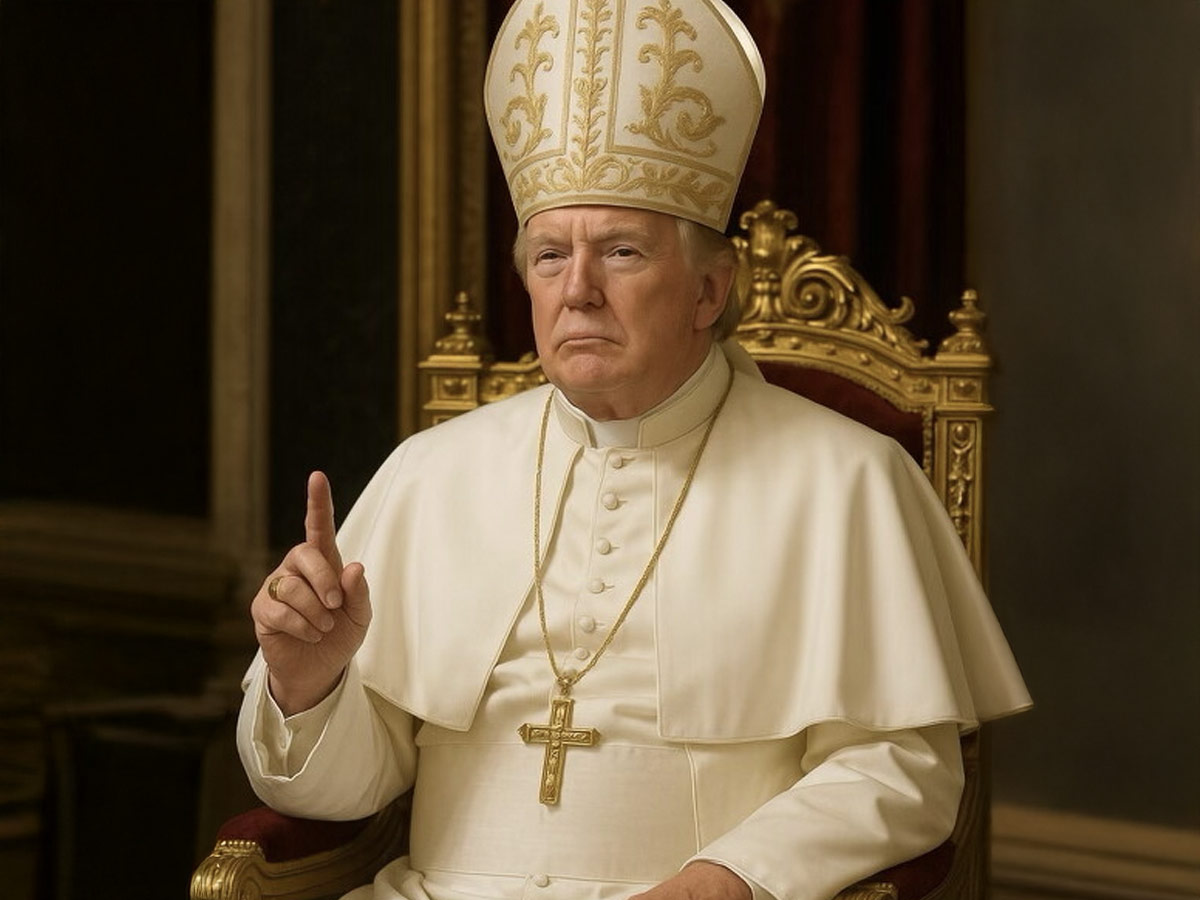
In yet another headline-grabbing social media moment, President Donald Trump shared an AI-generated image of himself dressed as the pope, just days after joking with reporters that he’d “like to be pope.” The image, posted Friday on Truth Social, came as the Catholic Church prepares for the May 7 conclave to select a successor to Pope Francis, who passed away last week in Rome.
Trump had attended the funeral of Pope Francis alongside other world leaders, including Ukrainian President Volodymyr Zelenskyy. His comments outside the White House upon returning to Washington raised eyebrows: “I’d like to be pope,” Trump said. “That would be my number one choice.” He quickly added, perhaps tongue-in-cheek, “I have no preference” regarding who will ultimately be elected.
The AI image — which shows Trump in full papal regalia — drew a storm of reactions across social media. Some criticized the image as irreverent or inappropriate, particularly given the sacred context of the papal office and the solemnity of the conclave ahead. Others saw the post as a light-hearted jab in keeping with Trump’s often theatrical online presence.
Former RNC Chairman Michael Steele, a frequent critic of Trump, condemned the post: “This affirms how unserious and incapable [Trump] is,” he said in response to the AI image.
However, Trump supporters defended the post, suggesting it was meant in jest and pointing to the president’s long-standing penchant for dramatic symbolism and political theater. “It’s a meme. It’s funny,” one supporter wrote on X (formerly Twitter). “Don’t take it so seriously.”
This is not the first time AI-generated art has entered the Trump White House’s online communication strategy. Back in February, Deputy Chief of Staff Taylor Budowich posted a digitally generated image portraying Trump as a king after a policy move blocked New York City’s congestion pricing plan. Trump celebrated the decision with a post declaring, “Long live the king.”
The timing of the latest image — appearing amid a major moment for the global Catholic Church — has sparked discussion not only about Trump’s tone but also about the growing role of artificial intelligence in political messaging. It also underscores the unique relationship Trump has cultivated with Catholic voters and leaders, including Vice President JD Vance, a Catholic convert who met with Pope Francis one day before his death.
While many faith leaders have not directly commented on the AI image, the moment raises deeper questions for Christians about the intersection of politics, reverence, and technology.
In an era when sacred symbols are increasingly used in political memes and digital art, believers may be left asking: Is it just satire, or does it blur lines that should remain holy?
 Read Previous Post