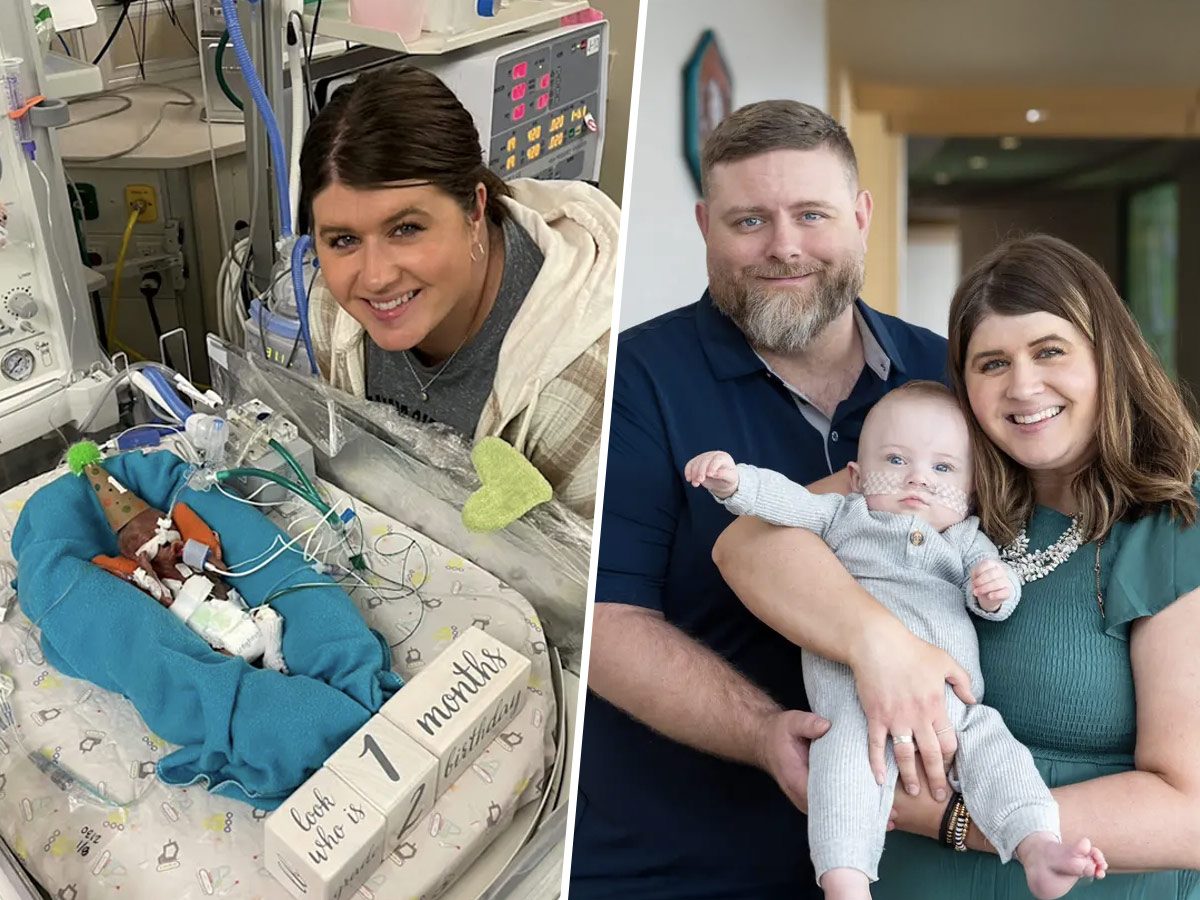
Little baby Nash Keen, affectionately called “Nash Potato,” celebrated his first birthday on July 5. It was a major milestone for little Nash, who overcame huge obstacles prior to his big day. When they found out they were expecting, Nash’s parents, Mollie and Randall Keen of Ankeny, IA, were hopeful but concerned. Mollie suffers from polycystic ovary syndrome (PCOS) and an incompetent cervix, which can cause premature labor. The couple had lost their daughter, McKinley, at 18 weeks gestation six months earlier. While she was pregnant with Nash, the couple was “excited,” but Mollie added, “We didn’t get our hopes up.”
At a twenty-week check, Mollie was having concerns. “When we went to our local doctor’s office for the 20-week scan for Nash, I just had some concerns about how I was feeling, so I asked them to look at me closer — which they normally don’t do at that appointment — and they found I was already 2 centimeters dilated,” she told Fox News Digital. The couple feared they were going to lose another baby. Mollie was put on bed rest to delay her labor and taken to Stead Family Children’s Hospital, part of the University of Iowa Health Care in Iowa City. The hospital’s neonatal intensive care unit (NICU) provides care for premature babies born at 21 weeks or later. Mollie’s labor was stalled up until Nash reached the 21-week marker, when he was delivered 133 days before his due date.
Nash was born at 9.5 inches and 10 ounces, less than a grapefruit, and needed specialized care due to his small size. Dr. Amy Stanford oversaw his resuscitation and discussed some of the special challenges of caring for such an early baby. “Caring for a baby born at 21 weeks is very different from typical premature cases. Babies born this early require highly specialized care, constant surveillance and frequent monitoring – every hour can make a difference,” she said. “While Nash faced many critical challenges early on, he showed remarkable resilience. After those first few extremely delicate weeks, he began to make steady progress, which was truly extraordinary to witness.” While the doctors worked tirelessly to care for Nash, they also wanted the family to be aware of the risks and struggles ahead. Mollie described Nash’s first few days as “a blur of fear, uncertainty and hope.”
Nash would ultimately spend 6 months in the hospital before he would be released home in January 2025. Nash continues to have medical needs: he is being weaned off oxygen, has a feeding tube, and wears hearing aids for mild hearing loss. Dr. Stanford, however, has been thrilled by his progress. “Watching him grow and thrive fills me with immense pride – not only for Nash himself but also for his family and the entire care team who made his success possible,” she said. “Nash is truly history in the making, paving the way for the care of other babies born as early as he was.” Her ultimate goal for Nash is that “by the time he’s 5 years old when he goes to kindergarten, no one will know that he was born so early.”
Nash has also received special recognition for being the world’s most premature surviving baby. Mollie called making it to Nash’s first birthday “surreal.” “It feels surreal, honestly. A year ago, we weren’t sure what the future would look like, and now we’ve celebrated his first birthday,” she said. “It’s emotional in so many ways: pride, gratitude, even some grief for how different his journey has been. But above all, it feels like a victory.”
 Read Previous Post