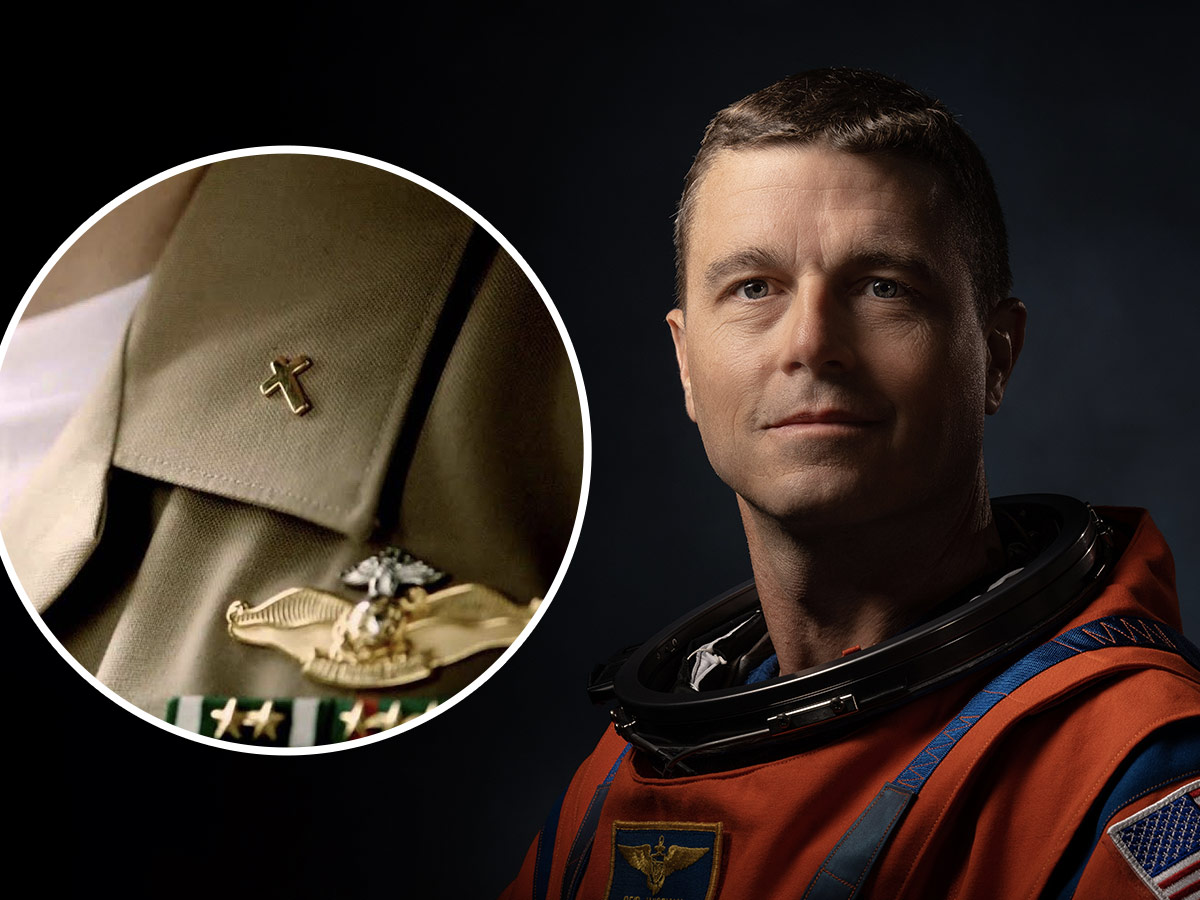
Artemis II Commander Reid Wiseman described being “moved to tears” while speaking to the Navy chaplain after the crew returned from its mission around the moon. Wiseman described the moment during a press conference where the team offered its first thoughts on their historic mission. The team had been taken for medical evaluation after landing, where Wiseman asked to speak with the chaplain. “I’m not really a religious person, but there was just no other avenue for me to explain anything or to experience anything, so I just asked for the Navy chaplain to come visit us for a minute. When that man walked in — I’d never met him before in my life, but I saw the cross on his collar, and I just broke down in tears,” he said during the conference. “It’s very hard to fully grasp what we just went through.”
The mission brought the astronauts into space further than any person has ever traveled, going to the far side of the moon and witnessing a solar eclipse. Wiseman described the eclipse as “otherworldly.” “So, I’m basing this on what we saw,” said Wiseman. “And when the sun eclipsed behind the moon, I think all four of us … I turned to Victor [Glover], and I said, ‘I don’t think humanity has evolved to the point of being able to comprehend what we’re looking at right now because it was otherworldly.’” He said the team still hadn’t really had time to process everything they’d seen.
Artemis II pilot Victor Glover has made headlines for his Christian faith. He called the visit with the chaplain “a really special moment.” “I was in the bed right across when the chaplain came in, and the only thing I would add is I am a religious person, but everything else is the same,” he said. “There is something in there, and as we start to process, I’ll have to tell you next week, but I haven’t had a chance to really unpack it all yet.” The mission took place over Easter Sunday, which Glover marked with an Easter message to Earth during their trip. Fellow astronauts Christina Koch and Jeremy Hansen also marked the occasion with Easter messages.
Wiseman’s story has been especially touching as he went on the mission six years after his wife, Carroll, died after a five-year battle with cancer. Prior to her death, Carroll had worked as a school nurse. Her death left Wiseman a single dad of two daughters. Prior to the mission, Wiseman discussed the sober reality of planning for his daughters should he not return from the mission. “I went on a walk with my kids, and I told them, ‘Here’s where the will is, here’s where the trust documents are, and if anything happens to me, here’s what’s going to happen to you. That’s just a part of this life,” he recalled.
During the mission, the team named one of the Moon’s craters in honor of Carroll. Wiseman called it “beautiful.” “I thought it was the most beautiful thing I’d heard in my entire life. She was an amazing human being, and she’s the mother of my two daughters,” he said. “And what man on this planet deserves a gift like that — to have your crew be so thoughtful and to do something so caring and so deep and so meaningful.”
 Read Previous Post