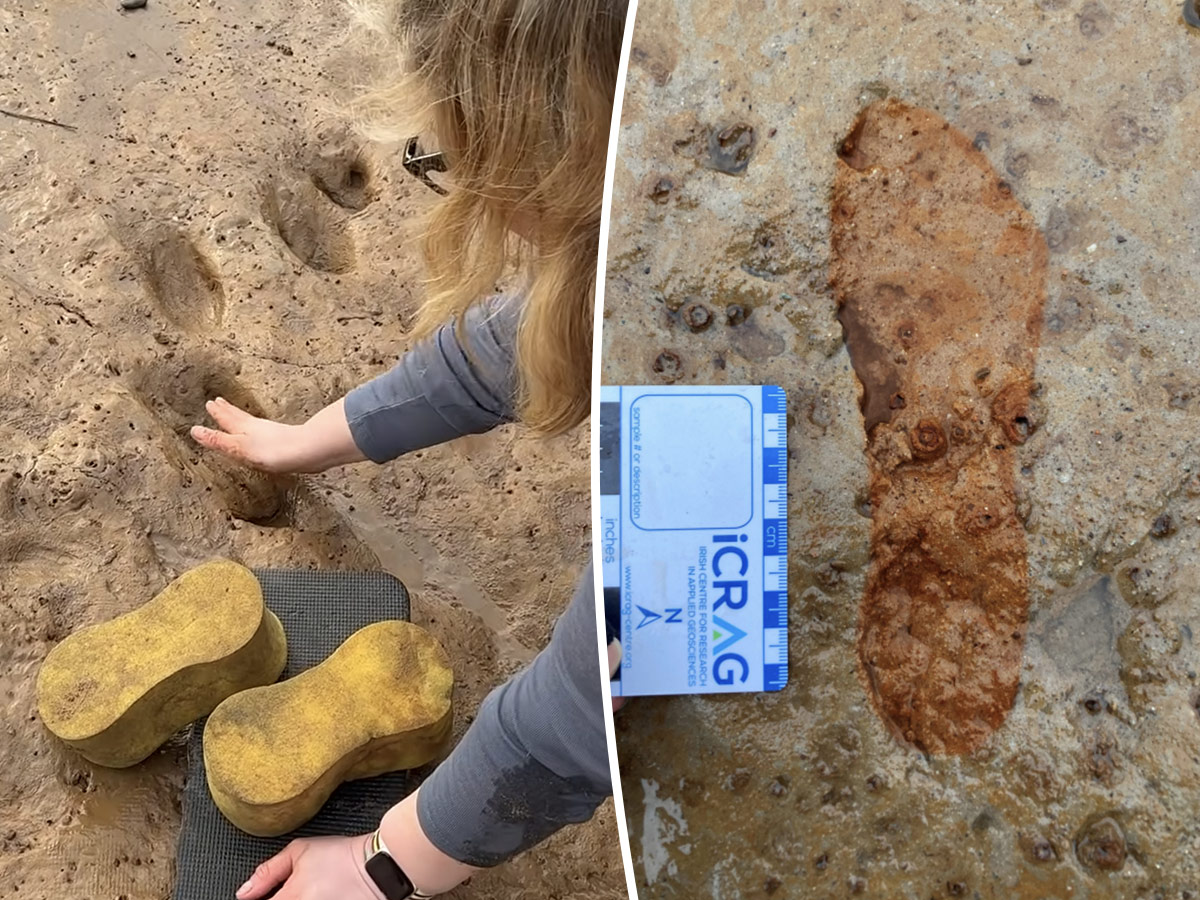
A pair of Scottish dogwalkers stumbled their way into a stunning archaeological find on the Scottish beach of Lunan Bay. Locals Ivor Campbell and Jenny Snedden were walking their dogs Ziggy and Juno along the beach when they spied “distinct markings” in the sand in late January. A storm the previous night had revealed a fresh layer of clay previously hidden to the human eye. The markings of both human and animal prints were so significant to Campbell that he made a call to archaeologist Bruce Mann. Mann then notified experts at the University of Aberdeen.
The call soon became a race against time as intrigued archaeologists bought plaster from local craft stores in order to make impressions before the markings were lost again. “This email came in quite late at night and we really rushed to get all our materials together. We had a lot of late-night phone calls planning how we could get to the site and record it, because it was revealed by these unseasonably harsh storms we’ve all been experiencing in Scotland this winter,” said Professor Kate Britton of the University. “But of course, those storms had revealed the site but were also actively destroying it at the same time.”
A team of researchers worked through gusts topping out at 55mph to make impressions. Experts have dated the prints to about 2,000 years old. Professor Britton noted that such prints had been found in other UK sites, but these were the first known ones in Scotland. She said that prior to being a beach, Lunan Bay would have been a “lush salt marsh” that would have attracted people and animals to the area. She described the working conditions archaeologists found themselves in as they raced against time. “We had to work fast in the worst conditions I’ve ever encountered for archaeological fieldwork – the sea was coming in fast, with every high tide ripping away parts of the site, while wind-blown sand was simultaneously damaging it. We were effectively being sand-blasted and the site was too, all while we were trying to delicately clean, study and document it, so it became a race against the elements,” she said, noting that “within 48 hours the entire site was destroyed.”
The two dogwalkers also found themselves as part of the dig, bringing buckets and tea to the archaeologists. Bruce Mann praised Campbell and Snedden for notifying the proper authorities so quickly. “As soon as I saw the first photograph, I realized I was looking at something very special. It was a powerful reminder that some of the most important discoveries start with someone noticing something and choosing to report it. What came next was a race against time, and I cannot thank the University of Aberdeen team enough for responding to my call for help,” he said.
Professor Gordon Noble, one of the archaeologists who worked on the dig, described what life could have been like at the time the impressions were made. “This is a real tangible link to the region’s past. The late Iron Age dates are in keeping with what we know about the rich archaeology of nearby Lunan Valley,” he said. “It’s very exciting to think these prints were made by people around the time of the Roman invasions of Scotland and in the centuries leading up to the emergence of the Picts.” So far, experts have identified prints from roe deer and other animals, as well as humans.
 Read Previous Post