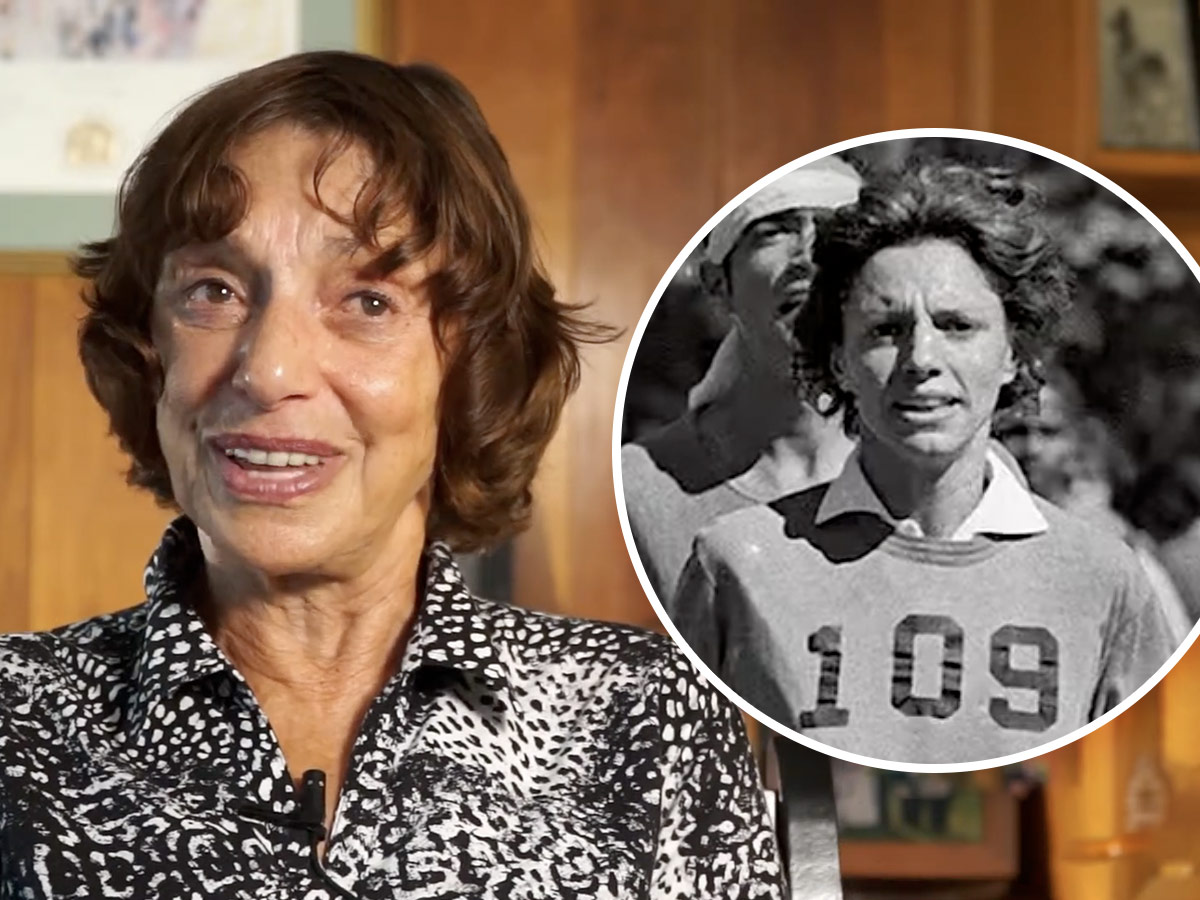
Nina Kuscsik, a true pioneer in women’s sports and a beloved figure in the running community, passed away on June 8 at the age of 86. She died of respiratory failure after a long battle with Alzheimer’s disease, according to her obituary.
Kuscsik made history in 1972 when she became the first woman to win the Boston Marathon after women were officially allowed to compete. But her legacy goes far beyond that one race—she opened doors for women everywhere by fighting for equality in sports, one stride at a time.
“Nina was more than a pioneer, determined women’s running advocate, and celebrated icon within the sport,” the Boston Athletic Association (BAA) shared. “To us, she was a friend who will always be remembered for her kindness, joyful laugh and smile.”
The BAA continued, “Nina held the distinct honor of winning the 1972 Boston Marathon, and recognized the platform that came with that triumphant moment, inspiring thousands of women to reach their own goals and finish lines in the decades since.”
But Nina’s story started long before her famous win. She graduated high school at just 16, studied nursing, and received her license at 18—after petitioning the state of New York to change a law requiring nurses to be 21. She was a champion in roller skating, speed skating, and cycling, all in the same year. When her bicycle broke, she turned to running—and never looked back.
Kuscsik wasn’t content with just running races. She also changed the rules of the game. Before women were officially allowed in marathons, she ran the Boston Marathon four times between 1968 and 1971 during what’s now called the Pioneer Era. She was one of the “Six Who Sat” in protest of unfair rules at the 1972 New York City Marathon and went on to win that race—and the next year too.
“She was not only a champion runner,” said Kathrine Switzer, another pioneer in women’s running, “but was instrumental in the official acceptance of women and distance running because she did years of tough work of changing rules, regulations, and submitting medical evidence to prove women’s capability.”
Switzer recalled that historic 1972 Boston race: “Eight of us registered, eight of us showed up, and all eight of us finished. It was a stunning moment — and a blistering hot day — but appropriately enough, Nina won.”
In her lifetime, Nina Kuscsik ran over 80 marathons. She set an American record for the 50-mile run in 1977 and won the Empire State Building Run-Up three years in a row. In 1999, she was inducted into the Long Distance Running Hall of Fame.
As Christians, we’re reminded that running the race isn’t just a metaphor—it’s a calling. Nina Kuscsik ran her race with passion, courage, and faith. Her story challenges us to break barriers, stand for what is right, and finish strong.
She truly lived a life worth celebrating—a life that inspired others to believe that with perseverance and purpose, no finish line is out of reach.
 Read Previous Post