

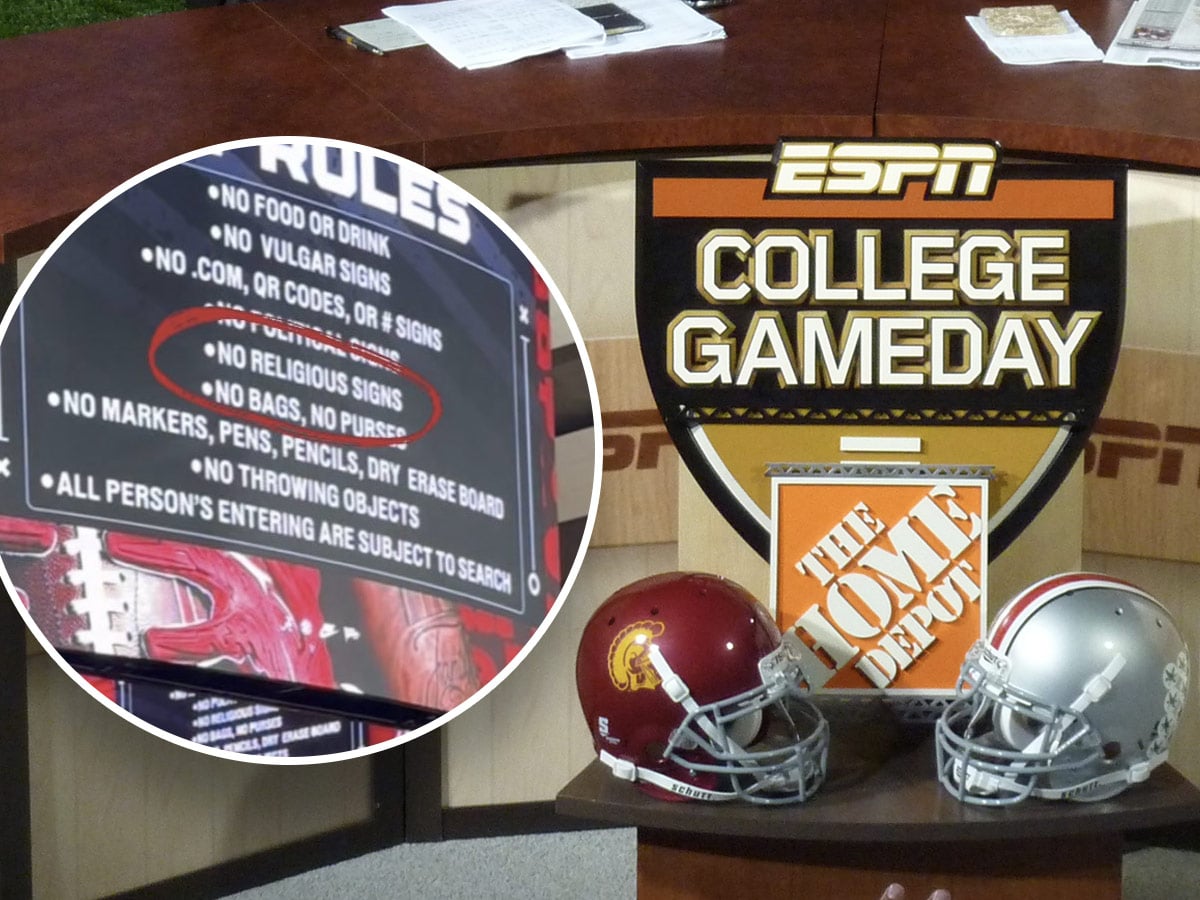
ESPN is facing criticism after reportedly banning religious signs from its popular College GameDay broadcast, sparking frustration among Christian fans who say faith has always been part of college football culture.
The controversy began last weekend when the network introduced a “no religious signs” rule before Alabama’s highly anticipated matchup against Georgia in Tuscaloosa.
For decades, College GameDay has been known for its lively crowds, creative signs and passionate fans. Scripture references, including the familiar John 3:16, have long appeared alongside jokes, team slogans and playful insults aimed at rival schools.
The reported restriction has raised questions about whether religious expression still has a place in one of college football’s biggest traditions.
Shawn Carney, CEO of the Christian pro-life organization 40 Days for Life, criticized the decision in an interview with OutKick and said ESPN is alienating a significant portion of its audience.
“We’ve done this, and it doesn’t work,” Carney said. “It’s called 2020, and all of the companies that decided to go in that direction, it just backfired. It’s so stupid.”
Carney, a devoted Texas A&M fan, said the decision makes little sense given the strong connection between Christianity and college football, particularly in the South.
“Football is religion in the South,” he explained. “You look at the SEC, and you can throw in the Big 10, these are religious people that follow college football. That’s a huge market that is college football.”
Faith has long been visible throughout college football. Players regularly pray before and after games, coaches speak openly about their Christian beliefs, and athletes frequently thank God during postgame interviews.
Carney believes restricting religious signs sends the wrong message to those fans and athletes.
He was particularly surprised that the rule was introduced in Alabama, a state where Christianity remains deeply woven into the local culture.
“It’s shocking that (Alabama) would be the location,” he said. “It’s the heart of the Bible Belt unapologetically, and Nick Saban definitely had a theme of his faith and faith in God when he was a coach.”
Carney also questioned whether the policy would be applied equally to all religions.
“They’re not going after Muslims, they’re not going after Hindus,” he argued, suggesting that corporate restrictions on religious expression often disproportionately affect Christians.
However, the reported rule was described as a ban on religious signs generally, rather than one specifically targeting Christianity. Carney’s claims about selective enforcement have not been independently verified.
The controversy also raises broader questions about the balance between a television network’s control over its broadcasts and fans’ desire to express their beliefs in public settings.
While ESPN can establish guidelines for signs appearing on its programming, critics argue that excluding religious messages is unnecessary, especially when those messages are peaceful and non-disruptive.
Carney believes most viewers, regardless of their religious beliefs, have little reason to object to a simple Bible verse appearing in the crowd.
“Nobody’s for this. Nobody likes it,” he said. “Do you think atheists watching ‘GameDay’ are offended that somebody has a sign that says John 3:16?”
“It’s embarrassing.”
For Christian college football fans, the debate goes beyond signs. It raises a larger question about whether public expressions of faith are increasingly being pushed aside, even in traditions where they have long been welcomed.
 Read Previous Post