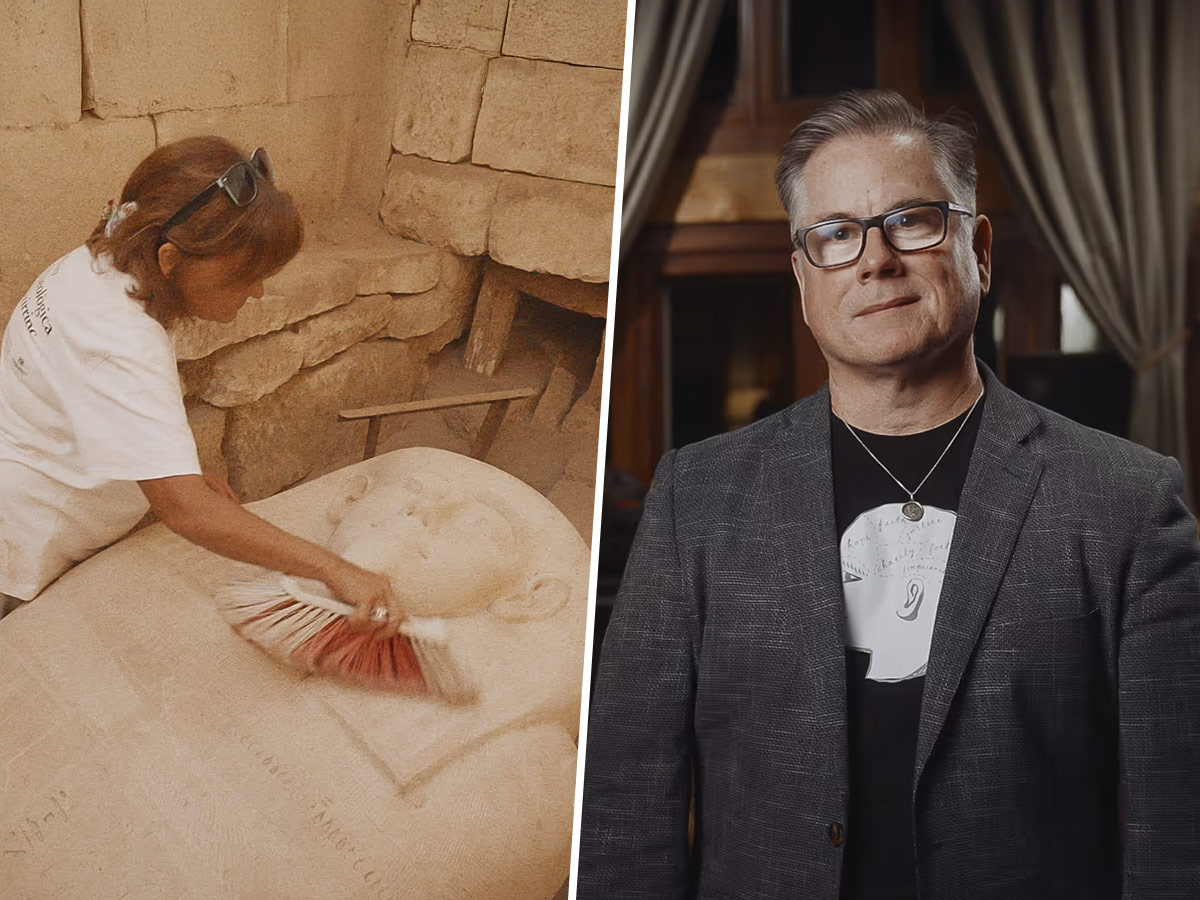
When Grammy Award-winning worship leader Chris Tomlin first laid eyes on a fragile scrap of papyrus discovered in Egypt, he wasn’t just looking at an ancient artifact—he was witnessing a powerful connection to the earliest days of Christianity.
“I was really, really moved by that and thinking, ‘Wow,'” Tomlin said. “It just feels like such a God story that it was even found in the scrap heap.”
The fragment, unearthed among thousands of documents in the ancient city of Oxyrhynchus, contains what is believed to be the oldest known Christian hymn, dating back to the third century. Preserved for years in a vault at Oxford University, the text has now taken center stage in The First Hymn, a new documentary that traces its journey from the desert sands to modern worship.
For Tomlin, the discovery wasn’t just historical—it was deeply spiritual. “Of all the things that were found in this archaeological spot … they find this little piece of a hymn, the earliest known hymn of the Church,” he said. “It’s like God bringing it to the people again.”
Teaming up with acclaimed songwriter Ben Fielding, Tomlin set out to reimagine the ancient hymn for today’s Church. The result was released on his album The King Is Still the King, blending timeless truth with modern melody.
What struck Tomlin most was the boldness of the early Christians who first sang these words. The hymn’s closing line—”To the only giver of all good gifts”—carried profound meaning in a culture where similar phrases were often used to honor pagan gods or even Roman rulers.
“I love that this little band of Christians … at the very end of their hymn would say, ‘To the only giver of all good gifts, amen,'” he said. “How powerful that is.”
Even more remarkable is the hymn’s reference to the Trinity—”the Father, Son and Holy Spirit”—written long before formal doctrine was established at the Council of Nicaea.
“This is the earliest discovery of that written outside of Scripture,” Tomlin explained. “This is the 200s, and they’re singing it already… It’s like a treasure for us as the Church.”
The project also reinforced a conviction Tomlin has carried throughout his career: worship music shapes what believers understand about God.
“What we sing is what gets in us,” he said. “Music is so powerful, it gets inside of us what we know of God.”
That’s why Tomlin approaches songwriting with great care, often working alongside theologians to ensure his lyrics are biblically sound. “I don’t want to be throwing heresy to the world,” he said. “I want people to have a right view of God when we sing these songs of worship.”
Reimagining a third-century hymn came with challenges, particularly because the original musical notation feels unfamiliar to modern ears. “The melody is very foreign,” Tomlin admitted. But with encouragement to adapt the piece creatively, he and Fielding crafted a version that resonates with today’s listeners while honoring its ancient roots.
The documentary culminates in a powerful moment: a live performance in Fort Worth, Texas, where a modern congregation sings words first lifted to God nearly 1,800 years ago.
“For me, that was so important,” Tomlin said. “Songs of worship are meant to be sung. They’re not meant just to be listened to.”
That moment, he said, captures the heart of the project. “To think that we’re singing something that 1,800 years ago was being sung, it connects us to the early Church.”
For Tomlin, the hymn represents something bigger than any one artist or denomination. “This predates denominations,” he said. “This is the early Church, and this is what they’re singing. I think that brings us to a pure place.”
With its reverent opening—”Let all be silent / The shining stars not sound”—the ancient hymn points worshipers away from themselves and toward the glory of God.
“I love that the earliest known song we have in the Church is not about us,” Tomlin said. “It lifts our eyes off ourselves and onto the greater story.”
The First Hymn will be shown in theaters nationwide on March 24 and 26, offering audiences a rare glimpse into the faith, courage, and worship of the early Church—echoing across the centuries into today.
 Read Previous Post