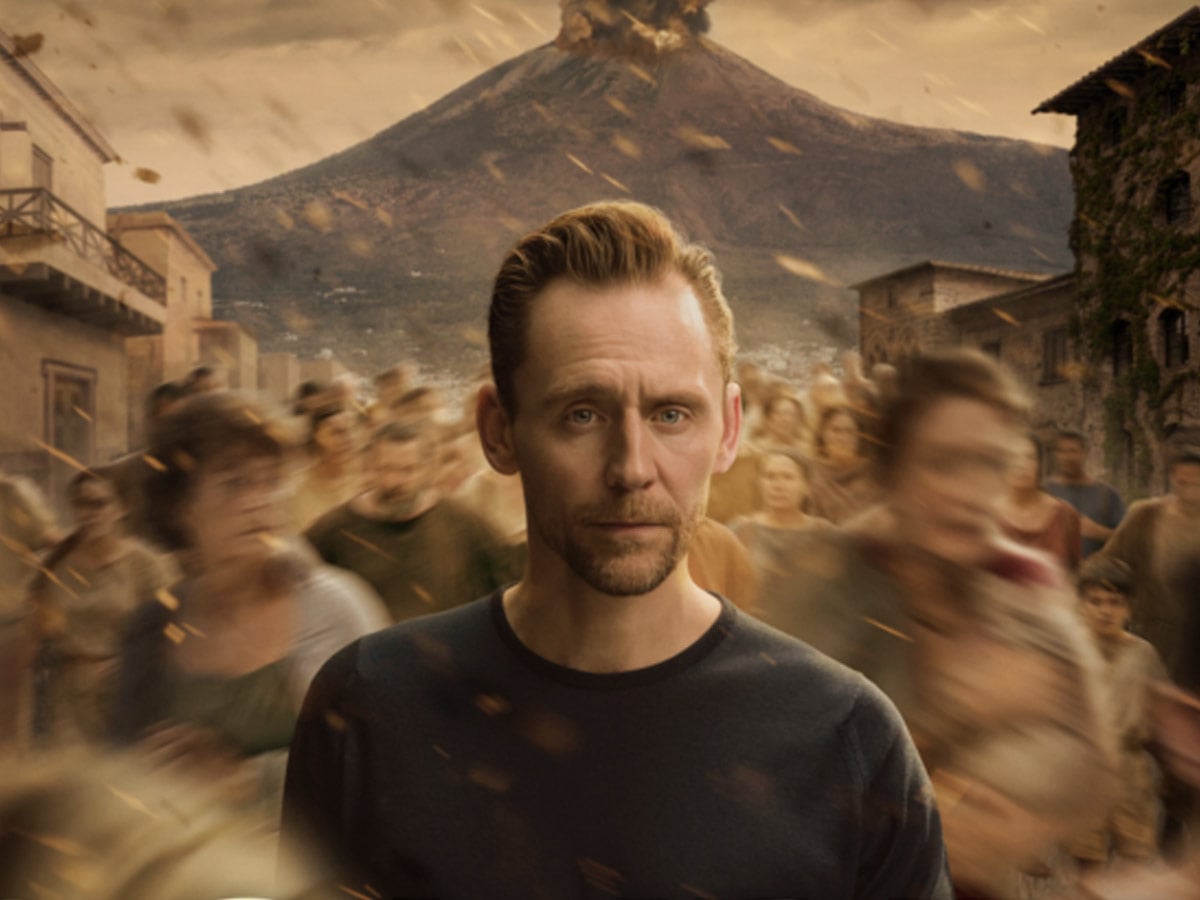
Acts 17:26 says God made every nation from one man, and marked out “their appointed times in history and the boundaries of their lands.” Watching National Geographic’s new docudrama “Pompeii: Out of Time with Tom Hiddleston,” arriving July 22, I found myself thinking about that verse more than once. The series never sets out to be a faith story. But its central question, what still connects us to people who lived and died two thousand years ago, is one Scripture has been answering since Genesis: we all come from one family, and none of our stories exist outside the time and place God appointed for them.
The three-part series reunites Hiddleston with “Loki” executive producer Kevin R. Wright for a new kind of history show: part scripted drama, part investigative documentary. Hiddleston steps directly into history as a host, working alongside a mix of historians and scientists as he pieces together Pompeii’s final hours. In an exclusive interview with Beliefnet, Wright, the former Vice President of Production and Development at Marvel Studios, explained why the team built the series around hope rather than tragedy.
Rather than following one hero, the series traces three real Pompeiians whose lives collided with the eruption: an apprentice barely into his teens, a woman who built her own business in a world not built for that, and a hardened Praetorian Guard soldier. The series rewinds time to return to the same eruption again and again, replaying it through each person’s eyes. “They offer very different life experiences of what they would have gone through that day,” Wright said, calling it an effort to build “a fuller picture of what that day would have looked like.”
Hiddleston, who has described his own fascination with the ancient world as lifelong, said the project let him collapse the distance between eras. “Classical Antiquity is the foundation and cornerstone of Western and European culture,” he said in the show’s official announcement. “The past becomes the present; the past feels so close.” He called hosting the series “a genuine honor,” adding that the goal was to “bring these remarkable human stories back into the light.”
That instinct to find hope rather than horror, Wright said, came directly from the show’s historical consultants, particularly a perspective from Dr. Serena Robinson that reshaped how the writers’ room approached the series. “We were moved very early by Dr. Serena Robinson’s perspective, what she called pro-social behavior,” Wright said. “It’s very easy to look at events and see the darkness in it, but she’s like, ‘Oftentimes it’s the opposite.’ It’s like tragedy brings out the best in people.” He pointed to what happened after the eruption as proof: “It was one of the first major humanitarian efforts in recorded human history. Rome came together to help these people relocate, to help them find new cities where they could start their families again.”
National Geographic executive Tom McDonald called the series “a process of inventing an entirely new genre of history programming, one which brings evidence and imagination together in a way which feels distinctive.” Wright described the discipline behind that blend: the writers’ room worked continuously with academics throughout production, and leaned on psychologists to responsibly fill gaps the historical record couldn’t answer. “You can’t know for certain,” he said, “but we can talk to a psychologist who’s going to tell you how a child would react in this situation, because they still do it today, and they would have back then.”
The series breaks the fourth wall throughout, letting its subjects speak directly to the camera. Wright said the confidence to try that came from making “Loki” with showrunner Tom Barbor-Might. That show used plenty of unconventional storytelling tools that, in his words, “shouldn’t have worked.” Audiences responded anyway, and the team carried that same willingness to experiment into Pompeii. Underneath the technique is an idea Wright kept returning to: the Latin word historia, meaning both “story” and “history.” “The biggest unlocking moment for us was when we found that idea of historia,” Wright said. “The Romans understood that, and it felt like we had to embrace that idea as well.” He said the same tension shows up in how Hiddleston has described the show’s method: a balance of “evidence versus empathy,” leaning on the archaeological record where it exists, and a compassionate reading of it where it runs out.
Asked what he hopes viewers take away, Wright pointed to a posture more than a lesson: “These were real people, and they had real experiences… we’re connected in a lineage to these people. It’s impossible to look at what they went through 2,000 years ago and not see yourself and your family and your neighbors in it.”
That’s exactly the reaction this series gave me. It was something more than a traditional documentary. Watching it, I kept coming back to that verse from Acts: we really are one family, appointed to our own place and time, but never disconnected from the people who came before us. It’s the kind of series I look forward to watching with my own family, and talking about afterward.
“Pompeii: Out of Time with Tom Hiddleston” premieres July 22 at 8/7c on National Geographic and begins streaming July 23 on Disney+ and Hulu.
About the Author:
Nate Powers is a filmmaker and founder of Contrast Collective, recognized with multiple awards for accomplishments in directing, editing, character design, and social impact. He conducts entertainment interviews with actors, directors, and creators as a personal passion alongside his filmmaking career. Connect with him on social media @natepowers.tv
 Read Previous Post