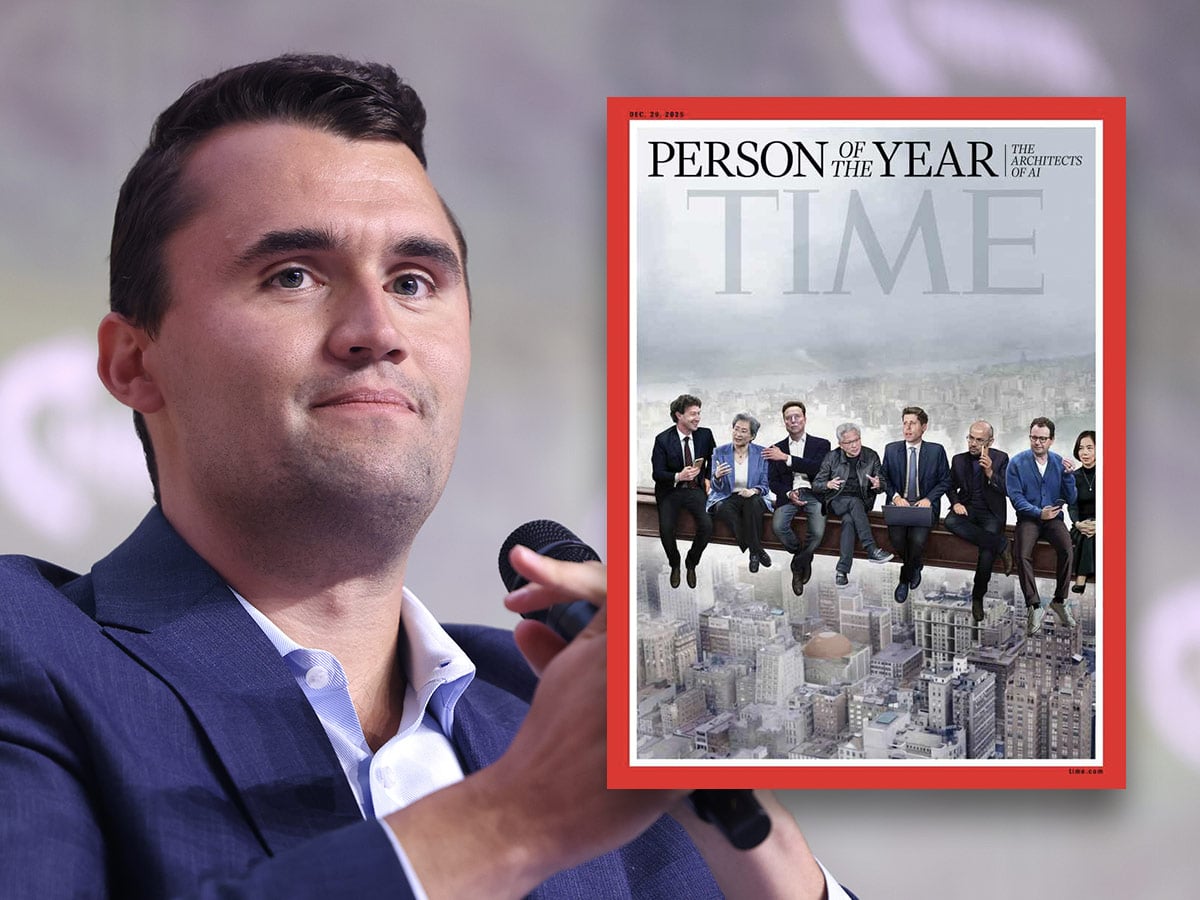
Time magazine’s choice for its 2025 “Person of the Year” is drawing sharp criticism — not for who it honored, but for who it left out. The publication selected a group of tech leaders dubbed the “Architects of AI,” overlooking Turning Point USA founder Charlie Kirk, whose assassination earlier this year became one of the most shocking and consequential events in modern American politics.
The annual recognition, which dates back to 1927, traditionally highlights the individual or group that had the greatest influence — for better or worse — on world events over the past year. However, this time, the magazine’s editors declared that 2025 belonged to artificial intelligence, stating that the “AI revolution roared into view” and transformed life as we know it.
The cover, released on Thursday, reimagined the iconic 1930s photograph “Lunch Atop a Skyscraper” — swapping out steelworkers for eight high-profile tech executives perched on a steel beam high above New York City. The honorees include Meta’s Mark Zuckerberg, AMD’s Lisa Su, Tesla and X’s Elon Musk, Nvidia’s Jensen Huang, OpenAI’s Sam Altman, Google DeepMind’s Demis Hassabis, Anthropic’s Dario Amodei, and AI pioneer Fei-Fei Li. Together, Time called them the “Architects of AI,” praising them for “delivering the age of thinking machines, wowing and worrying humanity, and transforming the present while transcending the possible.”
Time’s editor-in-chief, Sam Jacobs, defended the decision in an essay accompanying the announcement. “This was the year when artificial intelligence’s full potential roared into view, and when it became clear that there will be no turning back or opting out,” he wrote. Jacobs noted that Time has occasionally recognized groups or even concepts — such as “the personal computer” in 1982 and “the endangered Earth” in 1988 — rather than individuals. “We’ve named not just people, but movements,” he added.
Still, many saw the omission of Charlie Kirk as glaring. Kirk, a 31-year-old conservative activist and founder of Turning Point USA, was assassinated on September 10 while speaking at Utah Valley University in what became the first major political assassination in the U.S. since the 1960s. His death triggered an international wave of mourning and renewed conversations about faith, freedom, and civility in political discourse. Millions attended vigils, and social media feeds were flooded with tributes that often quoted Kirk’s outspoken Christian faith and his calls for “a spiritual awakening in America.”
For many of his supporters, Kirk’s impact on the national consciousness — especially in the months following his death — far outweighed the influence of any corporate tech figure. Critics of Time’s choice say the magazine failed to capture the real story of the year: a young leader’s tragic death and the revival of public faith it inspired.
Megyn Kelly, on her podcast The Megyn Kelly Show, didn’t hold back her frustration. “It’s [expletive] AI. It’s AI architects. It’s not Charlie Kirk, which is so obvious,” she said. “It’s as obvious as the nose on your face.” Calling Time’s decision “a thumb in the eye,” Kelly accused the outlet of ignoring “reality based on your own politics.”
She pointed out that Time has previously chosen controversial figures — from Vladimir Putin to Ayatollah Khomeini — based on their undeniable influence, even when unpopular. “To ignore what happened with Charlie Kirk in September and the worldwide revival of faith that followed his assassination is to ignore reality,” Kelly said.
Time’s defenders argue that its selection reflects the broader cultural moment, as AI continues to reshape industries, ethics, and human relationships. But many Americans — particularly people of faith — see a deeper irony: a world enthralled by “thinking machines” overlooking the human cost of division and the enduring power of spiritual conviction.
For those mourning Charlie Kirk, the magazine’s decision is another reminder of how faith-driven legacies are often eclipsed by technology and trend. Yet for millions who continue to quote his words and share his message, Kirk’s impact doesn’t depend on a magazine cover — his influence lives on, beyond headlines and honors.
 Read Previous Post