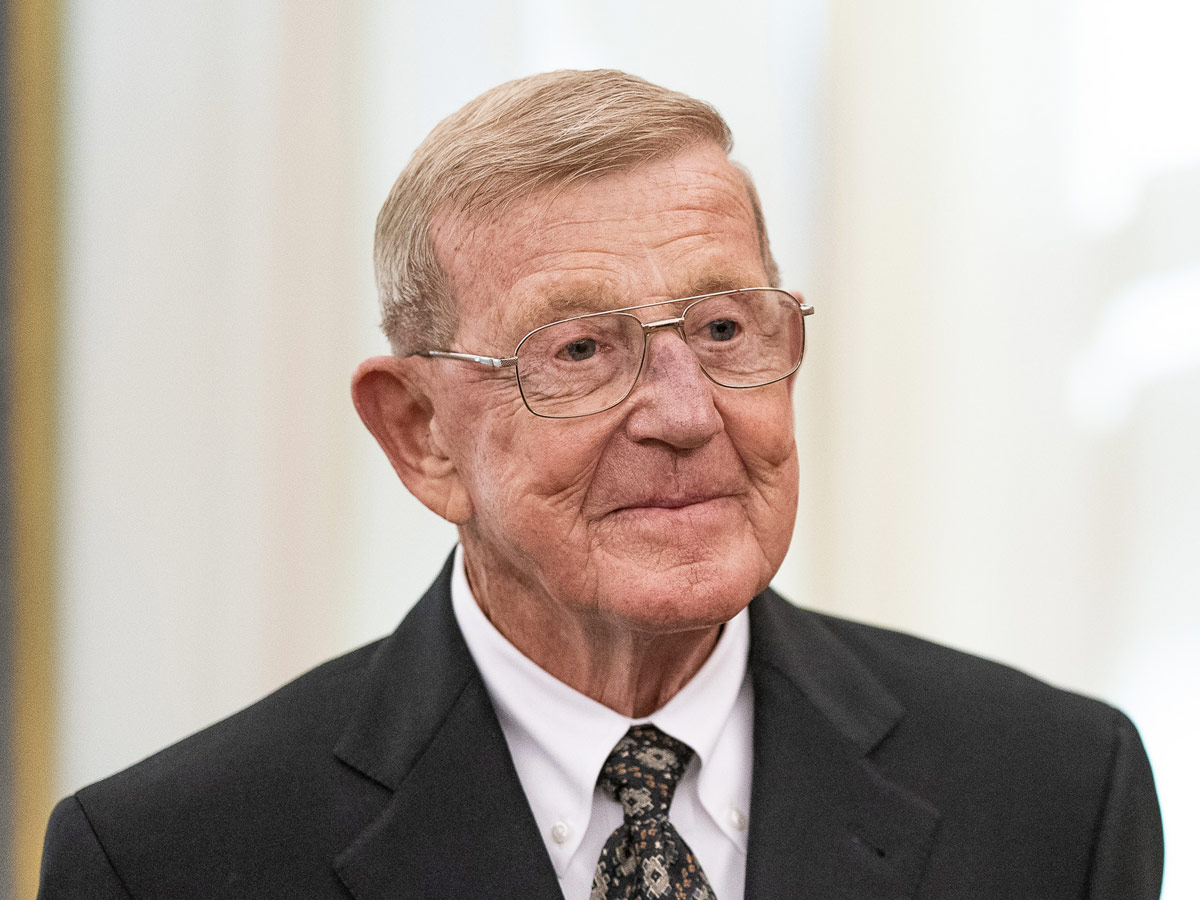
The world of college football is mourning the loss of one of its most influential and beloved figures. Coaching legend Lou Holtz, who led the University of Notre Dame to a national championship and became known for his sharp wit, discipline and deep personal convictions, has died at 89.
Holtz passed away in Orlando, Florida, surrounded by family, according to a statement released by Notre Dame. A cause of death was not provided. In the hours following the announcement, tributes poured in from former players, fellow coaches and fans who remembered not only his remarkable success on the field but also the values he championed throughout his life.
His son, Skip Holtz, offered a simple yet powerful tribute on social media: “He was successful, but more importantly, he was Significant.”
From the family of Lou Holtz pic.twitter.com/aYWiXYVnLq
— The Fighting Irish (@FightingIrish) March 4, 2026
Few coaches in college football history matched Holtz’s ability to transform struggling programs into winners. Over a career that spanned several decades and six college programs — William & Mary, NC State, Arkansas, Minnesota, Notre Dame and South Carolina — Holtz compiled an impressive 249-132-7 record. He also briefly coached in the NFL with the New York Jets during the 1976 season.
But it was at Notre Dame where Holtz cemented his legendary status.
When the Fighting Irish hired him in 1986, the program had fallen on hard times following the tenure of coach Gerry Faust. For Holtz, the opportunity represented the fulfillment of a lifelong dream. Growing up in the 1940s in East Liverpool, Ohio, Holtz had been captivated by Notre Dame football long before he ever imagined leading the program.
“I could not possibly turn down the opportunity to come to Notre Dame,” Holtz said at his introductory news conference. “I just felt this was the dream of a lifetime.”
His connection to the school ran deeper than football. Holtz often spoke about Notre Dame’s Catholic identity and how its spiritual mission shaped how he believed the game should be played.
“I remember at school that we would pray every Friday before a game for Notre Dame’s success,” he once recalled in a later interview with ESPN. “So it’s just part of our religion. It’s a part of the way we are, and the football team should reflect the values of Notre Dame. That means we had to play with great enthusiasm and play together. We had to play with great character, great integrity, but we also should be playing for our lady on the Dome.”
Those values quickly became the foundation of a cultural shift within the program.
Quarterback Steve Beuerlein recalled Holtz’s first team meeting as a moment when players realized things were about to change.
“A lot of us were kind of slouched back in our chairs, had hats on, head back, just not overly impressed with what was going on,” Beuerlein said in a video celebrating 125 years of Notre Dame football. “He got up to the podium, and he looked at our team, and he said, ‘Get your feet on the floor, sit up straight, take your hats off and get ready to play some football.’ We sat up, and we were like, ‘Whoa, what is this guy all about?’ We knew right away that it was a whole new deal.”
Holtz demanded discipline and excellence, and the results followed quickly. In 1987, wide receiver Tim Brown won the Heisman Trophy while Notre Dame finished 8-4 and earned a trip to the Cotton Bowl.
The following season would become the crowning achievement of Holtz’s career.
The 1988 Fighting Irish produced a perfect 12-0 season that culminated in a national championship. Along the way, they defeated archrival Miami in a legendary matchup famously dubbed “Catholics vs. Convicts.” The emotional 31-30 victory, sealed when Notre Dame’s Pat Terrell knocked down a two-point conversion attempt late in the game, remains one of the most iconic moments in college football history.
Notre Dame would finish the season by defeating USC and then beating West Virginia in the Fiesta Bowl to secure the title.
Holtz went on to win 100 games at Notre Dame during his 11 seasons, leading the Irish to nine straight January bowl appearances and setting a school record with 23 consecutive victories in 1988 and 1989.
Former running back Autry Denson once reflected on the impact of that success.
“I think what he did was he made that job look so easy that some people took it for granted and thought anybody could do it,” Denson said.
Holtz stepped away from Notre Dame in 1996, later explaining that the pressure of maintaining such high expectations had taken its toll.
“I was tired of maintaining,” he said in a 2002 interview. “What I should have done was set dreams and goals and ambitions for this university and the football program that nobody thought was possible.”
Yet retirement did not last long. In 1999, Holtz returned to coaching at South Carolina, where he worked alongside his son Skip and once again demonstrated his ability to rebuild a struggling program.
After going winless in his first season, the Gamecocks rebounded to finish 8-4 the following year, earning consecutive New Year’s Day bowl appearances — a first in school history.
Holtz was inducted into the College Football Hall of Fame in 2008 and later received the Presidential Medal of Freedom in 2020. After his coaching career, he spent more than a decade as a popular analyst for ESPN, where fans affectionately knew him as “Dr. Lou.”
Still, it was often Holtz’s humor and life wisdom that made him especially beloved. Known for quick one-liners and memorable advice, he often spoke about perseverance and humility.
“Coaching is nothing more than eliminating mistakes before you get fired,” he once joked.
Another favorite line captured his philosophy of hard work: “No one has ever drowned in sweat.”
Yet beneath the humor was a man deeply aware that life’s true meaning extended beyond wins and losses. In his book Wins, Losses, and Lessons, Holtz wrote with humility about how fleeting earthly achievements can be.
“When I die, and people realize that I will not be resurrected in three days, they will forget me,” he wrote. “That is the way it should be.”
For many who knew him, however, Holtz’s legacy will not be forgotten so easily.
“Lou Holtz was the rare blend of fierce competitor and master storyteller,” longtime coach Tom Coughlin said. “But beyond the humor was a man of deep conviction and character who supported his peers and led with integrity.”
His four children survive Holtz — Luanne, Skip, Kevin and Elizabeth — and leave behind generations of players, coaches and fans who were inspired by his leadership, his faith and his unwavering belief that character matters more than any scoreboard.
 Read Previous Post