

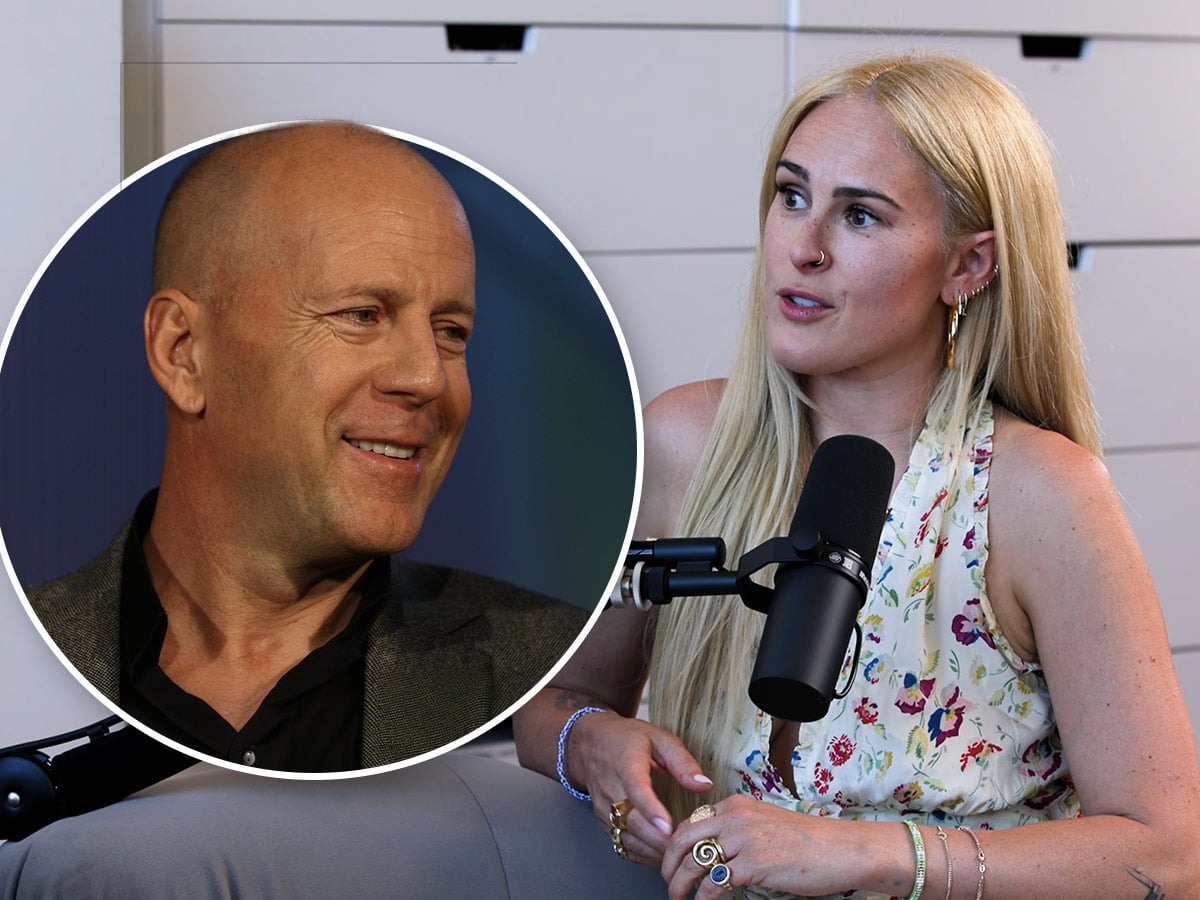
Bruce Willis’ daughter, Rumer Willis, is opening up about the emotional changes her family has experienced since the beloved actor was diagnosed with frontotemporal dementia — and she says the difficult journey has revealed a softer side of her famous father that many people never got to see before.
It has now been three years since Bruce Willis’ family first publicly revealed his health struggles. In 2022, the Die Hard star stepped away from acting after being diagnosed with aphasia, a condition that affects communication and language abilities. A year later, his family announced that his condition had progressed into frontotemporal dementia, commonly known as FTD.
Speaking recently on The Inside Edit podcast, Rumer reflected on how much she treasures the time she still gets to spend with her father despite the heartbreaking diagnosis.
“I’m so grateful I get to go see him,” Rumer shared. “Even though it’s different now, I’m so grateful.”
The actress said one of the most unexpected parts of the journey has been seeing a new emotional side of Bruce emerge.
“There’s a sweetness,” she explained. “He’s always been this kind of macho dude and there’s like a — fragile is not the right word but — just a tenderness that maybe being Bruce Willis might not have allowed him in a certain way.”
Rumer also admitted she had no idea how common FTD was until her father’s diagnosis connected her with countless other families facing similar battles.
“It’s wild to me,” she said. “So many people come up to me now and they say, ‘My uncle had FTD. My dad had this.’”
According to the Mayo Clinic, frontotemporal dementia is a group of brain diseases that mainly affect the frontal and temporal lobes of the brain, which are associated with personality, behavior, and language. The Willis family previously described it as “a cruel disease that many of us have never heard of and can strike anyone.”
The family added at the time that FTD is the most common form of dementia for people under 60 and noted that there are currently no treatments for the disease.
Back in November, Rumer gave another update during an Instagram Q&A, telling fans that while “anybody with FTD is not doing great,” her father still had a “spark” in him.
Bruce’s wife, Emma Heming Willis, has also spoken openly about the realities of caregiving and how the family has adapted as the disease has progressed. In an interview with Diane Sawyer last year, Emma explained that Bruce remains physically healthy overall despite the cognitive decline.
“Bruce is still very mobile. Bruce is in really great health overall,” she said. “It’s just his brain that is failing him… The language is going, and, you know, we’ve learned to adapt. And we have a way of communicating with him, which is just a… different way.”
Rumer also praised the way Bruce’s blended family continues to rally around him through every stage of the journey. Bruce shares daughters Rumer, Scout, and Tallulah with ex-wife Demi Moore, while he and Emma share daughters Mabel and Evelyn together. Despite Bruce and Demi divorcing in 2000, the family has remained close and supportive.
“We don’t do it perfectly, but we’re always striving to continue to create connection and find ways to be with each other and support each other through something that is kind of unprecedented,” Rumer said.
Emma has since turned the family’s painful experience into a mission to help others navigating dementia and caregiving. Earlier this year, she launched The Emma & Bruce Willis Fund for Dementia Research and Caregiver Support to help raise awareness and support families affected by FTD.
The Willis family has repeatedly said they hope Bruce’s story brings greater attention to the disease and the people impacted by it. “Bruce always believed in using his voice in the world to help others,” the family shared in a previous statement. “He would want to respond by bringing global attention and a connectedness with those who are also dealing with this debilitating disease.”
Despite the heartbreaking diagnosis, the family said Bruce “has always found joy in life — and has helped everyone he knows to do the same.”
And according to Rumer, that warmth and tenderness are still shining through even during the hardest moments.