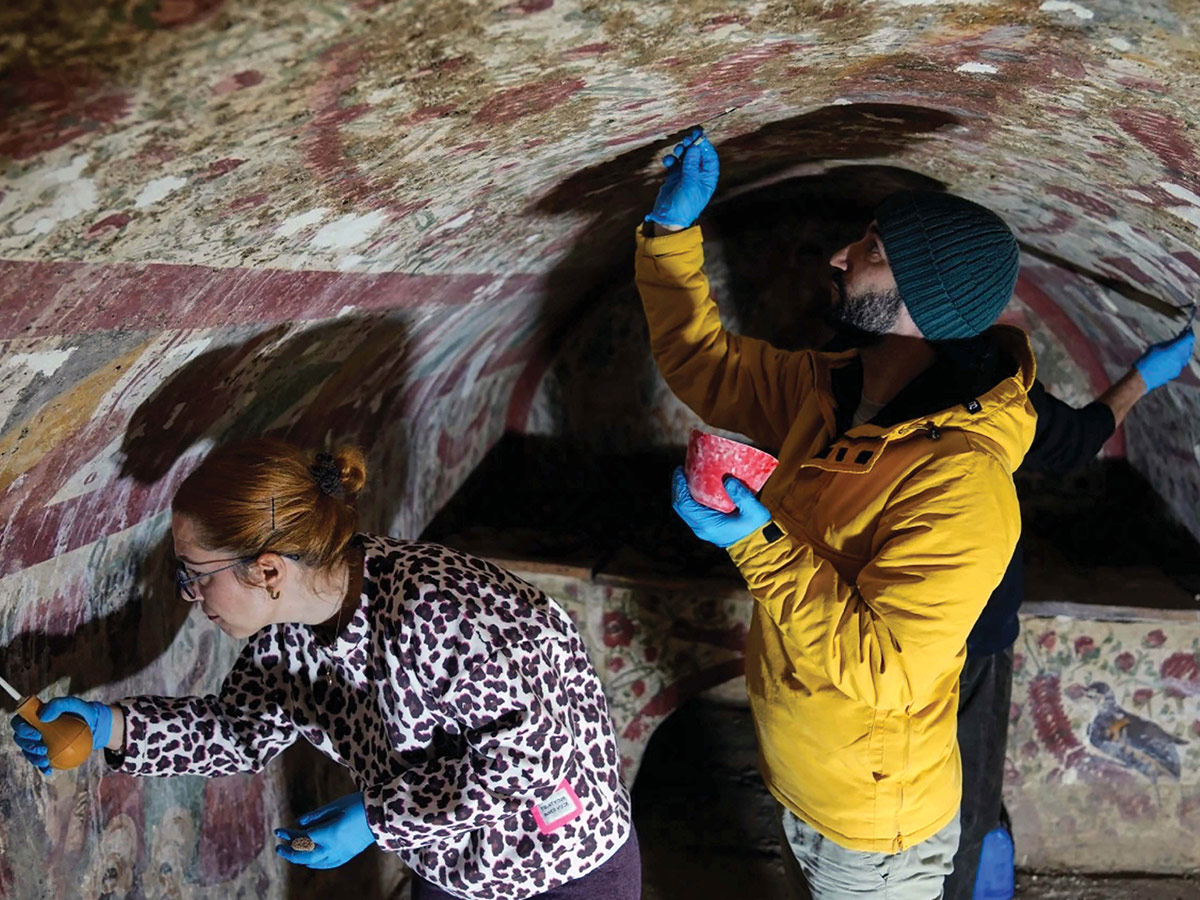
Archaeologists announced the discovery of a fresco with a rare depiction of Jesus on it. In August, archaeologists in Turkey discovered a fresco with a Roman-looking Jesus portrayed as the “Good Shepherd.” The fresco was discovered in an underground tomb in the village of Hisardere near Iznik, the birthplace of the Nicene Creed in 325 AD. The Creed confirmed many of the standard Christian beliefs of today such as the Jesus’s standing in the Trinity. During the time it was established, Arianism was being promoted, which stated that Jesus was not in fact God.
The tomb where the fresco was discovered dates to around the 3rd century, when the region was still under the Roman Empire and Christians faced persecution. The “Good Shepherd” image depicts a youthful, clean-shaven Jesus with a lamb over his shoulders. Gulsen Kutbay, lead archaeologist, described making the discovery. “We found that this tomb had been previously desecrated. In our initial examinations inside the tomb, which is oriented north-south, we encountered a fresco of the Good Shepherd Jesus on the north wall,” he told The Associated Press. “We believe that the other walls also contain depictions of individuals who likely belonged to an aristocratic or noble family. These depictions are very similar to the Fayum portraits.”
Archaeologist Eren Erten Ertem described the fresco as showing a shift in the religious culture of the region. “The depictions in the frescoes found inside the hypogeum tomb show a transition from late paganism to early Christianity, depicting the deceased being sent off to the afterlife in a positive and fitting manner,” he said. Kutbay noted that the image of Jesus as the Good Shepherd, used before the image of the Cross was more widely adopted in Christian symbolism, was extremely rare and suggested it could be “the only example of its kind in Anatolia.” Five individuals were also uncovered at the site, with two of them being too poorly preserved to determine their ages, according to anthropologist Ruken Zeynep Kose. Archeologists were able to determine that two of the bodies were young adults and another was a 6-month-old infant.
Pope Leo XIV had recently visited Iznik on his first international tour since becoming Pope. His visit marked the 1,700th anniversary of the Council of Nicaea. Turkish President Recep Tayyip Erdogan presented the Pope with a tile painting replica of the fresco.
 Read Previous Post