
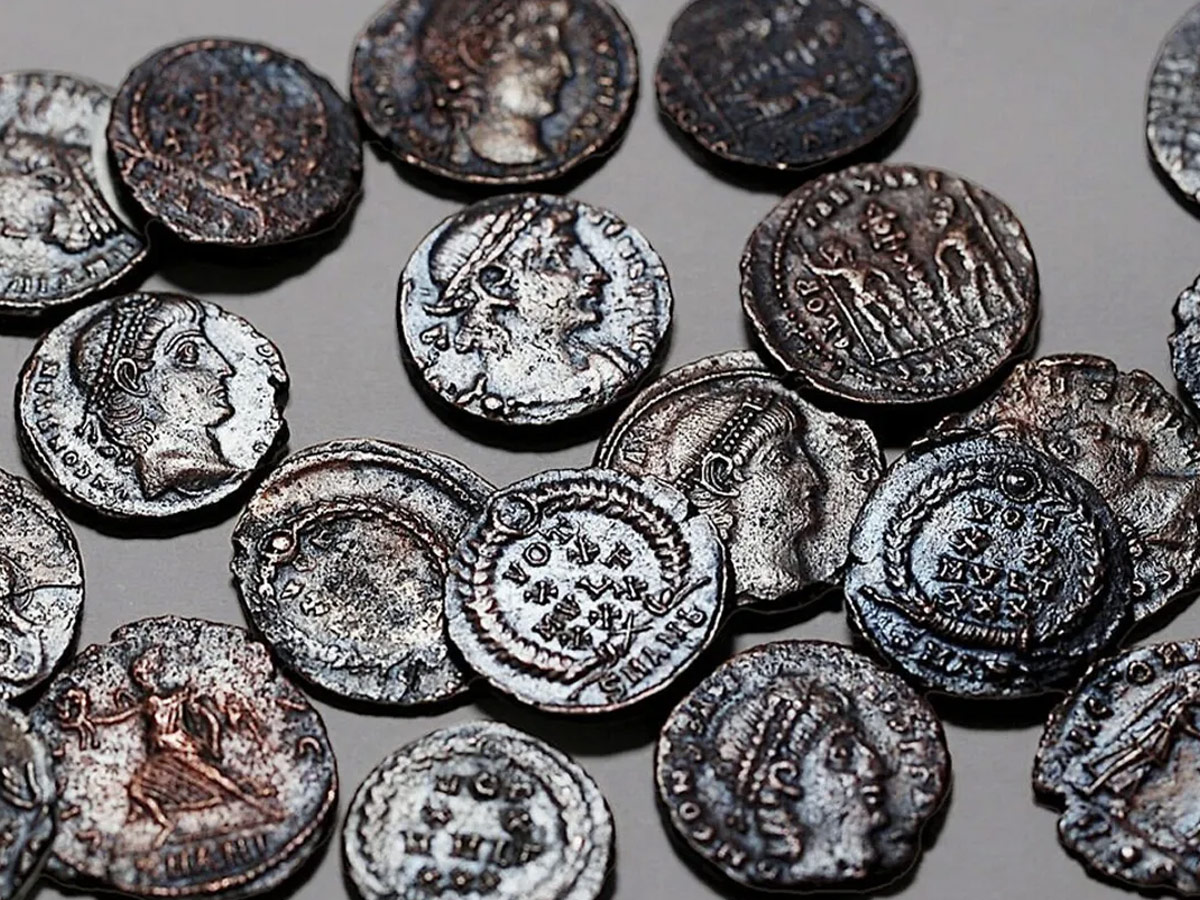
Archaeologists with the Israel Antiquities Authority (IAA) and Zefat Academic College announced the discovery of 22 ancient bronze coins found in Huqoq near the Sea of Galilee, which is near the Sea of Galilee. The coins date from around the 4th century AD and were discovered in a narrow crevice at the end of a winding tunnel. The tunnel was part of an underground network known as the Huqoq hiding complex. The tunnels were first dug beneath Huqoq during the first Jewish revolt against the Romans, known as the Great Revolt, which took place during 66-70 AD. The tunnels were later expanded during the Bar-Kochba Revolt from 132 to 136 AD.
However, the coins were dated during the third and last Jewish rebellion known as the Gallus Revolt. Archaeologists were able to date the coins due to bearing the image of Roman emperors Constans I and Constantius II, who ruled during the Gallus Revolt. During that time period, Jewish rebels revolted against the Romans in the eastern provinces. The rebellion was soundly crushed by the Romans, but archaeologists believe the coins might have been stashed with the hope of taking up the fight again later.
Finding coins dating to the lesser-known third revolt startled Prof. Yinon Shivtiel of Zefat Academic College and IAA archaeologist Uri Berger, who conducted the excavation. “A few months ago, as we were excavating the hiding complex in Huqoq, uncovering evidence from the First Jewish Revolt and the Bar Kochba Revolt, and we found the coins/ When we checked who the emperors appearing on them were, we realized that the coins were from the period of the rebellion that started in Tzippori [in the Galilee] in 351 CE,” said Shivtiel.
The coins are especially precious given how little archaeological evidence there is of the Gallus Revolt. “A priest named Hieronymus wrote briefly about the revolt, saying the Jews began their rebellion in Tzipori but were quickly crushed by the Romans. Now we can see that the Jews of the Galilee followed the path of their forefathers, retreating into the hiding complexes with their possessions — including this hoard of coins,” said Shivtiel. Shivtiel stated part of the difficulty in identifying evidence of the Gallus Revolt is due to an earthquake that struck Israel a decade after the revolt.
The coins were found while archaeologists were clearing up the site to make it more accessible to the public. “Fortunately, it was the many volunteers excavating the hiding complex who actually uncovered this important treasure, and they enjoyed this great moment of the joy and excitement of discovery,” said Einat Ambar-Armon of the IAA. “The excavation thus became not only an important scientific event, but also a significant communal educational experience – one that brings the public closer to its heritage, and strengthens the sense of belonging and the connection to the past.”
 Read Previous Post