
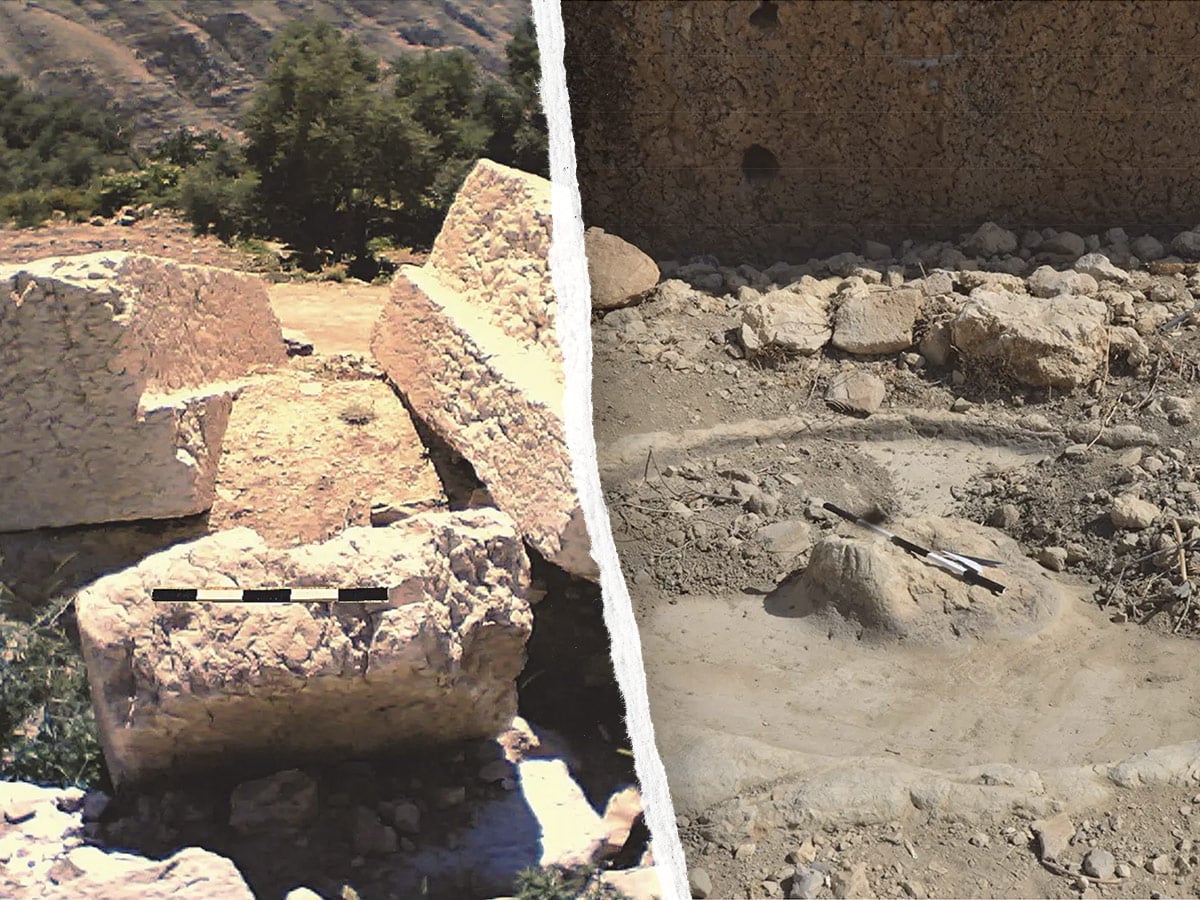
Archaeologists were able to find the remains of an ancient Byzantine city thanks to the help of a 1,500-year-old map. Musallam R. Al-Rawahneh, an associate professor of archaeology at Mu’tah University in Jordan, began a search for the ancient city of Tharais in 2021. One tool Al-Rawahneh used to find the city is known as the Madaba Mosaic Map, a sixth-century floor mosaic found in the Greek Orthodox Church of St. George in what is now Madaba, Jordan. The map depicts the locations of 157 sites throughout the ancient world, including Tharais. The city’s location had eluded archaeologists for over 100 years, but using the map, Al-Rawahneh and his team were able to trace the site to the Jordanian village of El-ʿIrāq.
Tharais had been an important hub of activity during Byzantine Empire. Al-Rawahneh stated it was more than just an agricultural site. “The prominence of Tharais on the Madaba Map and the discovery of a basilica church structure suggest that it served not only as an agricultural village but also as a sacred site and commercial rest stop,” he said. Archaeologists uncovered a number of artifacts that hinted at not only a vibrant agricultural community, but also a commercial and religious hub. Findings included fragments of mosaic floors, glassware, and even architectural features resembling a Byzantine basilica church. “[It] reflects Byzantine design, including a prominent entrance and possible remnants of decorative elements,” Al-Rawahneh told Fox News Digital.
Excavators were surprised by the accuracy of the Madaba Mosaic in its representation of Tharais. The map depicts towers near the city’s entrance, just as it was found, as well as the special arrangements of buildings being accurately displayed on the map. The site also includes evidence of olive oil presses, windmills, and grape crushing equipment, pointing to a thriving community. There are also inscriptions of Greek and Latin funerary inscriptions, indicative of the presence of a Christian community within the region. Despite its affluence, however, the site would be eventually abandoned around the 7th century AD.
While the site continues to hold fascinating secrets for researchers, the continual urbanization of the region could pose challenges for future excavations. With the region’s housing and infrastructure expansions, Al-Rawahneh expressed concerns that the site could be lost. “Our aim is not just to uncover Tharais, but also to advocate for the protection of Jordan’s rich cultural heritage,” he said.
 Read Previous Post