
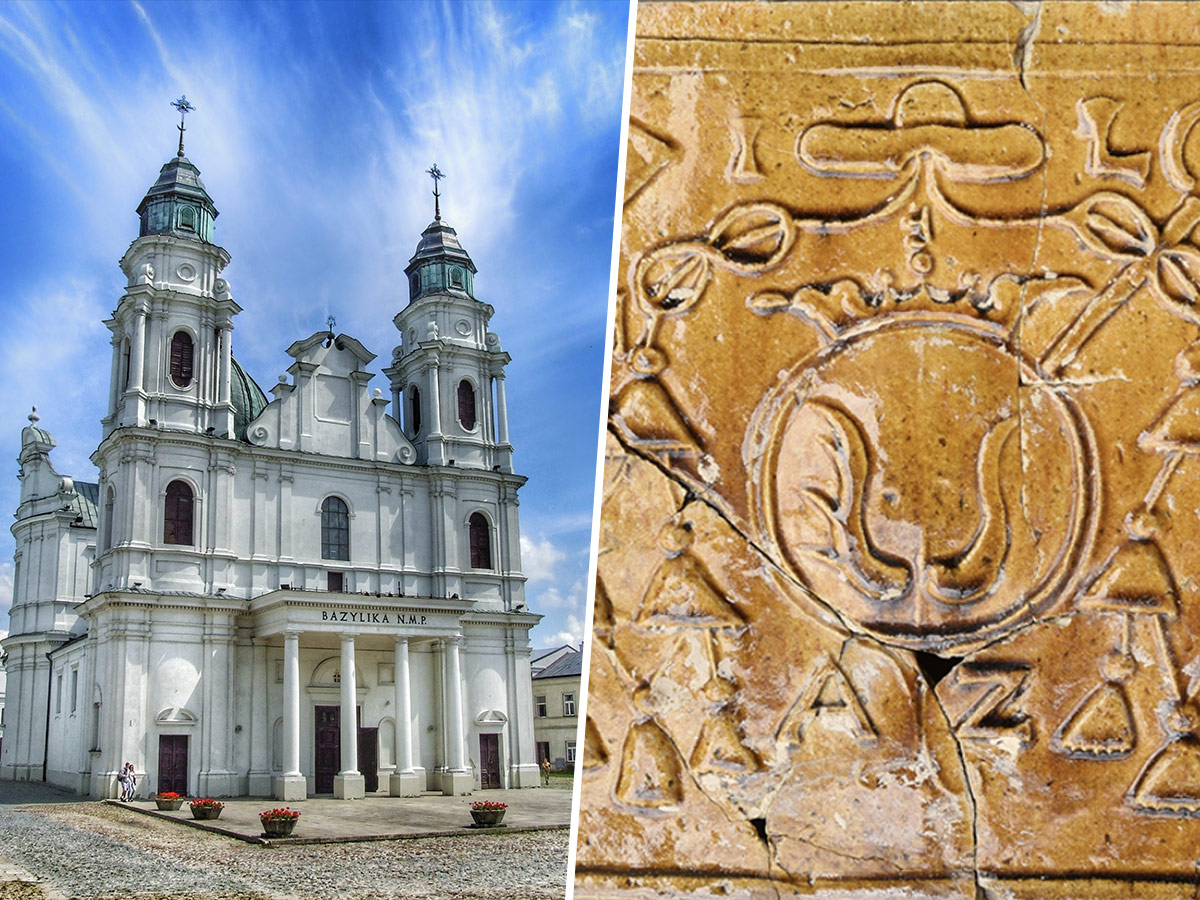
Archaeologists in Chelm, Poland uncovered a “sensational find” while excavating a 17th-century Basilian monastery next to the Basilica of the Birth of the Virgin Mary in Chełm, Poland, a Roman Catholic church built in the 13th century that has served as an Eastern Orthodox church in the past. The monastery was once home to Greek Catholic monks under St. Basil and revealed some rare green heraldic tiles under the upper room floors. “This year’s research season has yielded a sensational discovery,” researchers noted. “After dismantling the wooden floors on the upper level of the former Basilian monastery, hundreds of fragments of very rare heraldic tiles were found in the fill.”
Researchers described the tiles as, “in green and brown, and were made to order with specific symbolism, a bishop’s coat of arms and titles.” Understanding the significance of the tiles could take some time, however. “Currently, work is ongoing to inventory, piece together and study these extraordinary artifacts,” stated researchers. The tiles appeared to be made to fit a stove, with rectangular shapes distinctive for that function. Heating stoves would have been a common feature of such monasteries. The pieces appeared to be custom made according to archaeologists.
The statement outlined the unique structure of the tiles. “One of the reconstructed tiles had a faceplate shaped similarly to a square, measuring 25.8 cm x 25 cm x 9.5 cm (height of the chamber), while another measured 24.5 cm (length of one side) x 7.8 cm (height of the chamber),” it noted. The tiles are believed to date from 1711 to 1730. They also bear a reference to the name of one of the monastery’s superiors, Józef Lewicki. . He would eventually go on to become the bishop of Chewam Eperchi in 1711. The tiles include initials such as an “I,” “L” and “CH,” which may also be linked to Lewicki. Some of the tiles include bell-like images, tools, and ribbons.
The find is especially intriguing as the time of the Greek Catholic monks in the region remains mostly unknown. Researchers are hopeful that after the items are inventoried, they can begin the process of further exploration of what the daily life of the monastery would have been like.
 Read Previous Post