
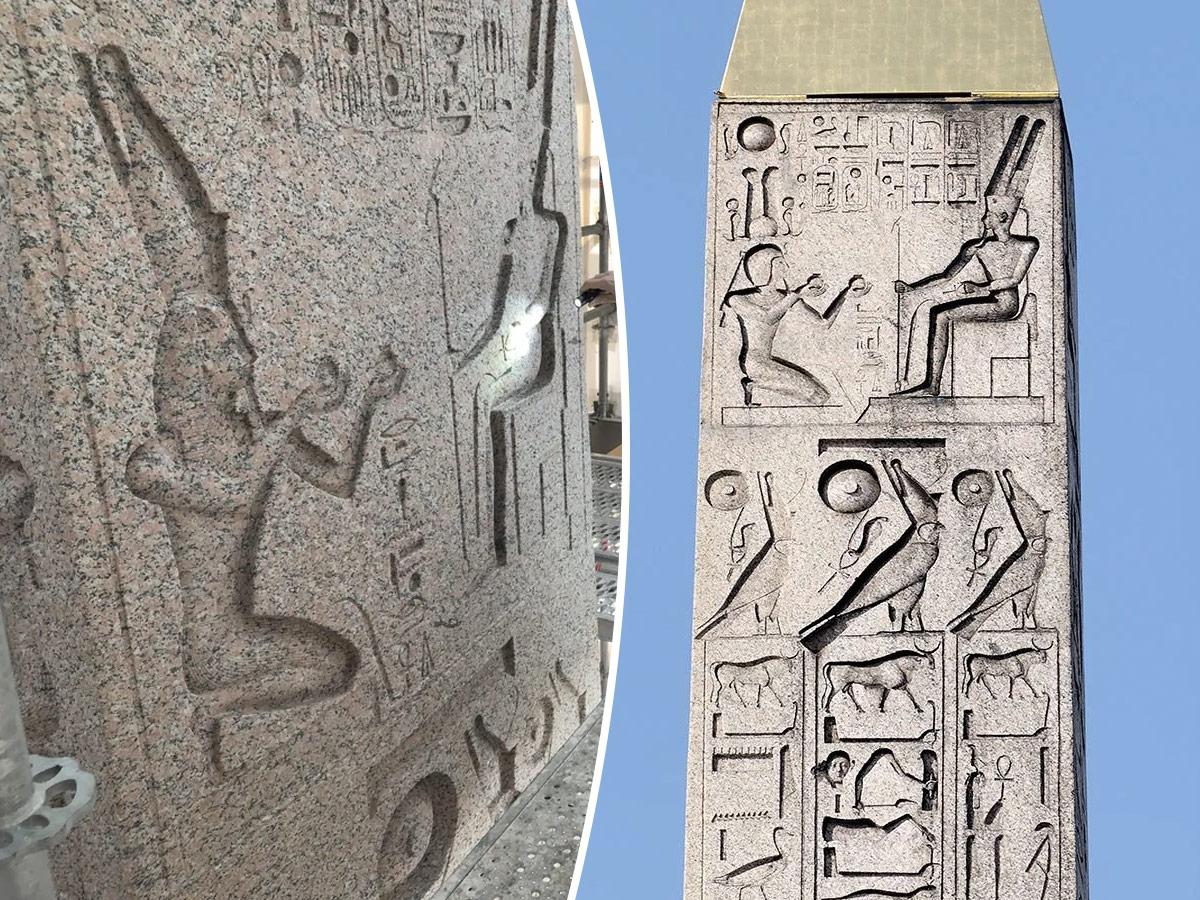
A French Egyptologist has uncovered ancient “propaganda” supporting Pharoah Ramesses II, who some have identified as the Pharoah in power during the time Moses demanded the release of the Israelites, as recorded in the book of Exodus. Jean-Guillaume Olette-Pelletier, an Egyptologist from Paris-Sorbonne University and Institut Catholique de Paris, spent his idle time during the COVID-19 pandemic walking around the streets of Paris, where he passed by the 3,000-year-old Luxor Obelisk. During his walks, he began to notice something strange about the ancient hieroglyphs that adorned the Obelisk and began writing them down. “I would walk up to it and read the hieroglyphs on its surfaces to relax. At one point, I realized something unusual: The hieroglyphs’ meaning indicated a direction, that of the entrance to the portico of the Temple of Luxor. But that was just the beginning,” he told Sciences et Avenir’s Marine Benoit. In 2021, he received permission to climb the 70-foot obelisk for a closer look.
What Olette-Pelletier found were seven cryptographies, or codes. “It was a message from Ramesses II to the nobility,” he told Fox News. “The nobility, able to read cryptographies, might be tempted by an overthrow of power since Ramesses II was not born of theogamy and therefore not divine by birth,” he said, noting that Ramesses was born before his father, Seti I became Pharoah, meaning he would not have been considered divine. The placing of the codes indicates the intended audience, according to Olette-Pelletier. “Given the angle of approach, the nobility would have seen the hidden message and reflected: ‘the king confirms himself as god incarnate, who cannot be dethroned. It was propaganda aimed at the very high intellectual elite,” he said in an email.
Having taken power at the age of 25, considered late for a Pharoah, and having been born outside of divinity, Ramsses had to spend much of his reign establishing his right to rule. “[Ramesses II] spent the first two years of his reign emphasizing his divinity with his wife Nefertari by paying homage at Egypt’s great shrines, and by buying priests. In the process, he changed his name from Usermaatra to Usermaatra Setepenra, [which means] ‘chosen of Ra,’” said Olette-Pelletier. Ramesses’s use of codes also “underlined his divine knowledge.” Ollette-Pelletier said it was another example of the mysteries left for Egyptologists. “The use of hieroglyphic cryptography allows us to provide a new reading of pharaonic texts. It’s an example proving that Egyptology still holds a lot of things waiting to be discovered.”
 Read Previous Post