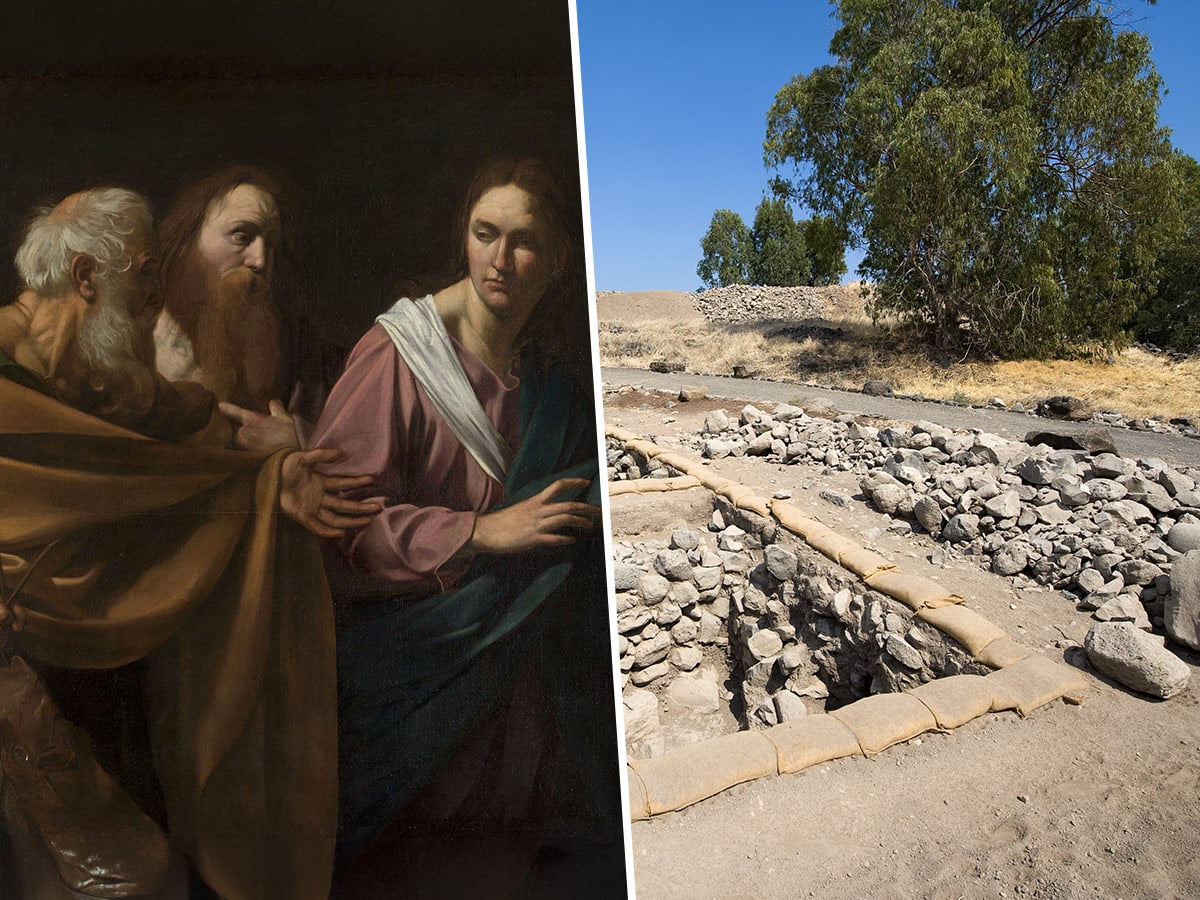
Archeologists have given an update on excavations on a site that could be one of the most important Biblical cities mentioned in the Bible. Steven Notley, the academic director of the El Araj Excavation Project, gave a presentation where he essentially confirmed that the site known as El Araj was once the ancient city of Bethsaida. Bethsaida is mentioned in the New Testament as the birthplace of three of Jesus’s disciples: Phillip, Peter, and Andrew. It was also the scene of a number of Jesus’s miracles, including Jesus walking on water and healing a blind man. Some also believe it may have been the site where Jesus fed the 5,000. Mentions of Bethsaida became less frequent after Jesus returned to Heaven, with some archaeologists believing the city may have been renamed Julias after Caesar Augustus’s daughter. This name change is mentioned in “Antiquities of the Jews” by first-century CE Jewish-Roman historian Josephus: “Philip [son of Herod the Great] advanced the village Bethsaida, situated at the lake of Gennesareth, unto the dignity of a city, both by the number of inhabitants it contained, and its other grandeur, and called it by the name of Julias, the same name with Caesar’s daughter.”
Notley listed out a number of finds that led his team to believe the site is Bethsaida, where excavations had begun in 2016. In 2018, archaeologists uncovered the remains of a Byzantine-era basilica said to have been in Bethsaida. Excavations at the basilica revealed a mosaic with the inscription “Chief of the apostles and keeper of the keys of heaven, intercede for him and his children George and Theophano.” Archaeologists also uncovered a first-century house beneath the basilica’s apse in 2023. A wildfire last year burned away thick brush that had previously hindered some of the researchers’ efforts, enabling them to uncover evidence of columns at the site. “After the fire, we carried out a ground survey and saw that the site was much larger than we realized. We identified remains of private houses as well as architectural elements typical of public buildings, including pillar drums, two Corinthian capitals, two Doric capitals, and several cornices,” Prof. Mordechai Aviam of Kinneret College, who was leading the excavation in 2025, told The Times of Israel at the time of the fire.
The site, according to Notley, matches a description by Willibald, an eighth-century bishop of Eichstätt in Bavaria, Germany. In 725 AD, Willibald traveled to Jerusalem and wrote about a church that had been built over the home of brothers Peter and Andrew. “So, we have a first-century house wall under the apse,” said Notley. “It doesn’t have a plaque on it that says, ‘Peter slept here,’ but from a perspective of archaeology, it doesn’t get much better than that.”
 Read Previous Post