In the early 1700s, Spanish missionaries made the dangerous journey to what is now modern-day Texas with the dream to share the Gospel with the native Karankawa people. They founded a mission, Mission Nuestra Señora del Espíritu Santo (Mission Our Lady of the Holy Spirit) where it became associated with the Spanish fort Presidio La Bahía and Fort Saint Louis. The missionaries inhabited the mission from 1721 to 1725 before abandoning the site due to the difficulties of the climate and the native people. They left for Goliad, TX, where they established a new mission.
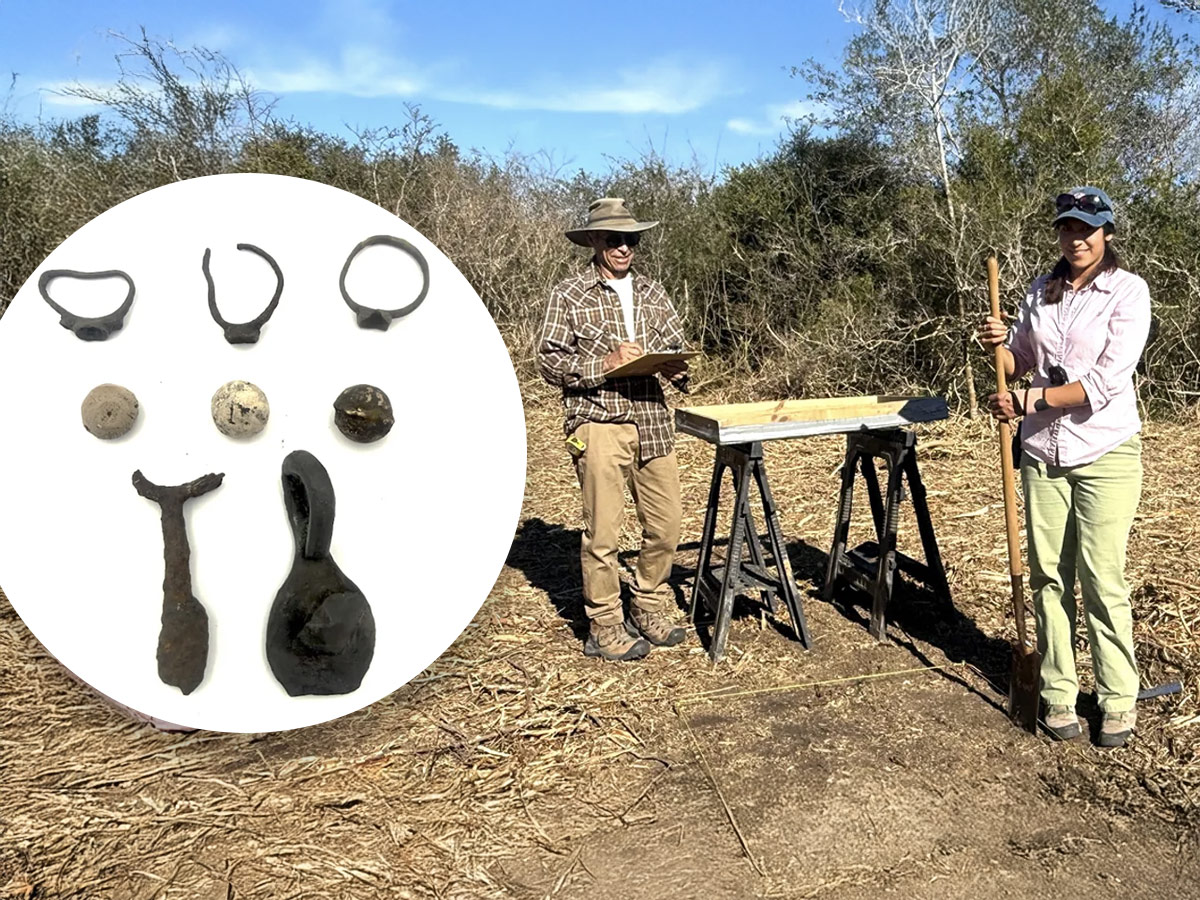
Mission Nuestra Señora del Espíritu Santo fell into decline and soon disappeared from the records, with its exact location lost to history. Throughout the decades, archaeologists have sought to recover the site of the lost mission, to no avail, until a team of archeologists and students from Texas Tech University (TTU) led by Tamra Walter finally found it this month. Speaking to Fox News, Walter shared that her students were “very excited” by the find. She also listed out some of the artifacts the team uncovered at the site. “We found lead shot and sprue, sourced to the mines in Boca de Leones in Nuevo Leon, Mexico, rose head nails — indicative of this time period — [and] parts of a copper kettle, including a handle,” said Walter. Pottery was also uncovered along with other objects that are waiting to be identified.
She said the site was significant, noting it as “one of the earliest definitively located Spanish missions in Texas.” The site brought great excitement to the archaeologists, with Walter adding that it “helps to provide a rare, undisturbed snapshot of daily life on the Spanish frontier in the early 18th century.” Walter hopes to bring another group of students back to the site to complete the excavation.
Speaking to The Texas Standard, Walter described some of the initial difficulties in uncovering the site. “Well, there are a lot of reasons why it was difficult. Part of that has to do with the documentary records. You get Spanish records that give you some idea about the distance between now what is the known side of La Bahia that would say ‘well, it’s about a three-quarters of a league from the Presidio to the Mission’ and those directions aren’t always exact,” she said. “Another really big problem for us is that in the century since the Spanish have left, it’s been overgrazed. And as a result of that, there’s a lot of vegetation that covered the area. So clearing that area was essential for helping us find the artifacts underneath.” She shared her hopes for what they can learn from the mission. “What was it like to live on the Spanish frontier in the 1720s? What was their day-to-day existence like? How were they surviving? Those are things that we can’t get out of the written records, but archeology can look at/through the things that people leave behind,” she said. “So that’s what we’re hoping to see. Just, it’s this moment in time, this snapshot of 1720s Spanish colonial Texas that this site allows us insight into.”
 Read Previous Post