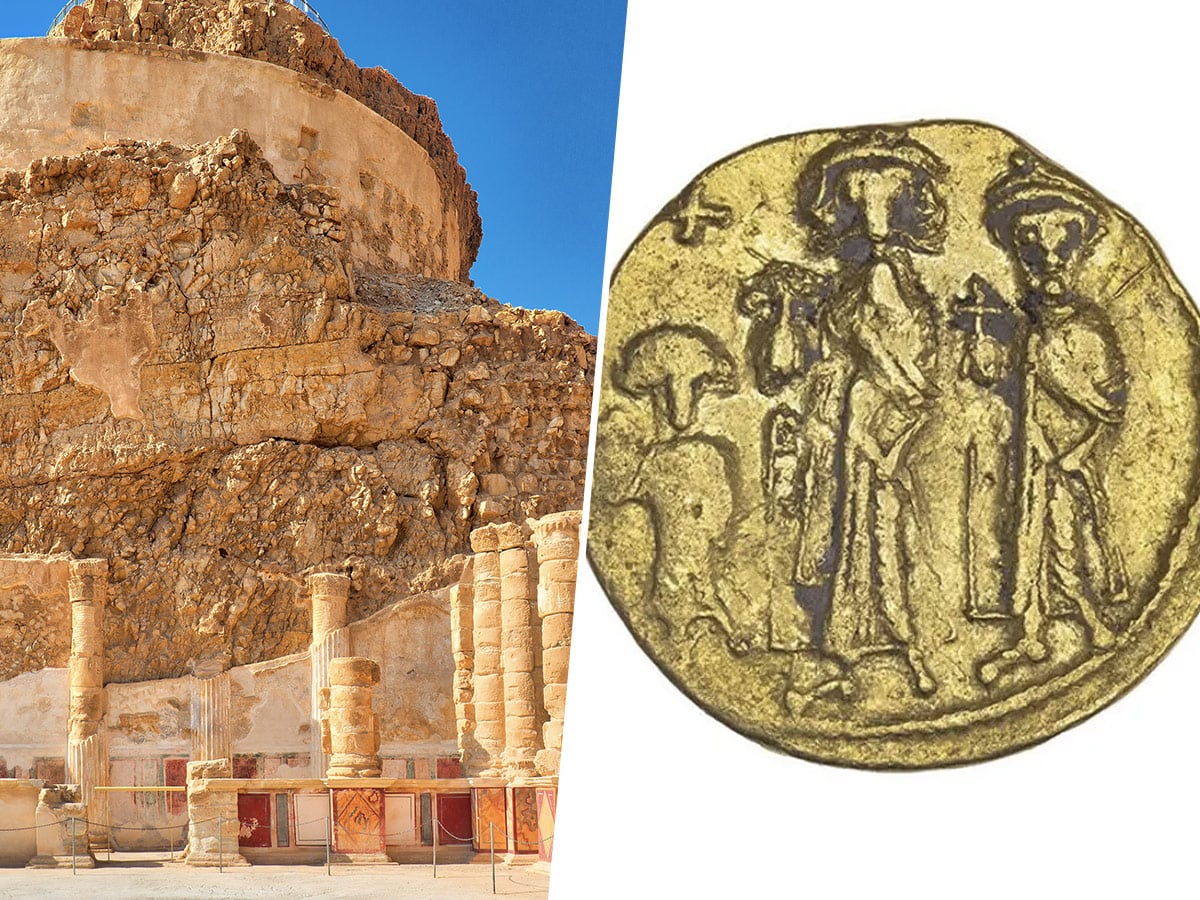
Archaeologists have discovered 1,400-year-old coins in the Judean Desert that could give insight to the Christian community in the area. Israel’s Coordinator of Government Activities in the Territories (COGAT) announced the discovery of two gold coins discovered at the Hyrcania archaeological site, which is about 10 miles from Jerusalem. A gold ring was also uncovered. The coins, referred to as solidi, bear the image of Emperor Heraclius, who ruled the Byzantine Empire from 610 to 641 AD. The other side of the coins bears a cross. The site where they were found was first a fortress named Khirbet Hyrcania in the Hellenistic period. It was later destroyed by the Romans and rebuilt by King Herod the Great before being abandoned after his death. By the 5th century, Christian monks resettled the area. The announcement of the discovery was made on Christmas Eve, although it remains unclear what was the exact date the coins and ring were found.
Binyamin Har-Even, head of the Civil Administration’s Archaeology Unit said the discovery revealed “an important chapter from the Byzantine period and the early Christian tradition in the region.” A statement shared that the monastery at the site was “attributed to the activity of Saint Sabbas, one of the founders of desert monasticism.” The ring also appears to have some sort of connection to the monastery’s religious dealings.
The monastery eventually fell out of use around the late 8th century or early 9th century. During that time, the area has fallen prey to looters and treasure hunters, who have plundered historical sites in search of gold. This makes finding the coins even more important given how rare it is to uncover finds left behind by the looters. The Archaeology Unit has partnered with the Hebrew University of Jerusalem in a campaign to preserve historical sites from the ravages of such looting activity.
“As an Israeli body operating in the area and entrusted with safeguarding its historical heritage, the Archaeology Unit at the Civil Administration sees great importance in preserving and researching sites from all periods and communities that have operated here over the generations, said Har-Even. “Our work is intended to protect the past, enable its study, and make it accessible to everyone.”
 Read Previous Post